

Campobello di Licata is a small town in the province of Agrigento, in Sicily, founded in the Middle Ages and characterized by its historic centre with Baroque churches and traditional squares. The surrounding area preserves prehistoric and ancient traces, including Bronze Age sites.
Ravanusa is located about 5 km from Campobello, and the two municipalities share the same living area. It is known for Mount Saraceno, a Siculo-Greek archaeological site with fortifications and necropolises, as well as for its Salvatore Lauricella museum, which displays the objects discovered on site. The town also has a Baroque religious heritage, such as the Chiesa Madre and the convent church.
Campobello di Licata
Campobello di Licata, situated on a rolling plateau at about 316 m above sea level with a population of around 11,881 inhabitants, was founded as a feudal village in 1681 by Baron Raimondo Ramondetta, who obtained the right to populate his fief from Charles II of Spain.
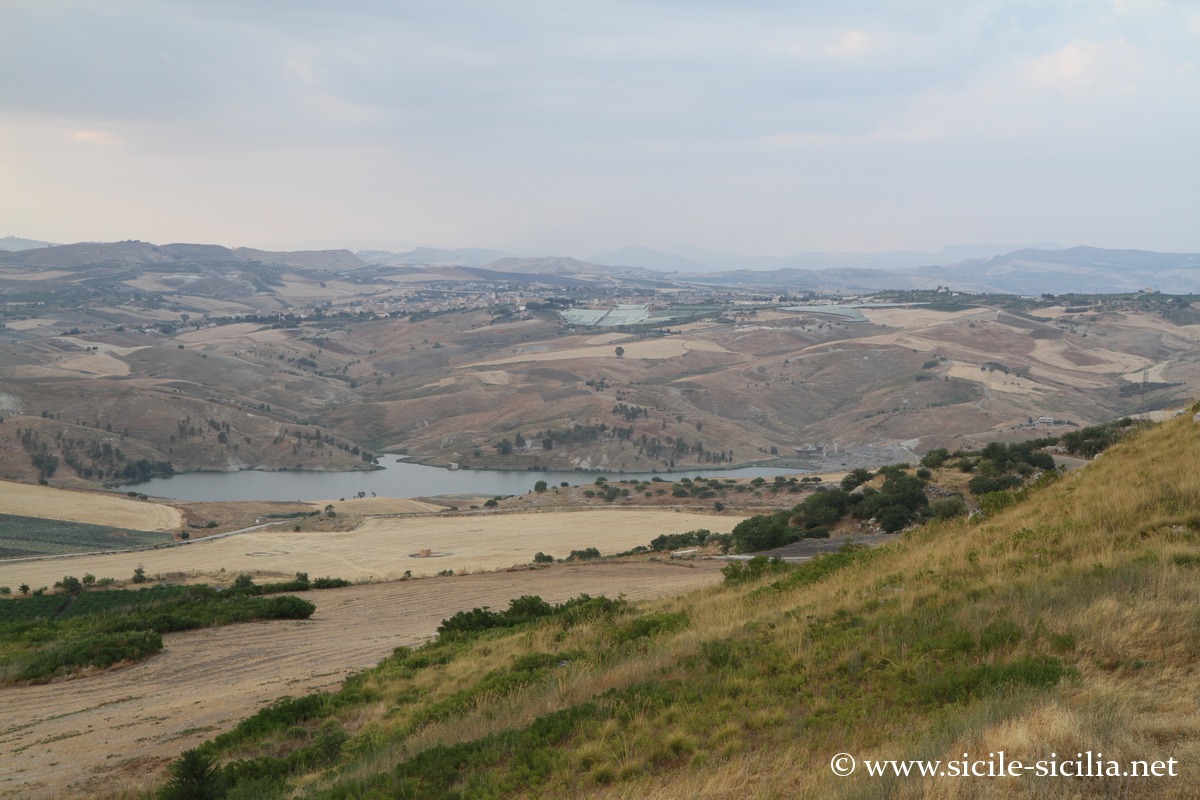
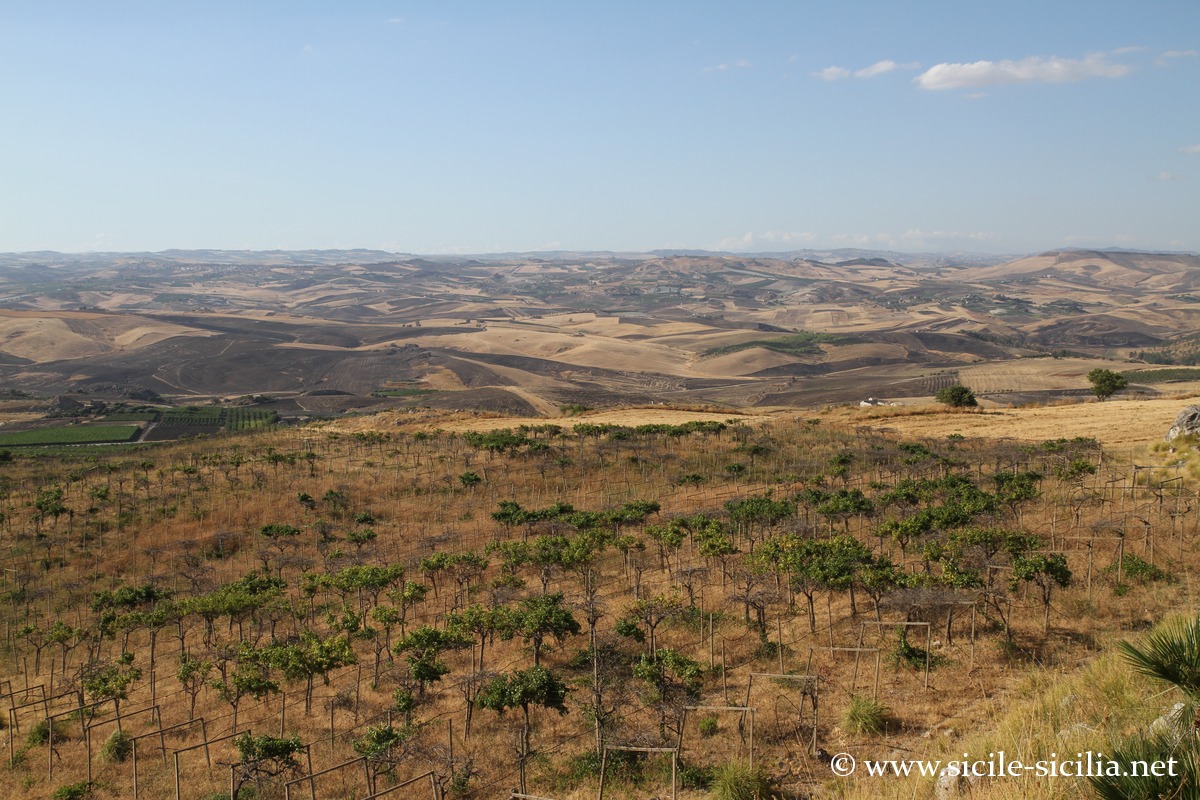
Campobello countryside 
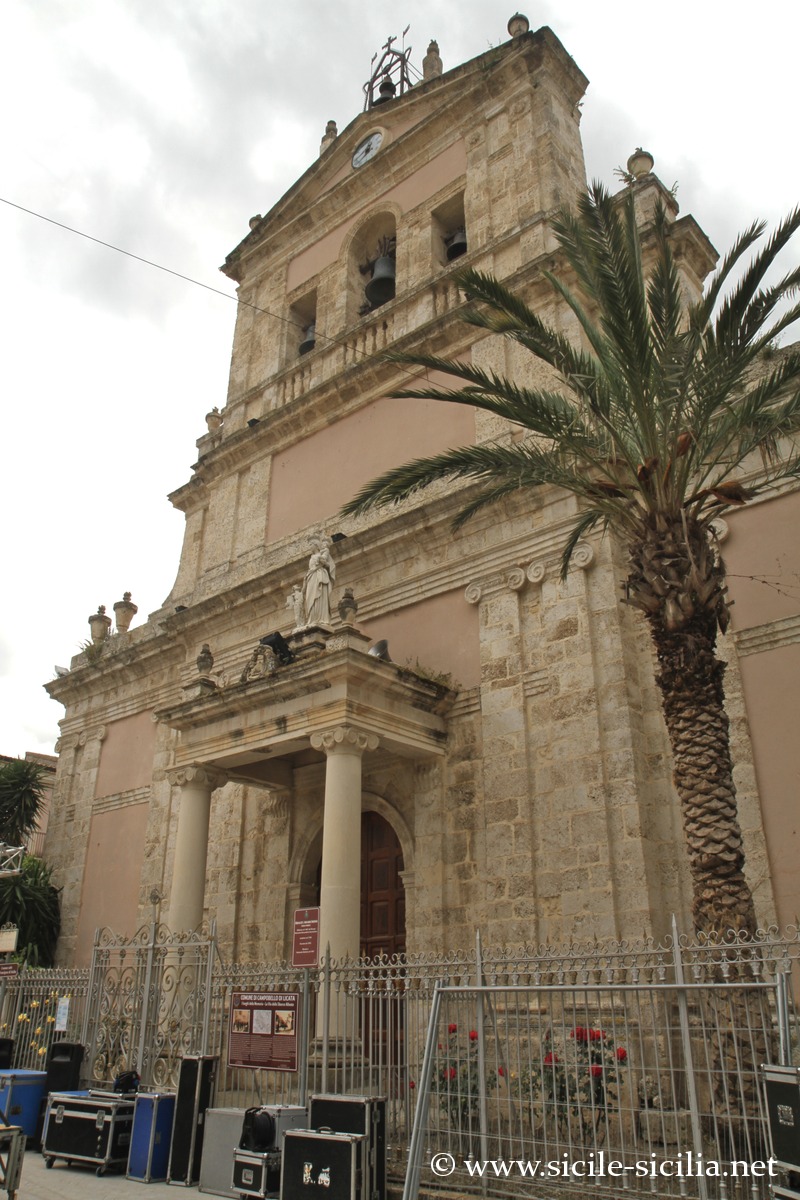
Piazza Giovanni Paolo II and Chiesa Madre

What to see first in Campobello
- Park of the Divine Comedy (Valle delle Pietre Dipinte)
110 painted travertine blocks inspired by Dante’s Divine Comedy. - Piazza XX Settembre and works by Silvio Benedetto
Murals and bronze statues.
Lively town centre with architecture and public spaces modernized by contemporary art. - Chiesa Madre / Madonna dell’Aiuto
Main church of the village, founded in 1681.
History and general overview
The village was founded on a rocky hill, close to water sources and crossed by an ancient road, which favoured agriculture and trade. Shortly after its foundation, the Chiesa Madre and a small administrative complex (Castellania) were built. The population grew rapidly: by the early 18th century, there were already more than 200 inhabitants. In 1734, the village acquired a communal organization with local notables assuming parish and administrative management. True autonomy came in 1786 with the purchase of full rights, freeing it from feudal power. In the 19th century, the population increased thanks to sulphur mining and new roads to Licata and Ravanusa. Some inhabitants also took part in the uprisings of 1820 and the Expedition of the Thousand in 1860. Campobello gradually became a notable agricultural and administrative centre of the territory.
Contemporary art and culture of Silvio Benedetto
In recent decades, the Italian-Argentine artist Silvio Benedetto has enriched the village with original works in squares, parks, fountains and streets. The most famous is the Valley of the Painted Stones, or Park of the Divine Comedy, on the southern slopes of the village. The park comprises 110 painted travertine blocks along a 300 m path, representing Hell, Purgatory and Paradise, inspired by Dante’s Divine Comedy. The highlight of the park is the “stone of the vision of God”, the largest monolith, placed at the summit.
Other creations by Benedetto in the town include:
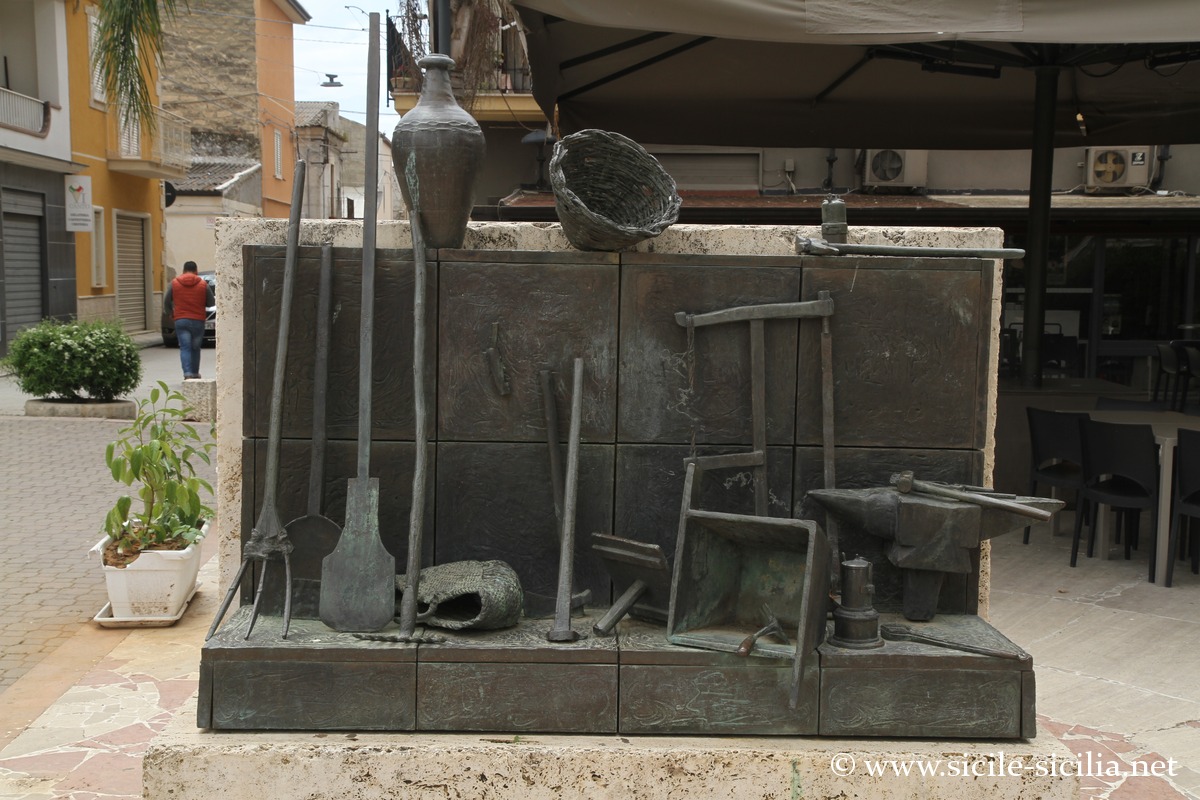
- Piazza XX Settembre: wall frescoes and bronze statues linked to the work of the land and water.
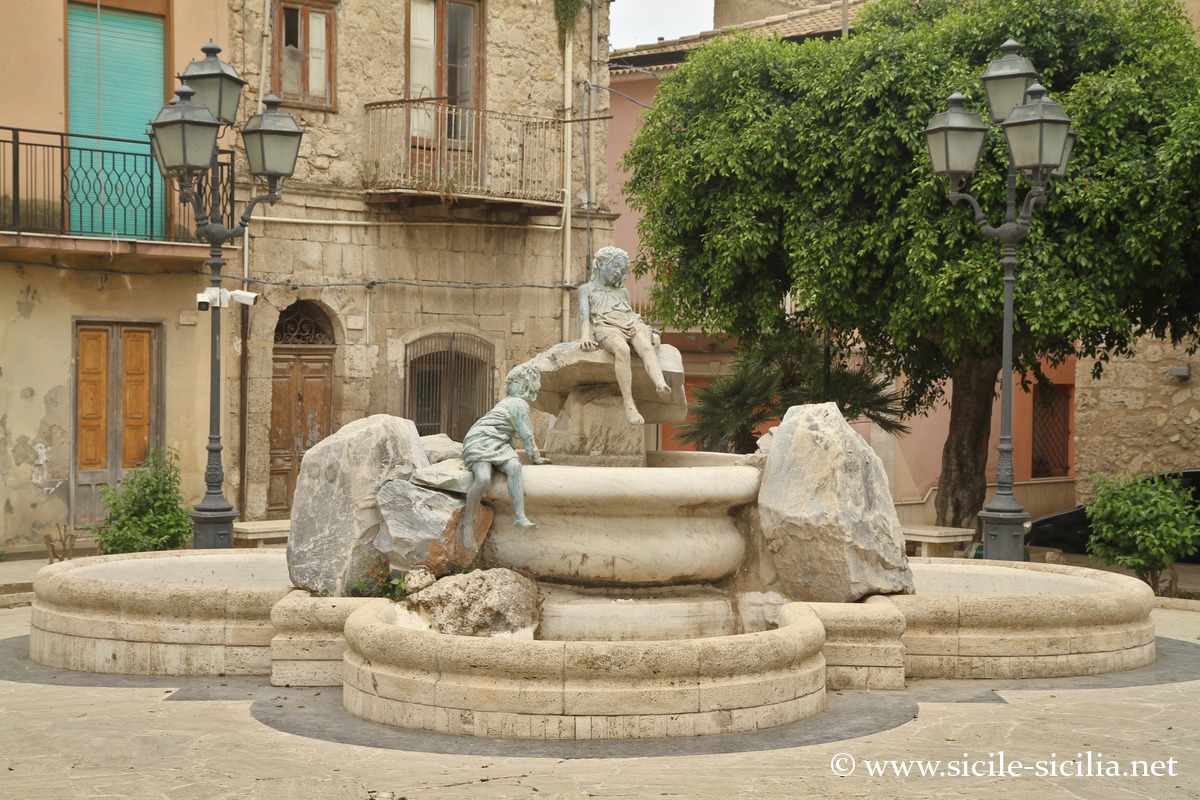
- Fountain of the Little Girls (piazza Aldo Moro): composition in marble and bronze.
- Villa XXV Aprile: mosaics and fountains with decorative motifs.
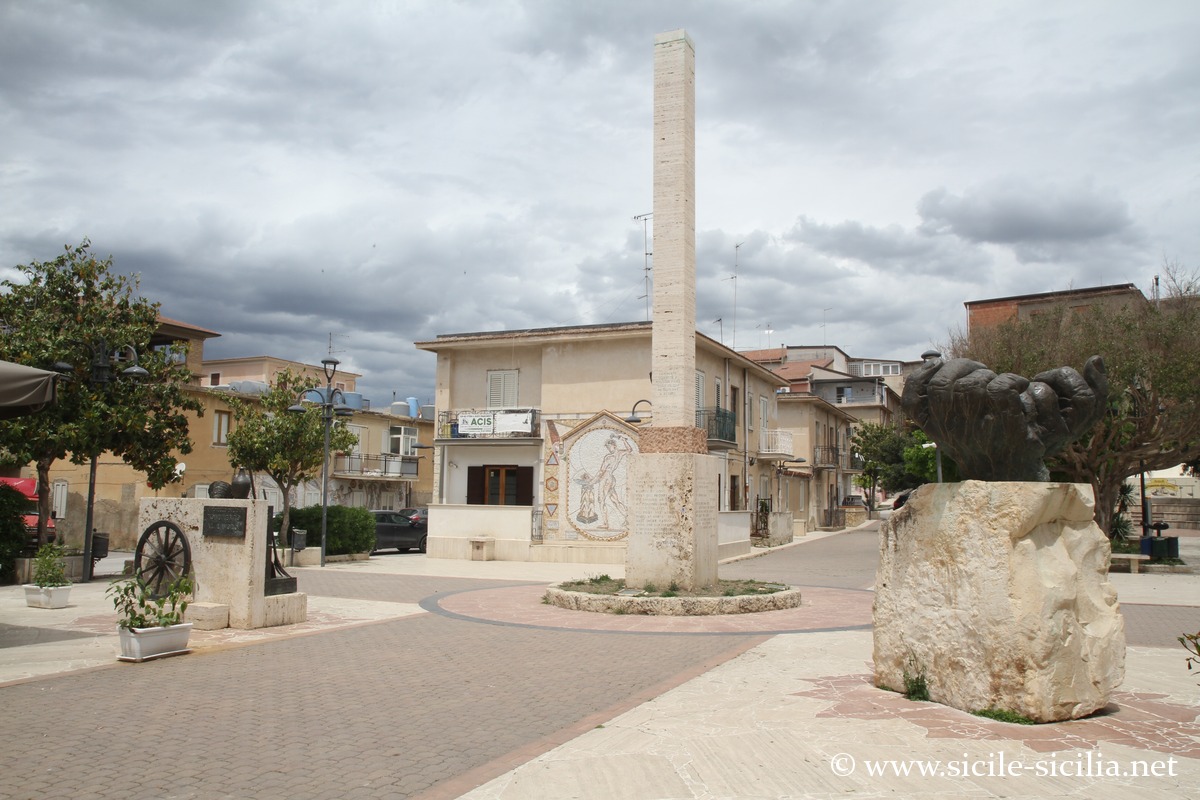
- Piazza Tien An Men: obelisk, bronze hands, symbolic tools, literary quotations, celebrating work and culture.
- Ceramic fresco Iliade in terra e fuoco: large wall fresco illustrating scenes from the Iliad.
- A broken stone column with bronze doves, Parco della Rimembranza.
- Sculptural triptych via Momigliano: three sculpted “doors” entitled “Donna – Sicilia”, “La porta barocca” and “La vigna”.
- Painted triptych in the Centro Polivalente with “La presa delle terre”, “La miniera”, “La semina”, as well as a “Micro-macro cosmo” on the tower balustrade.
Heritage of Campobello di Licata
Squares, parks and urban monuments
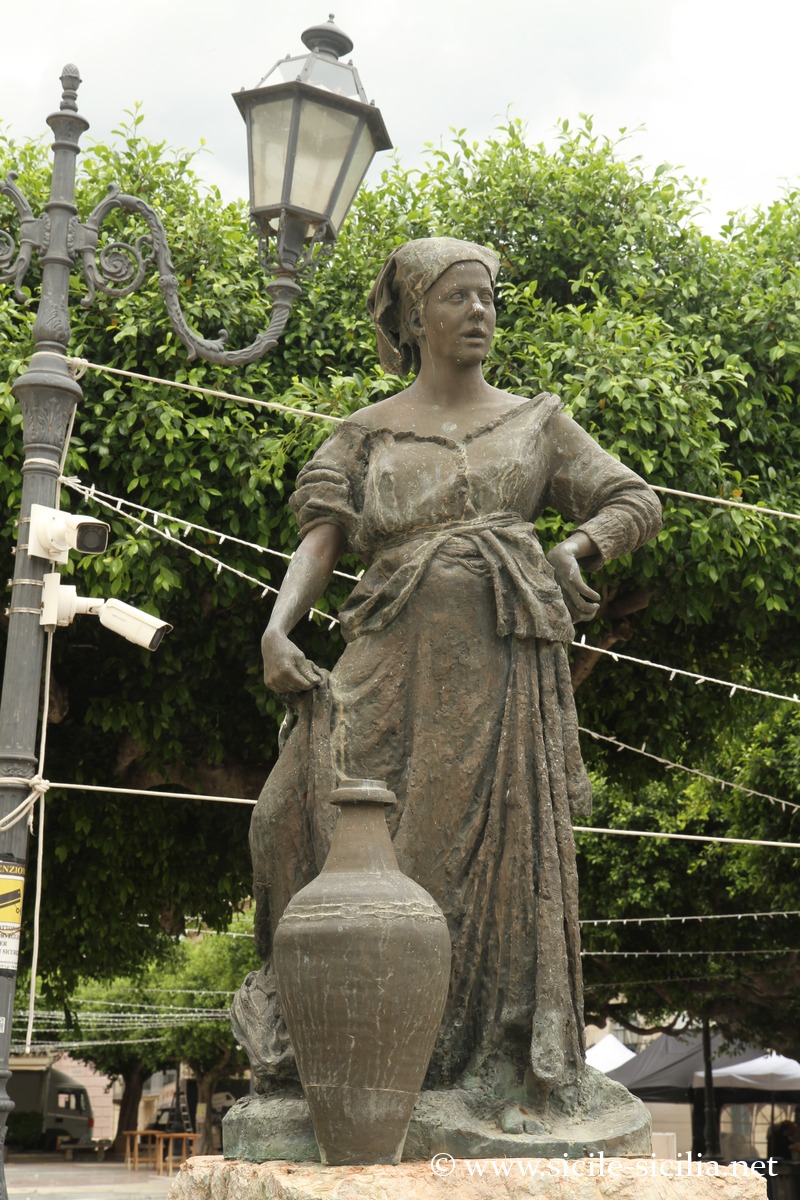
- Piazza XX Settembre: main square with benches, flower beds and marble and granite paving. Two bronze statues by Benedetto: the “Sower” and the “Water Carrier”.
- Fontana del Canale: built in 1650, restored in 1981 and recently illuminated.
- Parco della Rimembranza: park with war memorial (broken column + bronze doves).
- Piazza Tienanmen: obelisk with literary quotations and symbolic sculptures.
- Noble palaces: Palazzo municipale, Palazzo ducale, Palazzo La Lomia, Palazzo Bella, Palazzo Buffone, Palazzo Sillitti, Palazzo Lopez De Oñate.
- Park of the Divine Comedy (Valle delle Pietre Dipinte): symbolic 300 m route, 110 monoliths illustrating the Divine Comedy, culminating with the “stone of the vision of God”.
- Murals, fountains and mosaics by Silvio Benedetto and Olga Macaluso in the town.
Churches and sanctuaries
The Chiesa Madre, dedicated to Saint John the Baptist, was enlarged in the 18th century. It has a Baroque façade dating from 1869 and a bell tower with a clock completed in 1875.
The interior comprises three naves, several chapels, an 18th-century wooden crucifix and a statue of the Virgin, called Madonna dell’Aiuto, made by Filippo Quattrocchi.
The feast of the Madonna dell’Aiuto, celebrated in August, includes processions and elements of peasant tradition.
Events and traditions
- Sagra ’Mpurnatu e ’Mpanata: a food festival centered on traditional dishes (baked pasta, spinach bread).
- Religious folklore linked to the Madonna dell’Aiuto.
Photo gallery
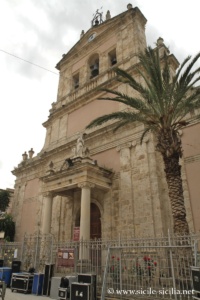
Chiesa Madre 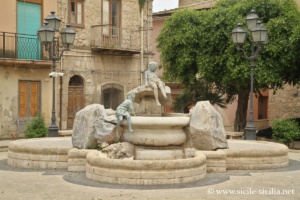
Fountain of the little girls 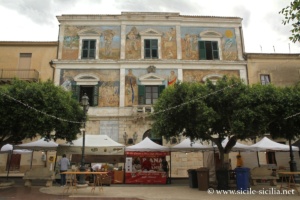

Wall frescoes, Piazza XX Settembre 

Water carrier, Piazza XX Settembre 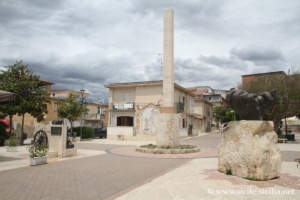
Piazza Tienanmen 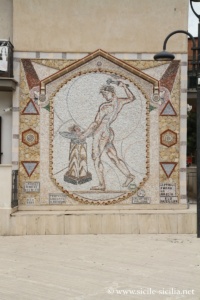
Piazza Tienanmen 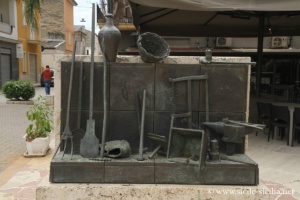
Piazza Tienanmen 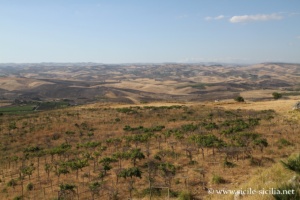
Countryside around Campobello 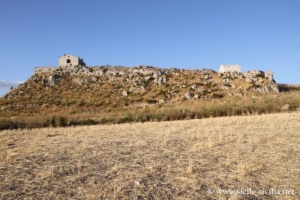
Countryside around Campobello 
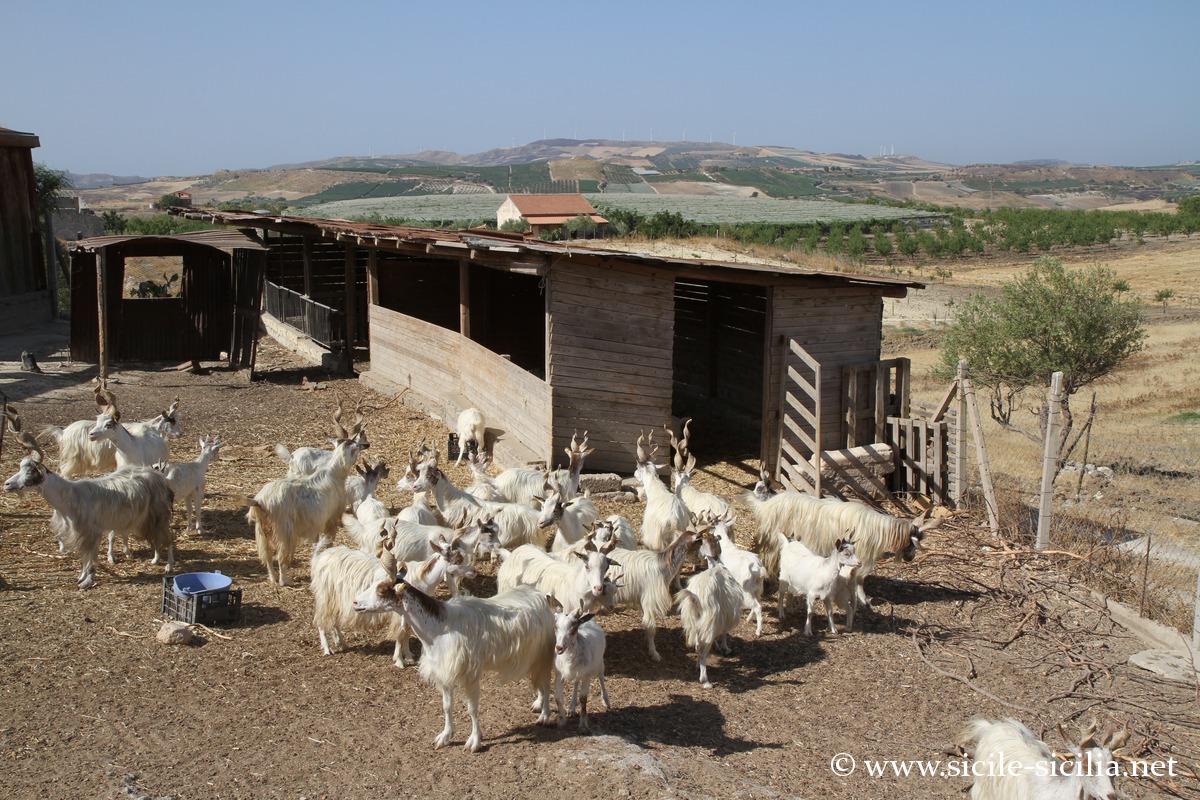
Rearing of local goats



Where Campobello di Licata is located: map
If you see this after your page is loaded completely, leafletJS files are missing.
Ravanusa
Ravanusa has a history spanning three millennia, with protohistoric caves and Monte Saraceno occupied by a Greek city from the 6th to the 4th century BCE, perhaps that of Kakyron.
Mount Saraceno
The Monte Saraceno site dates back to the Copper Age and Early Bronze Age, with the Thapsos culture in the Middle Bronze Age, then an early indigenous Sican village from the Iron Age with circular huts has been identified from the 8th to the middle of the 7th century BCE.
After a fire (possibly caused by the Geloi), it was rebuilt with houses on a rectangular plan and fortifications, and developed between the 6th and 5th centuries, with elements of Greek culture (grid-based urban planning, necropolises, fortifications).
The site appears to have been definitively abandoned at the beginning of the 3rd century BCE.
There was an Arab presence before the arrival of the Normans: according to the sources, Muslim rule in the region began in the 9th century (around 829) and ended in 1086, the year of the Norman conquest.
Legend reports that during the Norman conquest, Roger of Hauteville had a vision of the Virgin near a fig tree, which led him to find a water source; in memory of this, a sanctuary to the Madonna of the Fig Tree (Madonna del Fico) was built.
What to see first in Ravanusa
- Monte Saraceno – Siculo-Greek archaeological site with ruins, fortifications and necropolises.
- Salvatore Lauricella Archaeological Museum – collections of objects from the Early Bronze Age to the 3rd century BCE from Monte Saraceno.
- Chiesa Madre (San Giacomo) – Baroque architecture and 17th-century interior decoration.
Main buildings of Ravanusa
Churches
- The Chiesa Madre San Giacomo (cathedral of Ravanusa), in Baroque style, founded by the Duke of Montalbano Giacomo Bonanno in 1622.
- The pretty church of Santa Maria Assunta of the Franciscan convent, with paintings evoking the siege of the Arab fortress by the Normans.
Salvatore Lauricella Archaeological Museum
The Salvatore Lauricella Archaeological Museum preserves finds made in the surrounding area. Inaugurated in 2007, it is housed in two rooms that present a chronological and topographical itinerary, from prehistory to the 3rd century BCE.
Among the remarkable pieces are a child’s sarcophagus (necropolis of via Olimpica, dated between 520 and 460 BCE), polychrome terracottas, an architectural gorgoneion, vases, amphorae, loom weights, etc.
The museum is dedicated to Salvatore Lauricella, mayor of Ravanusa for many years, who campaigned for the enhancement of the Monte Saraceno site.
Monte Saraceno archaeological site
The site is accessible according to opening hours (summer / season).
Where Ravanusa is located: map
If you see this after your page is loaded completely, leafletJS files are missing.
Information
External sites
- Campobello di Licata: livingagrigento.it, en.wikipedia.org
- Ravanusa: livingagrigento.it, museoarcheologicoravanusa.weebly.com, en.wikipedia.org
Articles: surroundings of Agrigento
- Visit to Agrigento and surroundings
 C’est sur une colline, nommée Girgenti, que s’étend le centre historique d’Agrigente, formé de ruelles tortueuses et d’escaliers parfois un ...
 - Sicani Mountains
 The Sicani Mountains are a mountain range in the hinterland of western Sicily, straddling the provinces of Palermo and Agrigento, ...
 - Sutera
 12 kilometres south of Mussomeli and near the beautiful Platani valley, the medieval village of Sutera is listed among “the ...
 - Scala dei Turchi
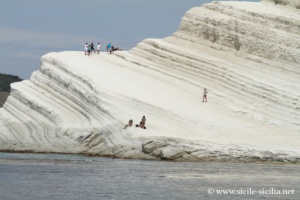 La Scala dei Turchi («escalier des Turcs» en français) est une paroi rocheuse dominant une partie de la côte près ...
 - Coastal itinerary west of Agrigento towards Sciacca
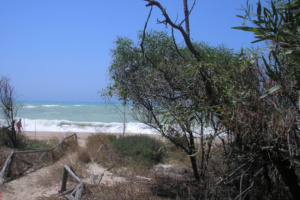 Itinéraire à l’ouest d’Agrigente, en partant de la maison natale de Pirandello au sud de la ville, poursuivant par Port ...
 - Favara, Racalmuto and Aragona
 If, after visiting the most attractive sites of Agrigento and its coastal strip, you are looking for a short getaway ...
 - Siculiana
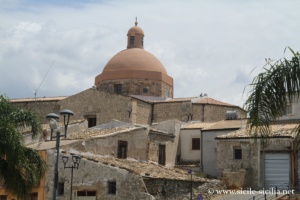 Siculiana is a pretty little village 20 km west of Agrigento, set on a promontory overlooking the coastal plain and ...
 - Naro and Surroundings
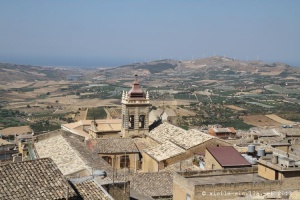 In the hinterland of Licata, Naro is a small town that rises on a promontory at an altitude of 600 ...