

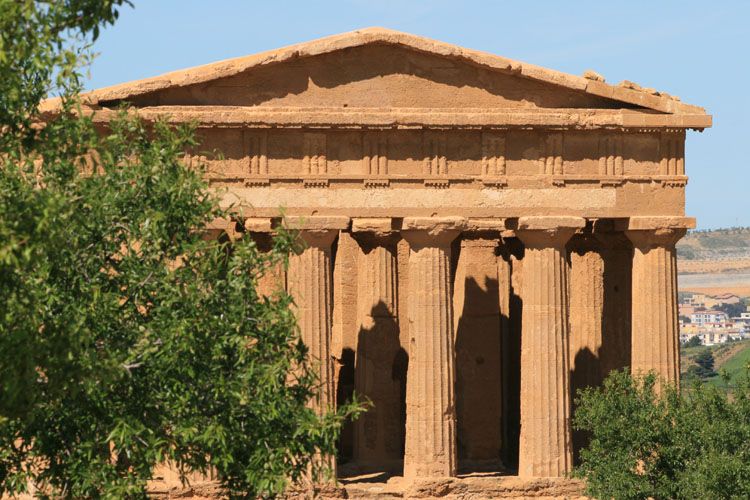
The site of the Valley of the Temples of Agrigento, a UNESCO World Heritage site, is also known as the “divine valley of the Gods,” with its almond trees that blossom from January onwards. It is a unique place, where important archaeological remains emerge amid a remarkable landscape. Here stand several Doric temples from the 5th century BCE, necropolises, and traces of the ancient walls of the Greek city of Akragas, one of the main cities of Magna Graecia, Magna Grecia.
Overview of the site
Despite what its name suggests, the Greek temples are built on a ridge, not in a valley, a few kilometres south of the modern city of Agrigento.
The archaeological park has several entrances. From the old entrance located to the west, two routes are available to the visitor: one leads west, where the ruins of the vast Temple of Olympian Zeus and the remains of other sanctuaries are found, including the Temple of the Dioscuri and the entrance to the Kolymbethra Garden; the other, heading east, crosses the most remarkable part of the park, where three temples follow one another: the Temple of Heracles, the Temple of Concordia – remarkably well preserved – and the Temple of Hera.
Itinerary in the Valley of the Temples

Map of the Valley of the Temples
The itinerary proposed here includes the main part of the archaeological park as well as extensions located outside it: the Rupe Atenea on the one hand, and the Agora with the archaeological museum on the other.
It starts from the north-east of the site, beyond the eastern car park and this eastern entrance.
The Rupe Atenea, the Athenian rock
To the north of the site entrance, one can reach (by car) the summit of the Rupe Atenea, the Acropolis of Akragas, where sanctuaries were notably located, such as the Temple of Demeter at the end of the cliff, incorporated into the medieval church of San Biagio.
Remains of towers from the 5th century BCE attest to its defensive role. A rock sanctuary, backed against the rock, features interconnected cavities, with a basin that served as a reservoir. This would be an indigenous sanctuary, probably with Punic occupation in the 4th century BCE.
Porta I is located in a natural hollow and preserves few remains, with a defensive tower reinforcing a corner.
The Porta II Quarter, on two terraces with a regular plan, of an artisanal nature, dates from the 5th century with a Punic occupation in the 4th century BCE. Porta II, or Porta de Gela, is located in a natural gap, which linked the valley to the main axis of the city.
Hill of the Temples: the main park
Eastern sector

Temple of Juno (Hera)
From the main eastern entrance, one reaches the Via Sacra and the highest part of the site, where the Temple of Juno stands (around 460 BCE), accompanied, in front, by the remains of the sacrificial altar. To the west opens another gate (Gate III).
Following the Via Sacra, the modern road that crosses the Hill of the Temples from east to west, one passes remains of Greek walls and Byzantine tombs located on the left. Further on appears the Temple of Concordia (around 430 BCE), one of the best preserved in the Greek world.
Continuing, one encounters on the right tombs belonging to the early Christian necropolis, while on the left is the garden of Villa Aurea, where underground tombs (catacombs) survive.

Temple of Heracles
The path then leads to the Temple of Heracles, the oldest of the temples of Agrigento (late 6th century BCE). Below, at nearly 200 metres, stands a Roman tomb traditionally called the Tomb of Theron (tomba di Terone in Italian), although this attribution is erroneous.
Western sector
After crossing the road, Porta IV or Porta Aurea leads to the plain of San Gregorio, where the remains of an important archaeological complex survive, with several sacred areas, whose religiosity dates back to the 6th century BCE, with particular reference to the chthonic cult (linked to the fertility of the earth and the underworld) of Demeter and Kore.
The area is also accessible from Gate V.
From the Hardcastle entrance, one reaches the western zone, with the remains of the Temple of Olympian Zeus, which was a colossal building, one of the largest in the Greek world (after 480 BCE), although never completed. There one can see the gigantic statues of the telamons (about 7.60 metres), once placed between the columns; a cast of one of them is displayed on site, the original being kept at the archaeological museum of Agrigento.

Temple of the Dioscuri
In the next, lower area lies the sanctuary of the chthonic deities (Demeter and Persephone), with in the center the remains of a temple known as the Temple of Castor and Pollux, uncertainly reconstructed in the early 20th century.
To the north stretches the Kolymbethra Garden, famous for its citrus fruits; to the south, Gate V leads to another ticket office of the site.
Further on, a path on the right leads to the Temple of Vulcan or Hephaestus, of which the base and two columns remain.
Agora and archaeological museum
From the Porta Aurea, towards the center of Agrigento, one reaches the hill of Saint Nicholas, where the Upper Agora once stood. It is dominated by the Cistercian Gothic church, which houses a famous Roman sarcophagus and a large crucifix.
Nearby are the Ekklesiasterion, a semi-circular meeting place of the popular assembly, as well as a sanctuary known as the Oratory of Phalaris.
The buildings of the former Cistercian monastery now house the Regional Archaeological Museum of Agrigento.
The remains of the Hellenistic-Roman Quarter, comprising houses and streets, are also located in this area.
Information and tickets
Opening hours and prices
- Archaeological Park of the Valley of the Temples
Weekdays: 8:30 am – 7:00 pm (exit before 8:00 pm)
Full price: €17 (from 1 December 2025) / Reduced price: €10 (from 1 December 2025)
Free on the first Sunday of each month - Combined Valley and archaeological museum
Full price: €22 / reduced: €12.40 - Combined Valley of the Temples and Kolymbetra Garden
? - Archaeological Museum of Agrigento
Opening hours: 9:00 am – 7:00 pm
Museum admission full price: €10 / reduced: €5
External sites
- Official website of the Valley of the Temples: www.lavalledeitempli.it
- Website of the municipality of Agrigento: livingagrigento.it
- PDF map and brochure of the Valley: www.visitsicily.info
Maps of the Valley of the Temples
 Show interactive map

Sites of the Valley of the Temples of Agrigento
- Temple of Concordia in Agrigento
 Construit entre 440 et 430 avant J.-C., le Temple de la Concorde, situé sur la crête de la Vallée des Temples d’Agrigente, figure parmi les ...
- Temple of Hera or Juno in Agrigento
 Situated at the end of the ridge, the Temple of Hera, also known as the Temple of Juno Lacinia or Temple D, overlooks a large ...
- Temple of Olympian Zeus in Agrigento
 Situé dans la Vallée des Temples d’Agrigente, le Temple de Zeus Olympien, ou Olympéion, était un édifice monumental demeuré inachevé. C’est le plus grand temple ...
- Temple of Hercules in Agrigento
 Bien que ses vestiges soient plus modestes que ceux d’autres monuments de la vallée des Temples d’Agrigente (l’ancienne Akragas), le temple d’Hercule, de style dorique ...
- Temple of the Dioscuri in Agrigento and western sector
 To the west of the Temple of Zeus extends a residential sector, followed by a sacred area up to Gate V, then the sacred area ...
- Regional Archaeological Museum of Agrigento and San Nicola
 The Regional Archaeological Museum of Agrigento, officially named Museo Archeologico Regionale “Pietro Griffo”, is located on the hill of San Nicola (known as Poggetto San ...
- Kolymbethra Garden in Agrigento
 The Kolymbethra Garden lies in the heart of the archaeological park of the Valley of the Temples in Agrigento, between the Temple of Castor and ...
- Temple of Vulcan at Agrigento
 Le Temple de Vulcain occupe la pointe occidentale de l’éperon rocheux qui forme la Vallée des Temples d’Agrigente, sur la crête en dehors de l’agglomération ...
- Hellenistic-Roman Quarter and Upper Agora
 Near the Archaeological Museum of Agrigento are several areas of remains, including the upper agora and the Ekklesiasterion on the one hand, and the vast ...
- Rupe Atenea and Temple of Demeter
 The Rupe Atenea constitutes the highest point and the natural acropolis of ancient Akragas, dominating to the north the Valley of the Temples and bounded ...
- Maps of Agrigento
 Interactive map of Agrigento, the Valley of the Temples, the ancient sites.
FAQ Valley of the Temples
- Is the Valley of the Temples accessible on foot from the center?
It is not very close, 3 km from the station, and with a slight elevation gain of 100 meters. However, buses go there frequently. - How long does a visit to the Valley of the Temples last?
Allow a good 2h30 – 3h, depending on the number of temples visited. You have to walk quite a bit to cover the site.
A shuttle inside the site allows you, for example, to avoid the walk back. - Which are the most important temples to see?
1) Temple of Concordia
2) Temple of Hera (Juno)
3) Temple of Heracles
4) Temple of Zeus (Olympieion, very ruined but remarkable) - Where to park to visit the Valley of the Temples?
There are two main parking areas: East Entrance (Tempio di Giunone) / West Entrance (Porta V)
A few photos of the ridge and the necropolises

Valley of the Temples 
Valley of the Temples from the surroundings of the Temple of Hera 


Arcosolia 
Arcosolia 
Arcosolia 
Arcosolia 
Arcosolia 
Arcosolia 
Arcosolia 
Necropolis 
Necropolis hypogea 
Necropolis hypogea 
Necropolis 
Necropolis 
Necropolis 
Olive groves of the Valley of the Temples 


Articles in the Agrigento category
- Agrigento
 Agrigento is a city near the southern coast of Sicily, whose origins date ...
- Visit to Agrigento and surroundings
 It is on a hill, named Girgenti, that the historic centre of Agrigento ...
- Hotels in Agrigento
 Hotels in Agrigento in Sicily and accommodations near the Valley of the Temples. ...
- Valley of the Temples of Agrigento
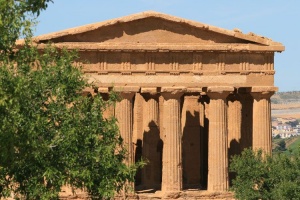 In antiquity, Agrigento was one of the most powerful Mediterranean cities of Magna ...
- Regional Archaeological Museum of Agrigento and San Nicola
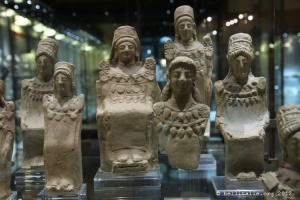 The Regional Archaeological Museum of Agrigento, officially named Museo Archeologico Regionale “Pietro Griffo”, ...
- Scala dei Turchi
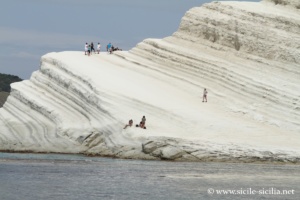 The Scala dei Turchi (“Stair of the Turks” in English) is a rocky ...
- Torre Salsa Nature Reserve and Heraclea Minoa
 This stretch of coastline in southern Sicily, west of Agrigento and east of ...
- Coastal itinerary west of Agrigento towards Sciacca
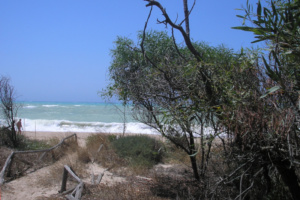 Itinerary west of Agrigento, starting from Pirandello’s birthplace south of the town, continuing ...
- From Licata to Agrigento
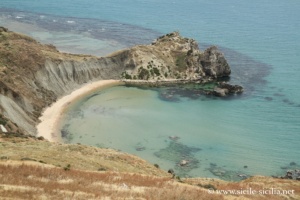 La côte entre Licata et Agrigente alterne plages sableuses, criques et promontoires rocheux. ...
- Favara, Racalmuto and Aragona
 If, after visiting the most attractive sites of Agrigento and its coastal strip, ...
- Siculiana
 Siculiana is a pretty little village 20 km west of Agrigento, set on ...
- Maps of Agrigento
 Interactive map of Agrigento, the Valley of the Temples, the ancient sites.
- Gastronomy and traditions in AgrigentoGastronomic specialities in Agrigento The gastronomy of Agrigento revolves mainly around seafood, with original ...
- Near Agrigento
 Sicilian destinations near Agrigento, including the Sicani Mountains inland to the north, Licata ...
- Activities in Agrigento, guided tours and excursions
 Booking of activities in Agrigento and its surroundings, guided tours of the old ...