

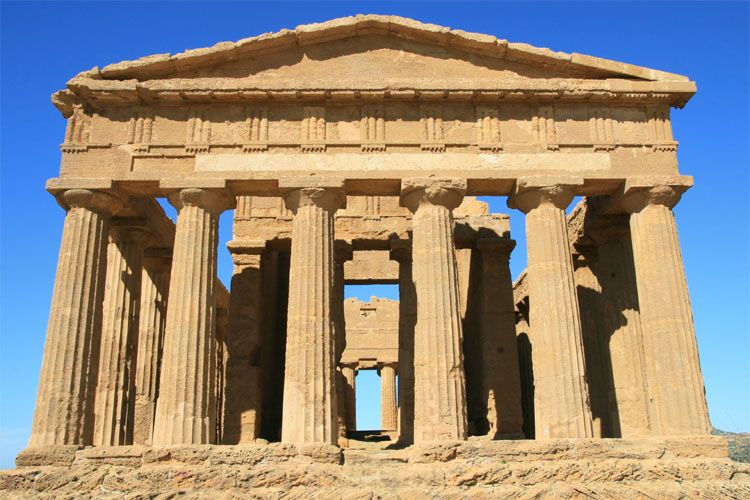
Agrigento is a city near the southern coast of Sicily, whose origins date back to 581 BC when Akragas was founded by settlers from Gela, located further east along the coast.
Perched on a hill at nearly 230 metres above sea level, it offers a broad panorama over the Mediterranean Sea, and it has become famous for its exceptional archaeological heritage, notably with the Valley of the Temples, a UNESCO World Heritage Site since 1997, one of the most visited sites in Sicily.
Overview of Agrigento
The Valley of the Temples is located on a long ridge between the city and the coast, 3 km from the modern districts of Agrigento. It is one of the best-preserved groups of Doric architecture outside Greece, a legacy of the flourishing period of Akragas, which experienced its rise under Theron, before its destruction by the Carthaginians in -406.
With its ancient ruins, its Sicilian atmosphere, the medieval alleys of its historic centre inherited from the Arabs, the Normans and the Baroque period, Agrigento appeals to lovers of history, culture and landscapes.
The upper town of Agrigento is often overlooked yet has a certain charm and deserves to be discovered.
Around it, you can also discover beautiful countryside and one of the most beautiful Sicilian coasts, including the nearby and famous Scala dei Turchi with its white undulating cliffs.
Here is how the archaeological area of Agrigento is presented by UNESCO:
” A Greek colony founded in the 6th century BC, Agrigento became one of the leading cities of the Mediterranean world. The remains of the magnificent Doric temples that dominated the ancient city, a large part of which remains intact beneath today’s fields and orchards, bear witness to its supremacy and its pride. A selection of excavation areas sheds light on the Hellenistic and Roman city and on the funerary practices of its early Christian inhabitants …”
(source: UNESCO)
What to see in Agrigento
- The Valley of the Temples : This archaeological site is a marvel, a must-see. It is quite large, so bring comfortable shoes and water!
It stands out with its well-preserved Doric temples, such as the Temple of Concordia, one of the best preserved in the world, or the Temple of Heracles, the oldest on the site.
The Temple of Juno or Hera is perched on a ridge, offering a spectacular view and impressive remains, although partially damaged by time.
The Temple of Zeus, the Olympieion, never completed, would have been one of the largest temples of the Greek world with its extraordinary dimensions. It is now in ruins, but its gigantic stone blocks bear witness to its grandeur. - The Regional Archaeological Museum : Located near the Valley of the Temples, it houses an exceptional collection of Greek objects, including the famous Telamon, a colossal statue from the Temple of Zeus.
- The old town of Agrigento : Explore its narrow alleys and its major buildings such as the Cathedral of San Gerlando, which blends Norman and Baroque styles, the Church of Santa Maria dei Greci, built on an ancient Greek temple, or the Monastery of the Holy Spirit, a beautiful medieval building known for its cloister and its delicious cakes sold by the nuns.
Along Via Atenea you can sample local specialities such as arancini or almond paste. - The Kolymbethra Garden : Adjacent to the Valley of the Temples site, this green oasis managed by the FAI (Italian Environment Fund) is planted with citrus trees and almond trees and contains some remains.
Where is Agrigento: map
Articles: Agrigento Category
- Visit to Agrigento and surroundings
 C’est sur une colline, nommée Girgenti, que s’étend le centre historique d’Agrigente, formé de ruelles tortueuses et d’escaliers parfois un peu sportifs. Il est souvent ...
 - Hotels in Agrigento
 Hotels in Agrigento in Sicily and accommodations near the Valley of the Temples. Farm stays, apartments and bed and breakfasts.
 - Valley of the Temples of Agrigento
 In antiquity, Agrigento was one of the most powerful Mediterranean cities of Magna Graecia. Its archaeological area of the Valley of the Temples, listed by ...
 - Regional Archaeological Museum of Agrigento and San Nicola
 Le Musée Archéologique Régional d’Agrigente, officiellement nommé Museo Archeologico Regionale “Pietro Griffo”, est situé sur la colline de San Nicola (désignée comme Poggetto San Nicola), ...
 - Scala dei Turchi
 La Scala dei Turchi («escalier des Turcs» en français) est une paroi rocheuse dominant une partie de la côte près de Realmonte, à 15 km ...
 - Coastal itinerary west of Agrigento towards Sciacca
 Itinéraire à l’ouest d’Agrigente, en partant de la maison natale de Pirandello au sud de la ville, poursuivant par Port Empédocle jusqu’à Seccagrande, en suivant ...
 - Favara, Racalmuto and Aragona
 If, after visiting the most attractive sites of Agrigento and its coastal strip, you are looking for a short getaway of about a day in ...
 - Siculiana
 Siculiana is a pretty little village 20 km west of Agrigento, set on a promontory overlooking the coastal plain and the Mediterranean Sea. Its origins ...
 - Gastronomy and traditions in AgrigentoGastronomic specialities in Agrigento The gastronomy of Agrigento revolves mainly around seafood, with original recipes such as spaghetti with prawns and pistachios, or pasta with sardines. Inland, ...
What to see around Agrigento
- Scala dei Turchi : About 15 km away, this spectacular white cliff in the shape of a natural staircase plunges into a turquoise sea.
- The Torre Salsa nature reserve : A haven of peace with wild beaches and rich biodiversity.
- Sciacca : A charming coastal town 30 km away, known for its thermal baths, its ceramics and its colourful carnival.
→ See also: dossier near Agrigento
Historical overview of Agrigento
Agrigento, founded in 581 BC by Greek settlers from Gela and Rhodes, quickly became a prosperous city under the name of Akragas, thanks to its trade and agriculture. In the 5th century BC, it was one of the most powerful and wealthy cities in the Mediterranean, rivalling Syracuse. Its majestic temples bear witness to this prosperous period, under the rule of tyrants such as Theron.
In 406 BC, it was pillaged by the Carthaginians, marking the beginning of its decline. The Romans conquered it in 210 BC, renaming it Agrigentum, and it continued to prosper as an agricultural centre.
In the Middle Ages, under Byzantine, Arab and then Norman rule, the upper town developed, leaving behind varied architectural traces. The Arabs introduced irrigation techniques still visible in the surrounding gardens.
Invasions and earthquakes, notably in the 18th century, damaged part of its heritage.
FAQ – Frequently asked questions about Agrigento
- How long do you need to visit Agrigento?
One day is enough to see the Valley of the Temples, but to also discover the old town, the archaeological museum and the surroundings (Kolymbethra, Scala dei Turchi), allow at least 2 days.
For the Valley of the Temples, allow 3 to 4 hours, depending on your pace and the number of temples visited. Bring water and suitable shoes. - How do you get to Agrigento?
Agrigento does not have an airport. Arrivals are generally via Palermo or Catania, then by train, at nearly 2 hours from Palermo, or by bus. - What to see in the surroundings?
- Scala dei Turchi (white cliffs)
- Torre Salsa nature reserve
- San Leone beaches
- When to visit Agrigento?
The months of April to June and September-October offer ideal conditions: soft light, pleasant temperatures and fewer crowds. - Where to stay in Agrigento
If you are travelling by car, it is better to avoid the historic centre of Agrigento, which is not easy to access with its narrow alleys and few parking spaces.
Information and resources
Tickets and tour suggestions
External sites
- Wikipedia page on Agrigento
- Tourist portal of the municipality of Agrigento
- Agrigento Turismo – Official tourism website of Agrigento
- La Valle dei Templi – Official website of the archaeological park
- Italia.it – Official page on Agrigento
- Pro Loco Agrigento – Association website for tourist information
Comments in other languages
If you visit the old town of Agrigento, one wonderful discovery is the Monastery of Santo Spirito, with its small artisan shop and the workshop where the nuns still prepare traditional pastries made with almond paste and pistachio!
Also visit the accessible rooms of the monastery, with its beautiful Chiaramonte architecture, the refectory, the chapel, and the small "museum" of traditional crafts.
Important point for the Valley of the Temples: remember to enter early in the morning or late in the day, because the light is much more pleasant at those times, especially in midsummer, with the temples better lit (especially the Temple of Concordia) and the heat can be very intense at true solar noon (around 1:20 p.m.).
The site is large and linear, so it is a good idea to take the shuttle (internal to the site) for the return trip if you want to go back to the entrance you used at the start, so you do not have to walk the entire site again, or else leave through another entrance connected to buses/taxis, etc.
my nice comment here !