
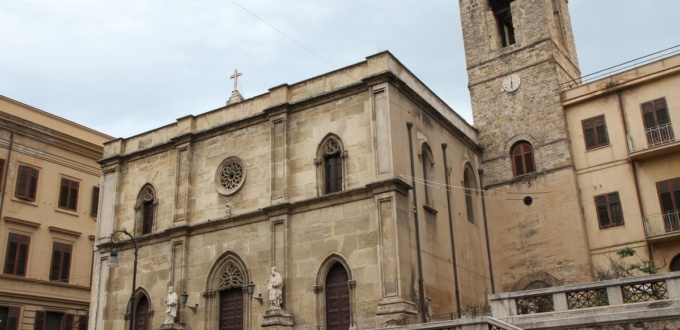
The church of Saint Anthony Abbot (Sant’Antonio Abate) was built around the beginning of the 13th century, on the site of the Muslim gate known as Bab al Bahr (Gate of the Sea).
In 1302, the Chiaramonte family added the bell tower, whose base is said to be an ancient tower.
Presentation and visit
Its current appearance dates back to the 16th century, but it was considerably remodelled after the 1823 earthquake, giving it a neo-Gothic style.
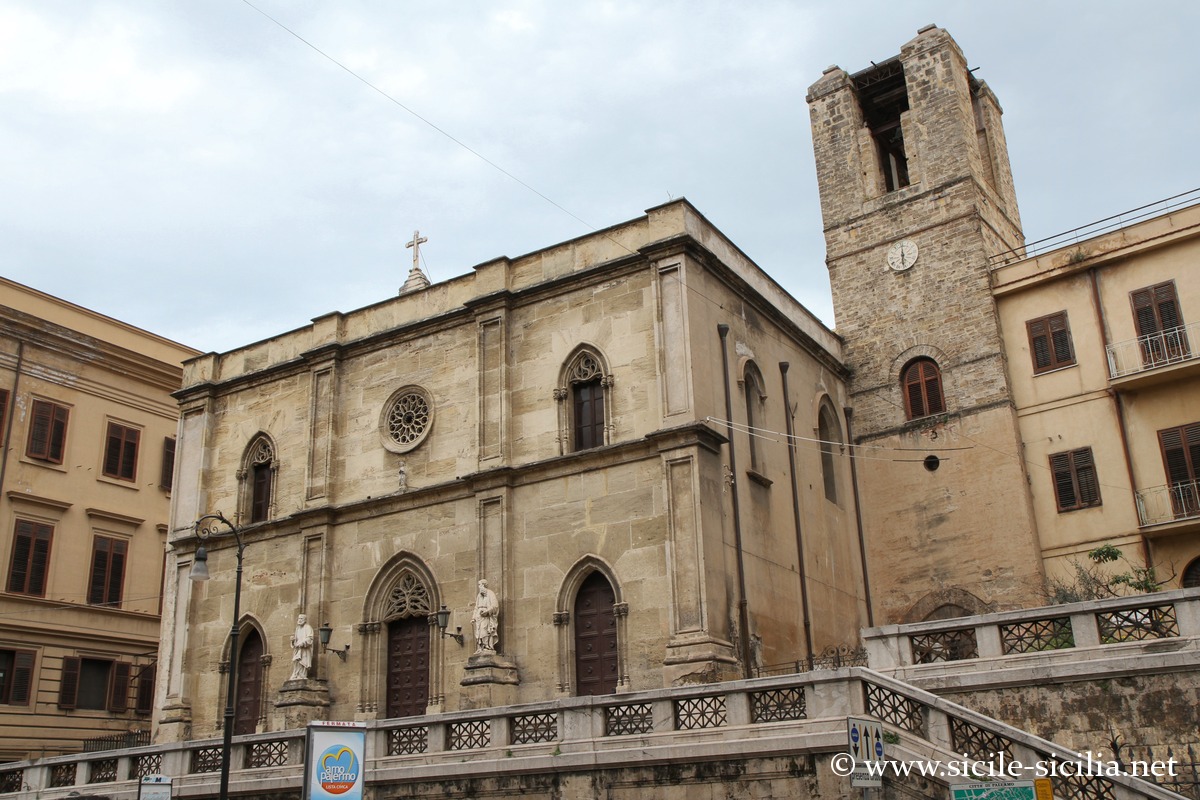
Sant’Antonio Abate
The square facade has three ogival portals. The lunette is framed by statues of Saint Peter and Saint Paul executed in 1551 by Antonio Gagini.
The bell tower was once nearly twice as tall.
The interior has a Greek cross plan on a square base, which was enlarged by the construction of a gallery with the wooden choir and the main altar of the 18th century.
The central dome, which was completed in 1536, is supported by ogival arches resting on the four columns.
On the walls on the sides of the choir there are two paintings by Gaspare Serenario, Christ and the Adulteress and Christ and the Centurion (1757), and in the centre San Carlo Borromeo by Giuseppe Salerno (early 17th century).
The church also preserves a fine baptismal font by Francesco Pennino from the 18th century, marble reliefs by Antonello Gagini (16th century), wooden statues, including the famous bust “Ecce Homo” carved in the early 17th century, an object of popular veneration.
The altar of the Blessed Sacrament in the chapel to the left of the chancel is a true marble jewel, part of the dismembered work of Gagini representing the Triumph of the Eucharist, with the eight Scenes of the Passion on the side panels.
Where the church of Saint Anthony in Palermo is located
If you see this after your page is loaded completely, leafletJS files are missing.
Via Roma, 203A, 90133 Palermo
Information
Chiesa di Sant’Antonio Abate
Via Roma, 203A, 90133 Palermo
Sources and external sites
- Chiesa di Sant’Antonio Abate on Wikipedia IT
- Tourist and municipal sites: turismo.comune.palermo.it, www.palermoviva.it,