

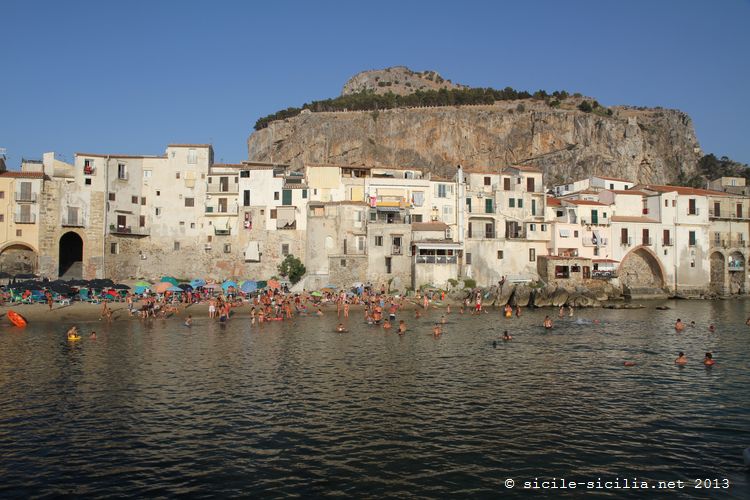
Cefalù is a small town of about 14,000 inhabitants, and a charming destination in Sicily, located on the Tyrrhenian coast, about 70 km east of Palermo.
It captivates with its unique blend of history, nature and dolce vita, often described as one of the most beautiful destinations on the island, combining a Greco-Norman heritage with golden beaches bathed by pure waters, dominated by its imposing Rocca.
Greek origins and Norman heritage of Cefalù
Facing the sea stand the Greco-Roman-era walls of the town, which the Greeks named Kephaloidion, meaning “head”. The city then became Byzantine, then Arab. The latter named the town Gafludi, meaning the “fortified town with abundant waters”. At the beginning of the 11th century it became Norman when the latter conquered Sicily. The Normans left a strong mark on the town, to the point that it was designated as the “Norman citadel”.
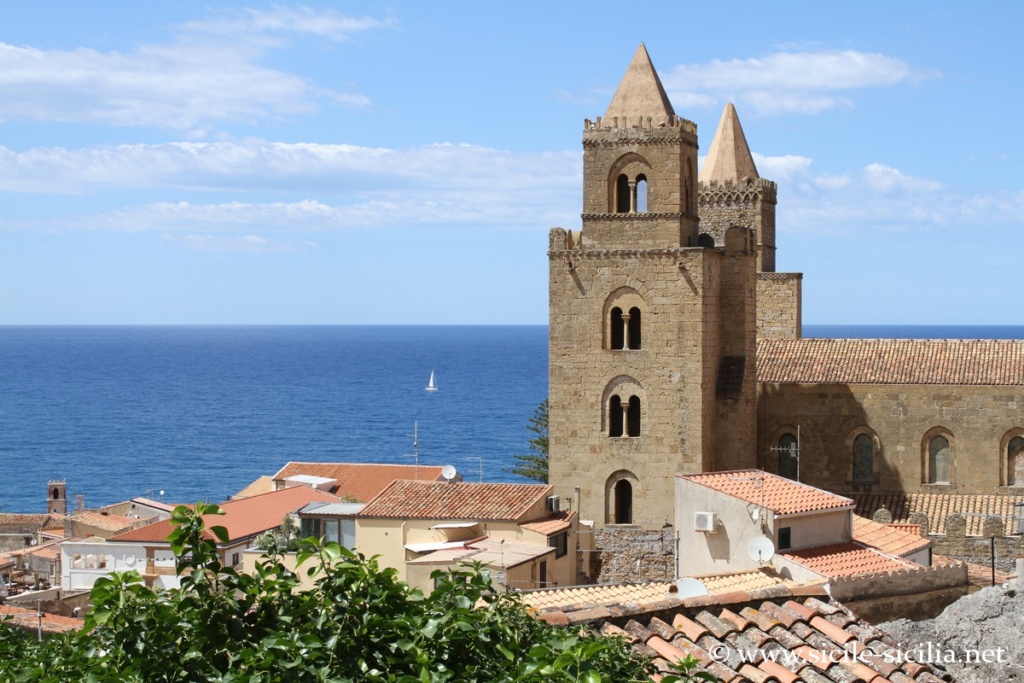
Bell towers of the Duomo of Cefalù
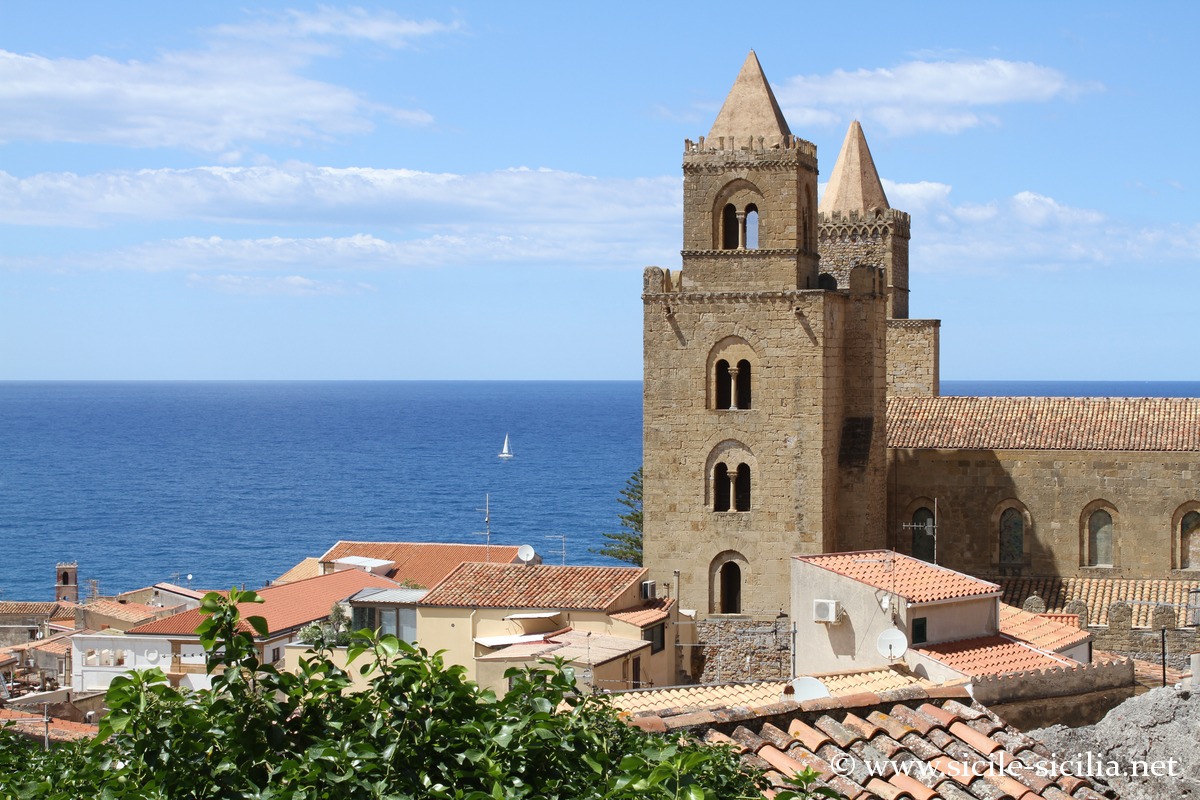
The many charms of Cefalù
The town is dominated by a singular large rock, called “La Rocca” (the rock or the fort in French), 270 metres high, which the Phoenicians referred to as the promontory of Hercules. At its feet stands the magnificent Arab-Norman cathedral, built by Count Roger, which is the masterpiece of Cefalù. Beyond it stretches the centre with its charming streets of medieval origin.
It is also a seaside resort, very touristy in summer, with many bars and restaurants, shops and art dealers. It also attracts visitors for its long golden sandy beaches to the west of the town, including the bays of Aranciotto and Settefrati with its seven emerged rocks.
Its streets and roads are easily congested during the peak August season, when Italian and foreign tourists meet in large numbers.
Local cuisine revolves largely around fish, with in particular an anchovy stew that is spread on bread. There are also taianu pasta, pan-fried, with meat, aubergines, pine nuts and raisins.
A meat-based dish alternates layers of meat, potatoes and basil and oregano.
The Top 5 to discover in Cefalù
Here are the 5 places in Cefalù that characterise the town:
- The Cathedral of Cefalù : Norman from the 12th century
- La Rocca : rock overlooking the town
- The old town and the alleys of Cefalù including the washhouse
- The port and the Porta Pescara
- The beach of Cefalù
→ To find out more, see visit to Cefalù and places to discover
Where Cefalù is located: map
If you see this after your page is loaded completely, leafletJS files are missing.
Practical information about Cefalù
Access and transport
Cefalù is connected to Palermo by a direct train (1h, about 6-8 €) from the central station. Local buses also serve the surrounding area, such as Castelbuono (30 min, 3-5 €). By car, the A20 motorway runs along the coast (Cefalù exit, 1h from Palermo). On site, the centre can be explored on foot, a car park is near the port (2 €/h).
When to visit Cefalù?
Summer (July-August) is hot (30-35°C) and very busy, with crowded beaches and high prices. May-June and September-October offer pleasant temperatures (20-25°C) and fewer crowds, ideal for exploring the town and the Rocca. Winter (December-February) is mild (10-15°C) but rainy, with few tourists. Festivals, such as San Salvatore (6 August), attract visitors in summer, while spring sees less traffic in the narrow streets. Book 2-3 months in advance for July-August.
The Mediterranean climate guarantees 300 days of sunshine per year. Fishing remains active, with daily markets near the port. The clear waters attract swimmers from May. The town is quiet out of season, except during religious festivals.
The history of Cefalù from antiquity to the Middle Ages
Cefalù has its origins in Antiquity. Human traces date back to prehistory, notably in caves near the Rocca, but the town took shape with the Greeks in the 5th century BC. They named it Kephaloidion, meaning “head” or “point”, in reference to its rocky promontory. It became a prosperous city thanks to its strategic position on the Tyrrhenian Sea, attracting trade. In the 4th century BC, it came under the control of Syracuse, then of the Carthaginians during the Punic Wars. In 254 BC, the Romans took it, renaming it Cephaloedium, and made it an administrative and agricultural centre, exploiting its fertile lands and its port.
After the fall of Rome, Cefalù was integrated into the Byzantine Empire in the 6th century, retaining a Greek influence in its culture. The Arabs conquered it in 858, renaming it Gafludi (“fortified town with abundant waters”), and strengthened its defences while developing irrigation. Their rule ended in 1063, when the Normans, led by Roger I, took Sicily. Under Roger II, in the 12th century, Cefalù experienced a golden age: the Arab-Norman cathedral, a UNESCO-listed masterpiece, was erected in 1131, symbolising Norman power. The town became a “Norman citadel”, blending Greek, Arab and Christian heritages. This rise continued until the 13th century, despite the struggles between medieval kingdoms, leaving Cefalù with a heritage unique in Sicily.
Articles in the Cefalù category
Information
Suggested visits
Sources and information
- Municipality website: www.comune.cefalu.pa.it
- Wikipedia page: fr.wikipedia.org/wiki/Cefal%C3%B9
- Tourist websites: www.visitcefalu.com, www.cefalumadoniehimera.it
Comments in other languages
After the must-see Norman cathedral, the nicest thing in Cefalù is its little port behind the characteristic Porta Pescara, with the beach at the foot of the old town houses, which offers a beautiful view, especially at the end of the day when the sun lights up the façades. You can also find small trattorias serving grilled fish.
If you plan to climb up to the Rocca, which has a fee for entry, make sure to wear good shoes (sandals are not allowed!!) and bring water! The path, half paved and half dirt, is indeed quite steep and slippery.
As for the beach, the one in the center is convenient, pretty, but fills up quickly. If you walk 15 minutes toward the west, there is much more space!!
There are the Madonie in the countryside, a beautiful natural park, quieter and very green with lots of bends, but it’s worth it, small peaceful villages where you eat really well, especially the local cheeses and cured meats. Nice getaway in summer