

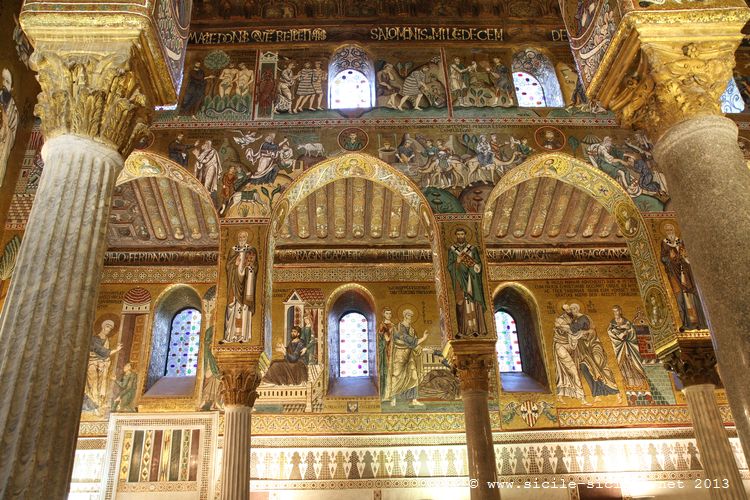
Since time immemorial at the crossroads of civilizations, between East and West, Africa and Europe, Palermo has preserved the imprints of all the cultures that settled there, through language, customs, architecture, and gastronomy.
Its thousand-year history, and even more so the atmosphere that prevails there today, contribute to the fascinating charm of this city of a thousand contrasts.
A city of astonishing diversity
Palermo is the capital of Sicily, home to more than 650,000 inhabitants, located at the foot of Mount Pellegrino and the mountain range called the Conca d’Oro, a fertile land where citrus fruits and vines have been cultivated for centuries.
It has inherited from its long history a remarkable artistic and architectural heritage, from the remains of Punic walls to Art Nouveau villas, by way of Arab-Norman buildings, Baroque churches, and Neoclassical theaters.
It is also a city of contrasts, sometimes scarred by earthquakes, or more recently by unchecked urbanization, unemployment, or Mafia crimes. This reality of Palermo, against which the inhabitants mobilize successfully, takes nothing away from the charm of discovering this astonishing city.
A thousand-year heritage
The heart of Palermo’s historic center is known as the Quattro Canti (the four corners in English), centered on the square of the same name, with its four main districts: Alberghiera, Capo, Cala, and Kalsa.
There you will find the city’s most beautiful sites, starting with the Palatine Chapel, an Arab-Norman jewel inside the sumptuous Palace of the Normans. Then there are the majestic sites of the cathedral from the 12th century, the Church of San Giovanni degli Eremiti (San Giovanni degli Eremiti), the Church of the Martorana, the Church of San Cataldo, the museums of the Abatellis Gallery or the National Archaeological Museum.
Visiting the city is well worth several days, to fully enjoy its atmosphere and the many places that deserve a visit, not to mention its surroundings with Monreale and an exceptional basilica, or the coast and its beautiful beaches.
The articles in the section devoted to Palermo offer you a general tour of the city, its heritage with its main sites, and articles that explore the most remarkable buildings and places in greater depth.
Must-sees in Palermo: summary
- Palace of the Normans and Palatine Chapel
- Cathedral of Palermo
- Church of San Giovanni degli Eremiti
- Piazza Bellini with the churches La Martorana and San Cataldo
- The Quattro Canti
- Piazza Pretoria and Pretoria Fountain
- Palazzo della Zisa
- Palazzo della Cuba
→ Read the pages: What to see and do in Palermo and tour of Palermo
Gastronomy and traditions in Palermo
Local gastronomy is generous, combining often original ingredients, such as pistachios, figs, saffron, and aromatic herbs.
Palermo’s street food is one of the richest in Italy. Beyond the traditional croquettes and arancini typical of Sicily, you will find cuttlefish sandwiches, sfincione (focaccia topped with tomato and caciocavallo cheese), veal tripe (stigghione), fried chickpea flour fritters (panelle), etc.
The city’s vast popular culinary culture has accumulated influences linked to its history: French, Spanish, Arab, etc.
Palermo’s pastry-making is also recognized as among the best, with its cannoli, cassata, almond pastries, watermelon jelly, and many other local inventions.
One of the fine discoveries to be found in Palermo is the Opera dei Puppi, the puppet theaters, a Sicilian tradition inherited from the Middle Ages, which can be discovered in several places in the city (Teatro del Museo Internazionale delle Marionette, Teatro Argento, Gento Mimmo Cuticchio, Franco Cuticchio figlio d’arte, Teatro Ippogrifo).
Map of Palermo
Articles in the Palermo category
Information
Ideas for visits
Sources and external information
- Tourism section of the municipality: turismo.comune.palermo.it
- Wikipedia page: en.wikipedia.org/wiki/Palermo
- Tourist office of the metropolitan area: turismo.cittametropolitana.pa.it
- City website: www.comune.palermo.it
- Cultural portal of Palermo: www.palermoviva.it
Comments in other languages
If you want to taste a very typical specialty, look for "frutta martorana," near the Martorana church but also in traditional pastry shops in the center. It is almond paste shaped into very realistic fruits, handcrafted. They are usually associated with religious festivities, and the best ones can be found in the center.
To plan your visit, think of the midday “lull,” when everything closes between about 1 p.m. and 4 p.m. (markets, shops, churches, etc.), especially in summer!!
Honestly, beyond its monuments, Palermo is also, and above all, something you feel in its streets. For example, neighborhoods like the Kalsa have preserved their layout from the Arab era, with those narrow alleyways where shadows and light alternate. You can discover this blend everywhere, of course in places like the Palace of the Normans, but also in the everyday atmosphere, the markets, and the smells. It also deserves to be visited without a fixed plan, taking the time to get a little lost there.