
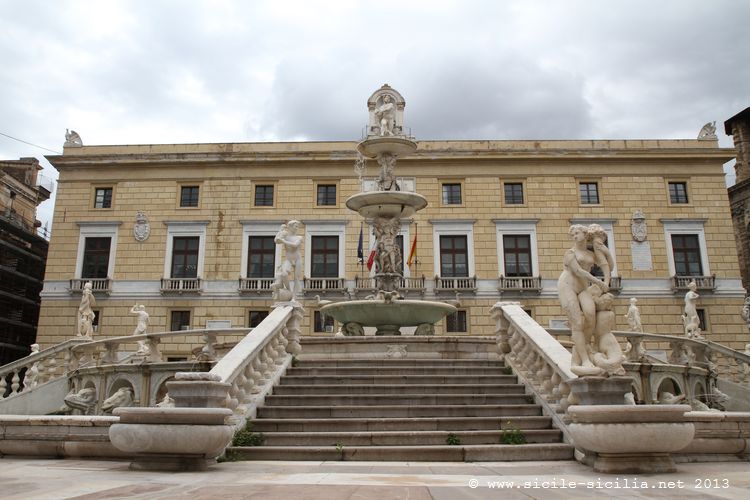
The Praetorian Palace, or Palazzo delle Aquile (Palace of the Eagles in English), is the seat of the municipality of Palermo.
It was built starting in 1470 by the architect Giacomo Bonfante, and later transformed. In 1553, the main entrance was moved from Piazza Bellini to Piazza Pretoria. It was also remodelled at the end of the 19th century with a neoclassical facade replacing the Baroque version.
Architecture and visit of the palace
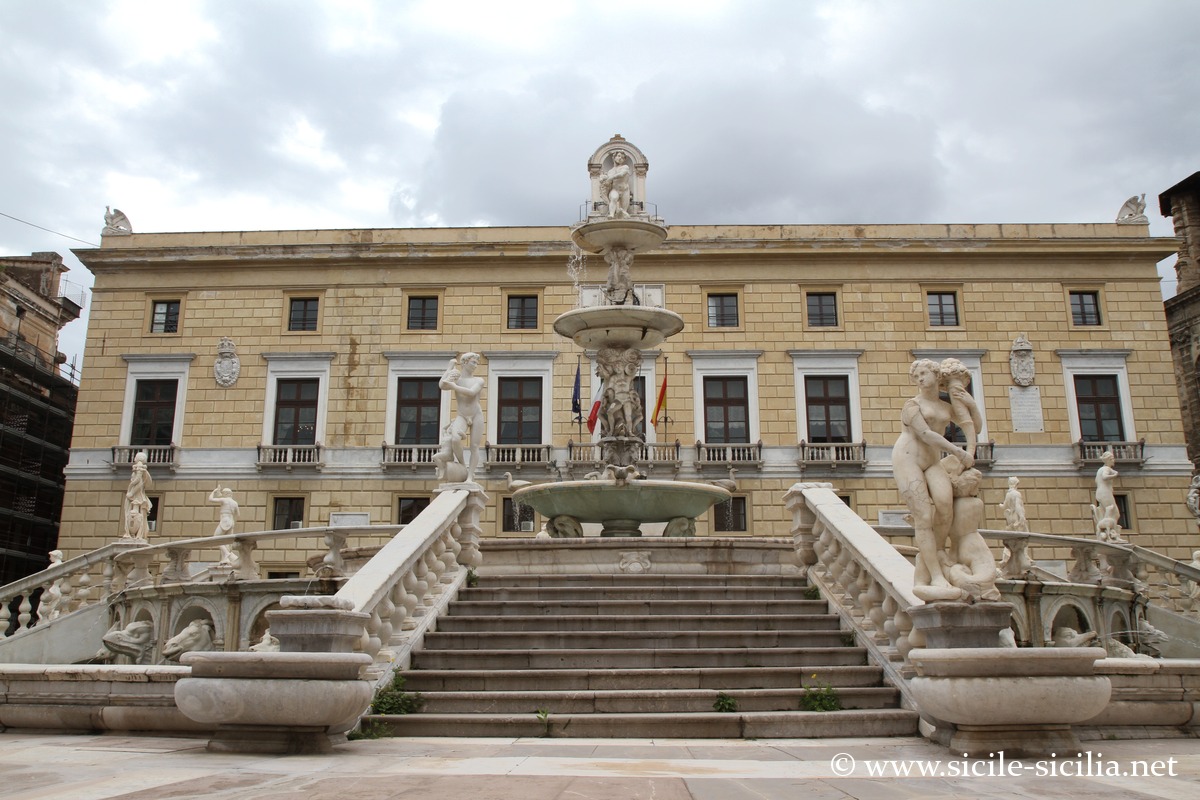
Fountain and Praetorian Palace
On the main facade, above the imperial eagle, a niche houses the statue of Saint Rosalia, the patron saint of Palermo (by Carlo D’Aprile, 1661).
The eagles that crown the facade at its corners, symbols of the city, are the origin of its name “Palazzo delle Aquile”.
The beautiful central courtyard, where the colonnades support a gallery, preserves frescoes and statues such as the one representing Palermo and Rome shaking hands. It has been covered by a glass roof.
To the left of the imposing staircase is a statue representing the genius of Palermo (attributed to Domenico Gagini), above a small pool.
A Baroque-style chapel is dedicated to Saint Rosalia.
The palace is rich in numerous works of art, paintings and sculptures by Sicilian artists, mainly from the late 19th and early 20th centuries.
The interior can be visited with the reception rooms; the red room, which is the mayor’s office; the yellow room where the municipal council meets; the Sala dei Tombini with the marble inscriptions covering its walls; the Sala Garibaldi where marbles bear extracts from Garibaldi’s speeches.
Where is the Praetorian Palace in Palermo
If you see this after your page is loaded completely, leafletJS files are missing.
Information
| Palazzo Pretorio Piazza Pretoria, 1, 90133 Palermo Visiting conditionsThe palace is open to the public from Monday to Saturday, generally from 9:00 am to 1:00 pm and from 3:00 pm to 6:00 pm. No free visits on Sundays and public holidays. External sites
|