

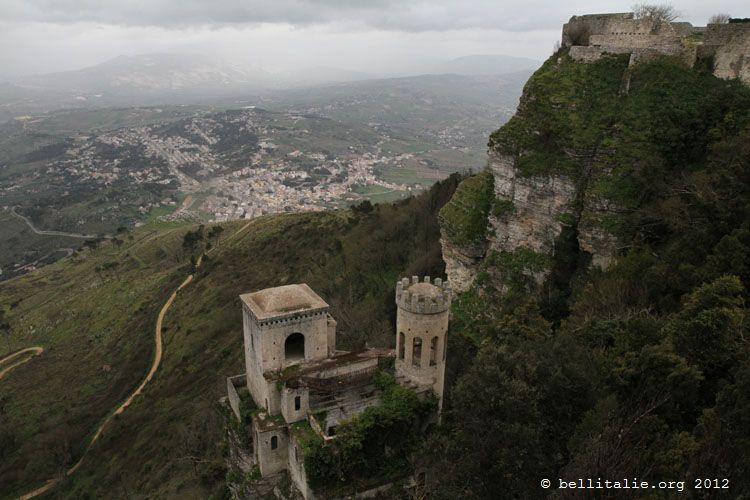
Erice is a small medieval and tourist town of about 26,000 inhabitants, overlooking its maritime neighbour Trapani, situated on the remarkable site of Mount Eryx, which is also called Monte San Giuliano.
The town can be reached by road or by a cable car connecting Erice to Trapani.
A picturesque town at the top of a mountain
At 750 metres above sea level, the panorama from Erice extends over the coast, with Trapani and the salt flats, the Egadi Islands, and, on very clear days, the shores of Tunisia.
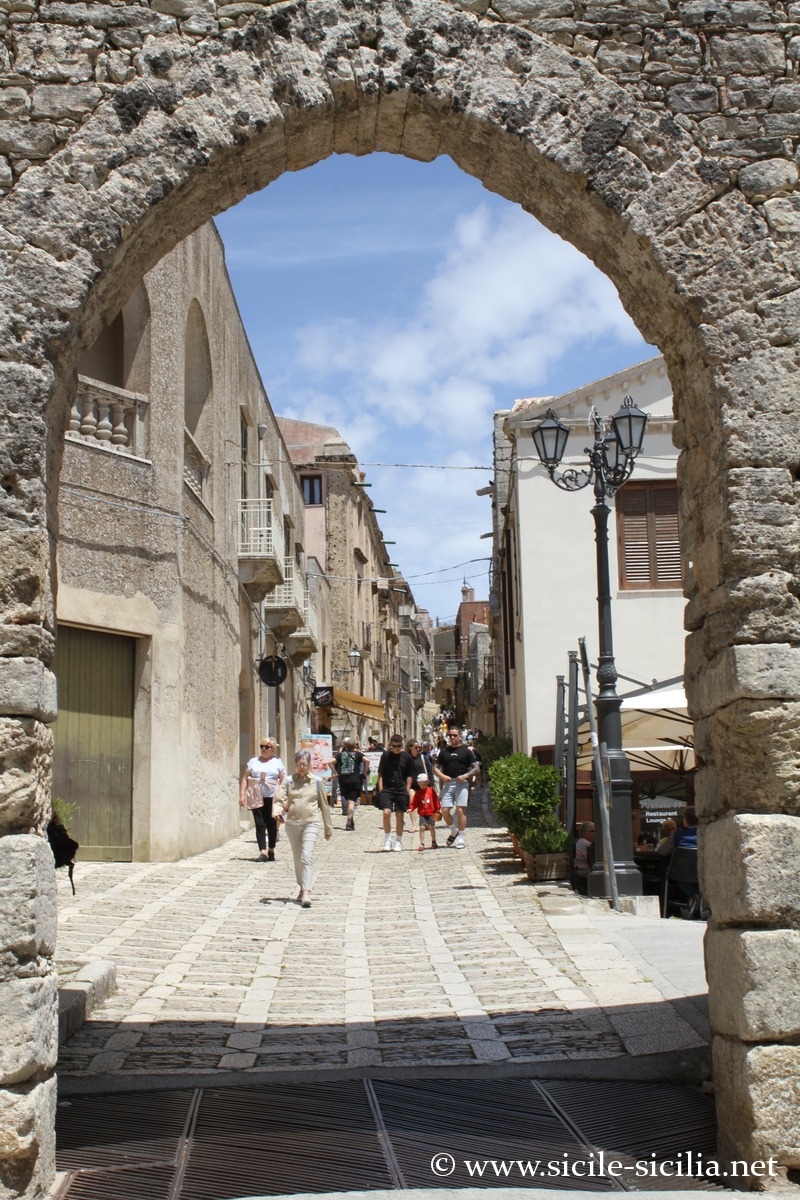
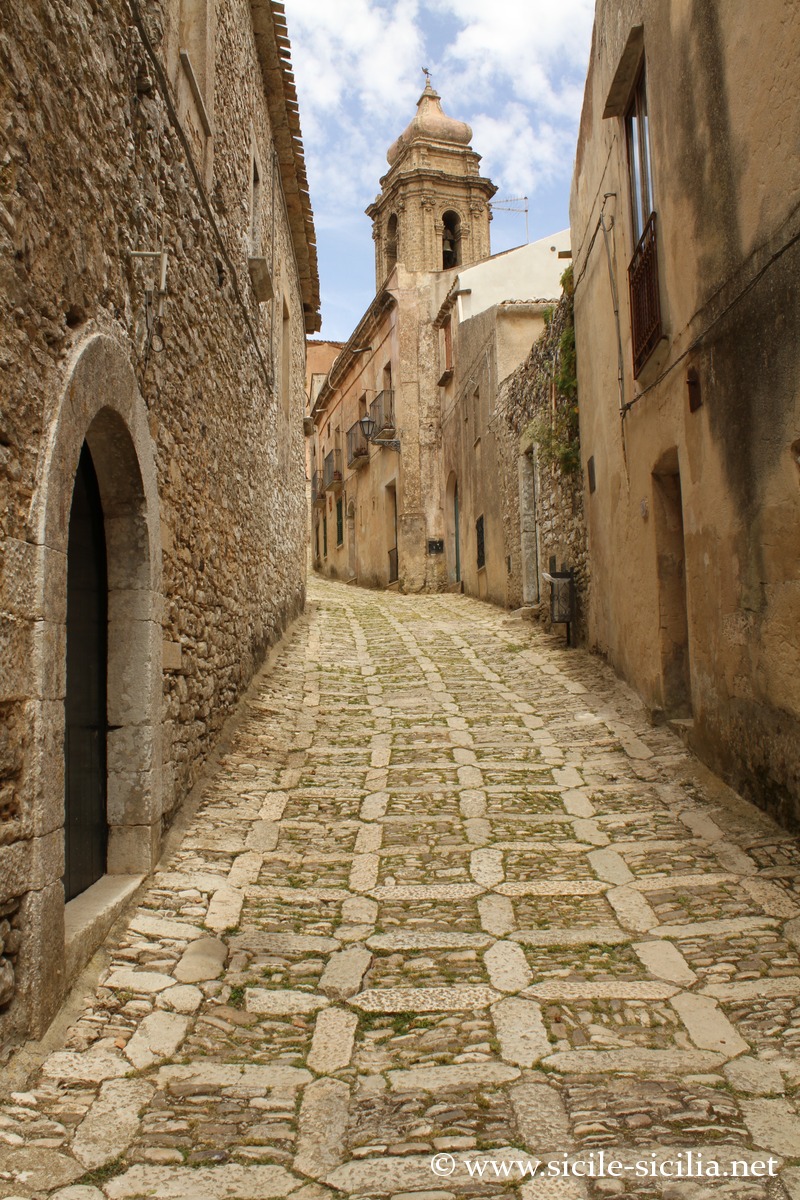
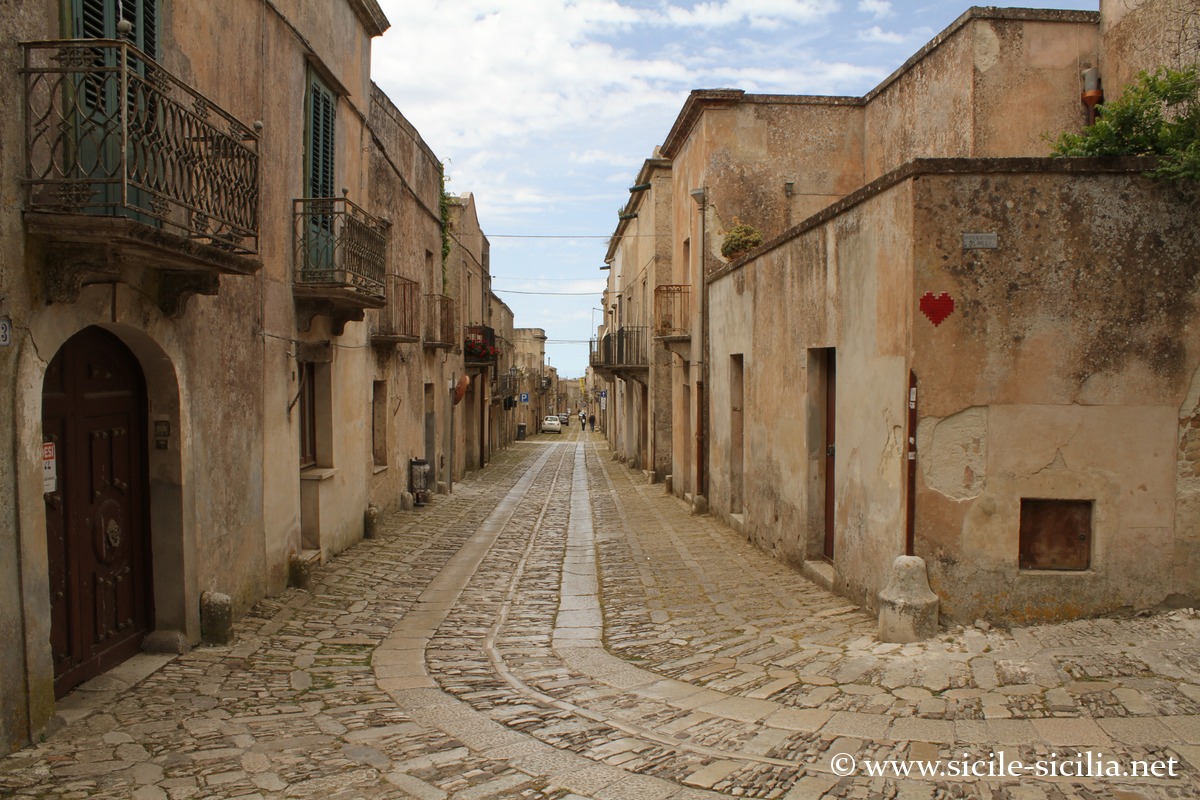
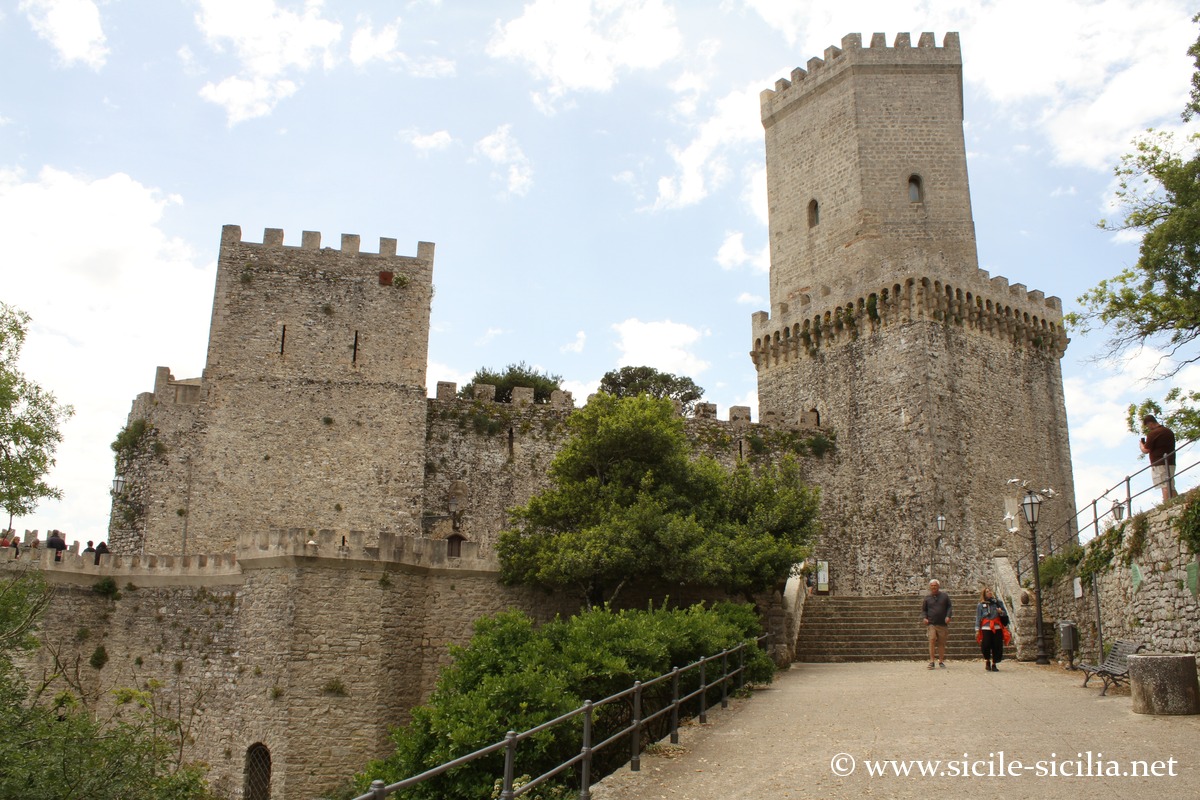
The medieval centre of Erice is a vast ensemble with a singular atmosphere, especially in the winter mists. The maze of paved alleys and stairways, dotted with churches and palaces, stretches up to the summit on the eastern side of the hill, where the old Norman castle stands, built on the site of the ancient Temple of Venus.
→ Discover the sights and the visit of Erice.
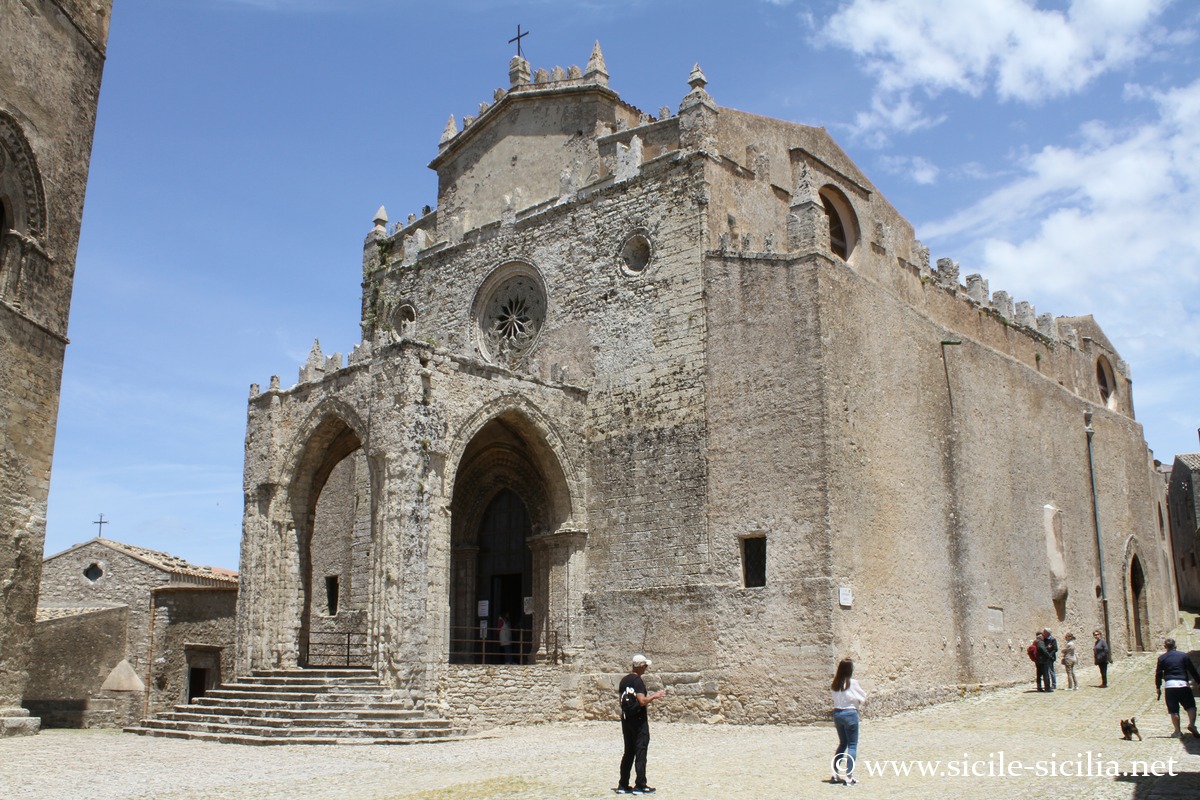
Cathedral of Erice
Erice’s local craftsmanship is particularly marked by pottery, ironwork dating back to the 16th–17th centuries, and carpet weaving, ancient traditions still alive today.
The town preserves an important religious and cultural heritage linked to its many confraternities and old trade guilds, still visible during religious processions, especially at Easter.
What to see and do above all in Erice
- Castle of Venus
The Castello di Venere is the icon of Erice, a medieval fortress built by the Normans in the 12th century on the site of an ancient sanctuary dedicated to the goddess Venus Ericina. The site combines fortifications, archaeological remains and spectacular views. - Chiesa Madre
Erice’s Gothic cathedral, built in the 14th century with materials from the ruins of the sanctuary of Venus, for its remarkable architecture, including the bell tower and its interior. - Alleys of the historic centreThe medieval centre of Erice is distinguished by its maze of paved alleys and stairways. These narrow streets reveal traditional architecture: stone houses, ancient palaces, small squares and secondary churches. The route between the cathedral and the castle allows one to appreciate its scale.
- Elymian-Phoenician wall and medieval ramparts
Erice’s fortifications are among the oldest urban remains on the site: portions of walls date from the time of the Elymians and the Phoenicians and frame the historic centre. They are visible around the gates such as Porta Trapani and Porta Spada. - Garden and towers of Balio
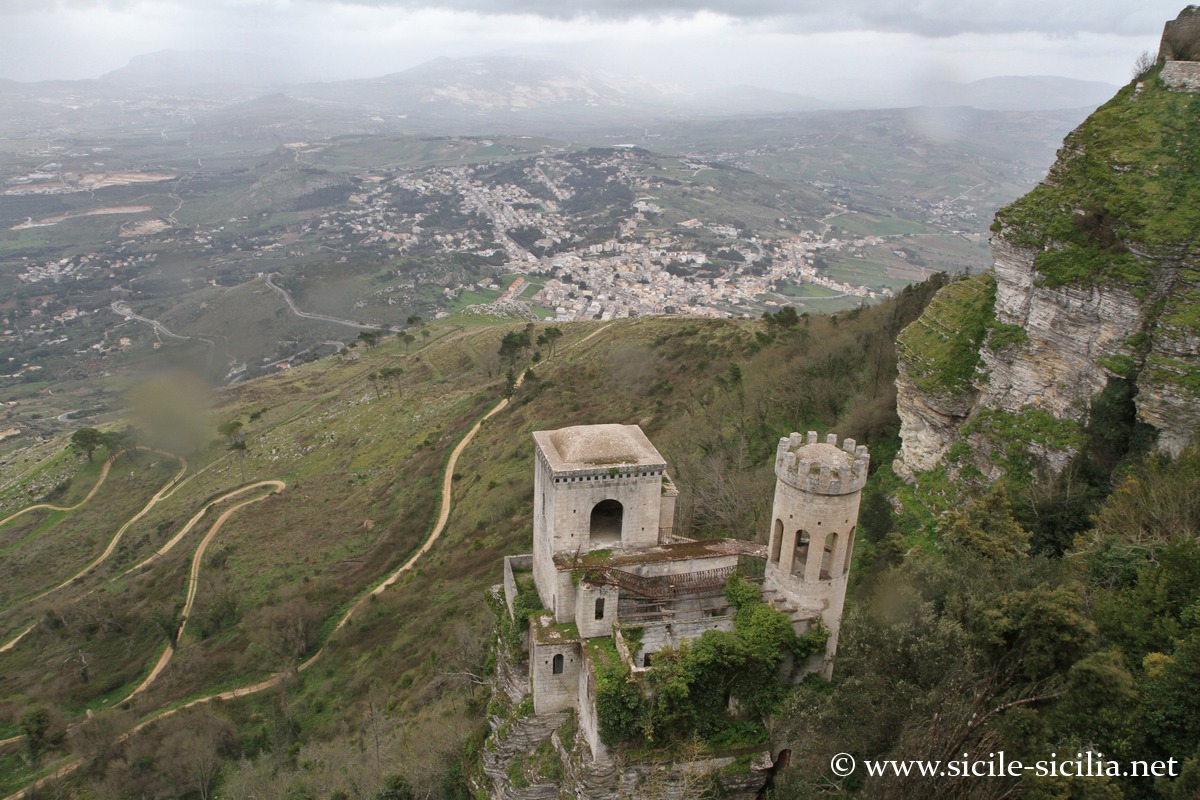
Historic public gardens created in the 19th century, near the castle of Venus with its Towers of Balio, a medieval defensive complex, overlooking the landscape with views of Trapani, the salt flats and the coast.
→ Discover the sights and the visit of Erice.
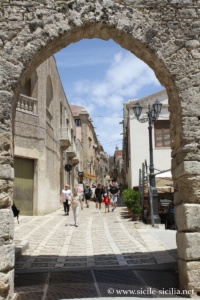
Porta Trapani 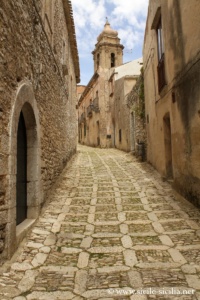
Alley in the centre 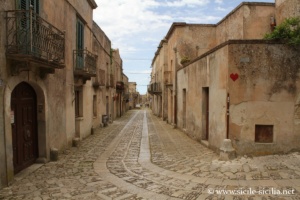

Alley in the centre
Historical overview since ancient Greece
According to Thucydides, the town was founded by Trojans, like the neighbouring city of Segesta, in a territory then occupied by the Sicans, the population from which the Elymians people originated (between the 15th and 8th centuries BC).
The origin of its name remains uncertain. In Greek, Eryx would refer to the legendary figure of the giant king of the Elymians and would also mean “mountain”. Tradition holds that Heracles passed through these places with the oxen of Geryon, during one of his labours, and that he killed King Eryx after a challenge.
The name could also derive from “Erech”, a name of Phoenician origin attested on an ancient coin.
Since Antiquity, Erice has also been a major centre of worship of the goddess of fertility: first in the form of Astarte among the Phoenicians, then Aphrodite among the Greeks, and finally Venus in Roman times. For centuries the town was an important spiritual centre, with numerous temples, churches and convents.
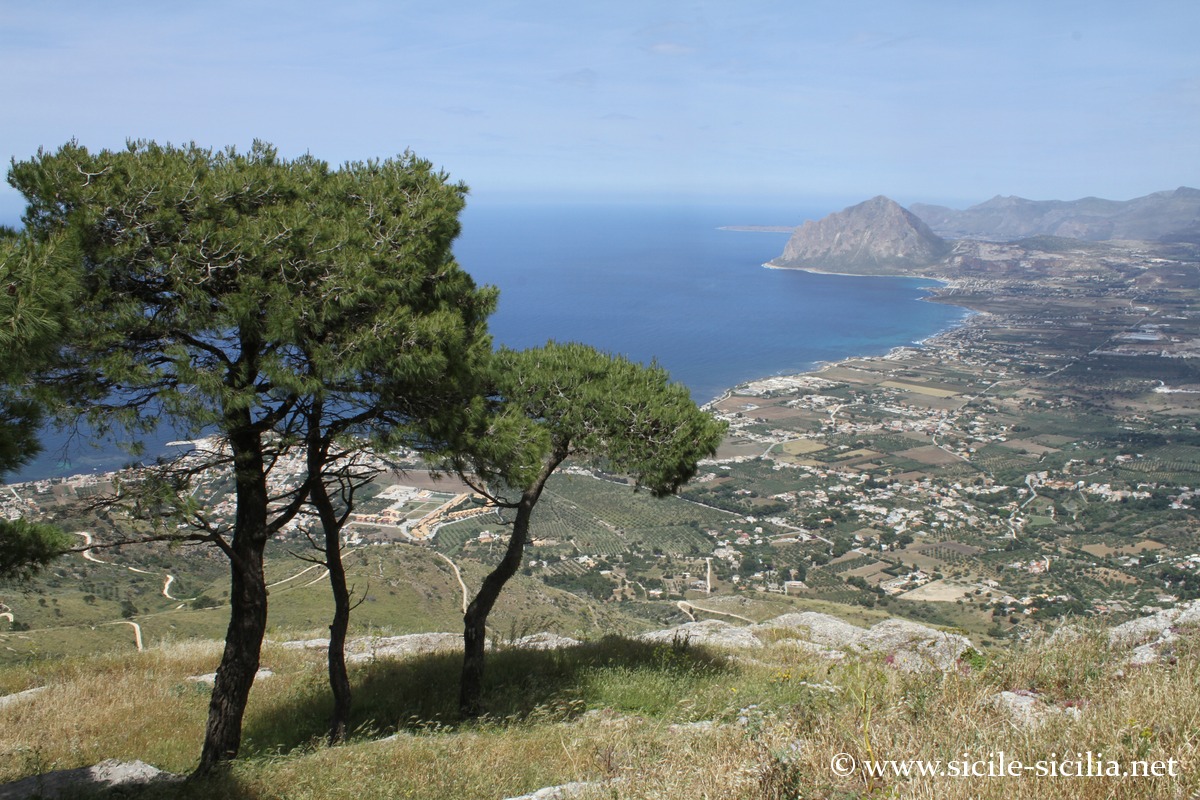
Panorama of the coast and Mount Cofano
The mountain has been inhabited since prehistoric times, and Erice preserves traces of the peoples who succeeded one another there: Sican remains, Greek and Phoenician walls, Roman evidence, Norman urban fabric and castle, houses of Arab influence, then Swabian and Spanish contributions. These historical layers are also found in local culinary traditions.
Festivities, gastronomy and traditions
Traditional feasts, sagras and major festivals
- Misteri di Erice – Good Friday
On Good Friday, Erice celebrates the traditional procession of the Misteri, during which wooden sculptural groups depicting episodes of the Passion of Christ are carried through the streets of the town by members of the confraternities and local artisans, mainly from the church of San Giuliano. - Festa di Maria Santissima di Custonaci – Late August
The feast of Maria Santissima di Custonaci, patron saint of Erice, takes place at the end of August, with processions. One of the central moments is the Consegna delle Chiavi d’Oro, a symbolic ceremony during which the mayor hands the keys of the town to the Virgin. - EricèNatale – winter period
Between early December and Epiphany, Erice hosts EricèNatale, an event during which the village is transformed into a “village of nativity scenes”, with art installations, exhibitions, concerts, etc. - Cultural events
Erice also hosts contemporary cultural events, including concerts and festivals organised in historic venues such as the Teatro Gebel Hamed, contributing to the town’s cultural life.
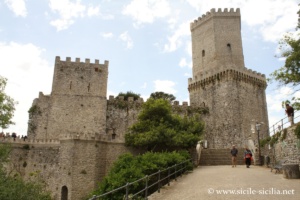
Castle of Balio 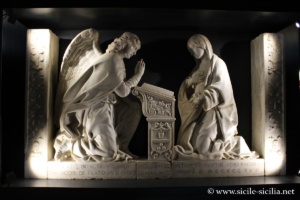
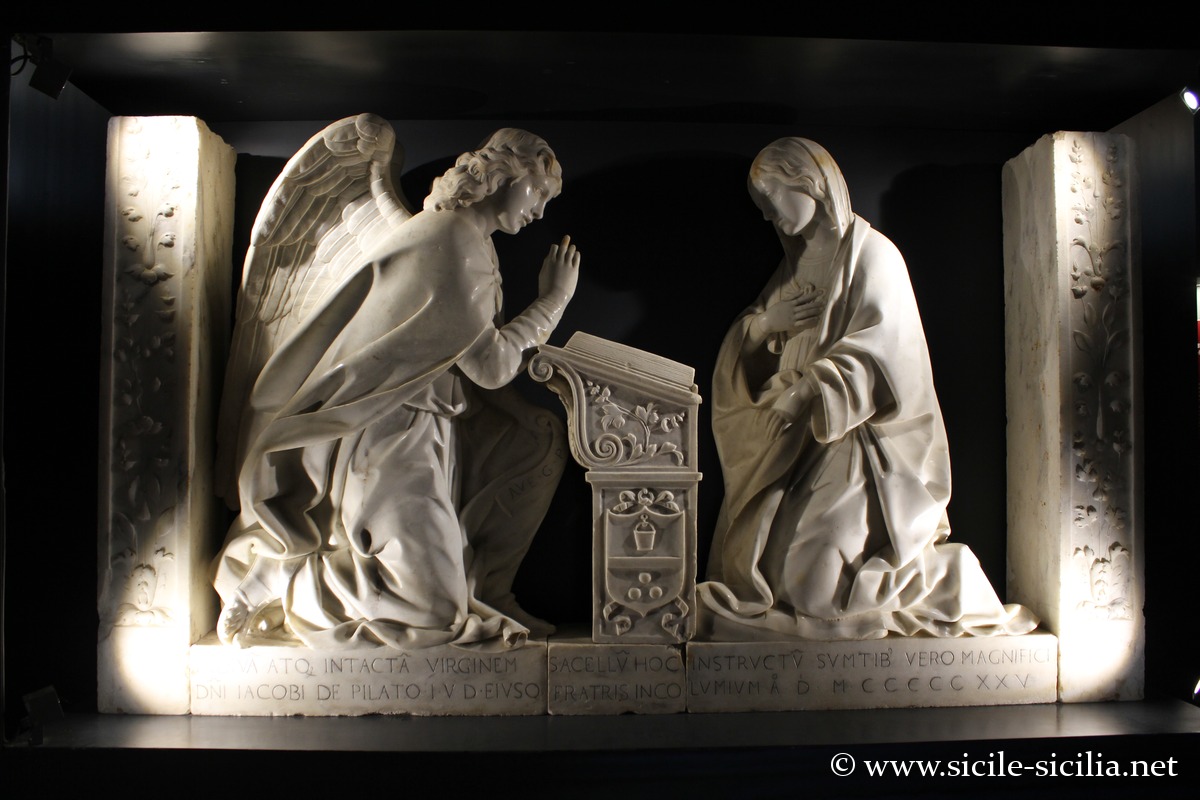
Annunciation by Gagini, Antonio Cordici museum 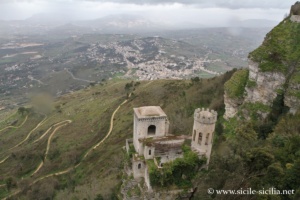
Castle of Venus and Pepoli Tower
Gastronomy: local products, cuisine and specialities
Erice’s gastronomy reflects the agricultural, religious and Mediterranean influences of the territory, including its proximity to Trapani and the sea:
- Fish couscous, a heritage of the Arab-Mediterranean culture of western Sicily.
- Ericino cheese: a firm-textured cheese made from sheep’s and cow’s milk, produced in the hinterland.
- Busiate with Trapanese pesto, a signature dish based on local products.
Busiate are hand-made twisted pasta typical of the Trapani area, often served with Trapanese pesto made from tomatoes, basil and almonds. - Mufuletta: a semolina bread roll, sometimes flavoured with fennel, traditionally eaten during certain religious feasts.
- Erice DOC wines: wines produced on the slopes of Mount Erice, including aromatic whites and more structured reds.
Erice is particularly renowned for its traditional pastries, largely inherited from female convents:
- Genovesi alla crema: shortcrust pastries filled with cream.
- Bocconcini di Erice: small biscuits, often filled with citron jam.
- Mustaccioli: ancient almond-based biscuits, linked to the monastic tradition.
- Pasta reale di Erice: almond paste from the convent pastry tradition.
Where Erice is located: map
If you see this after your page is loaded completely, leafletJS files are missing.
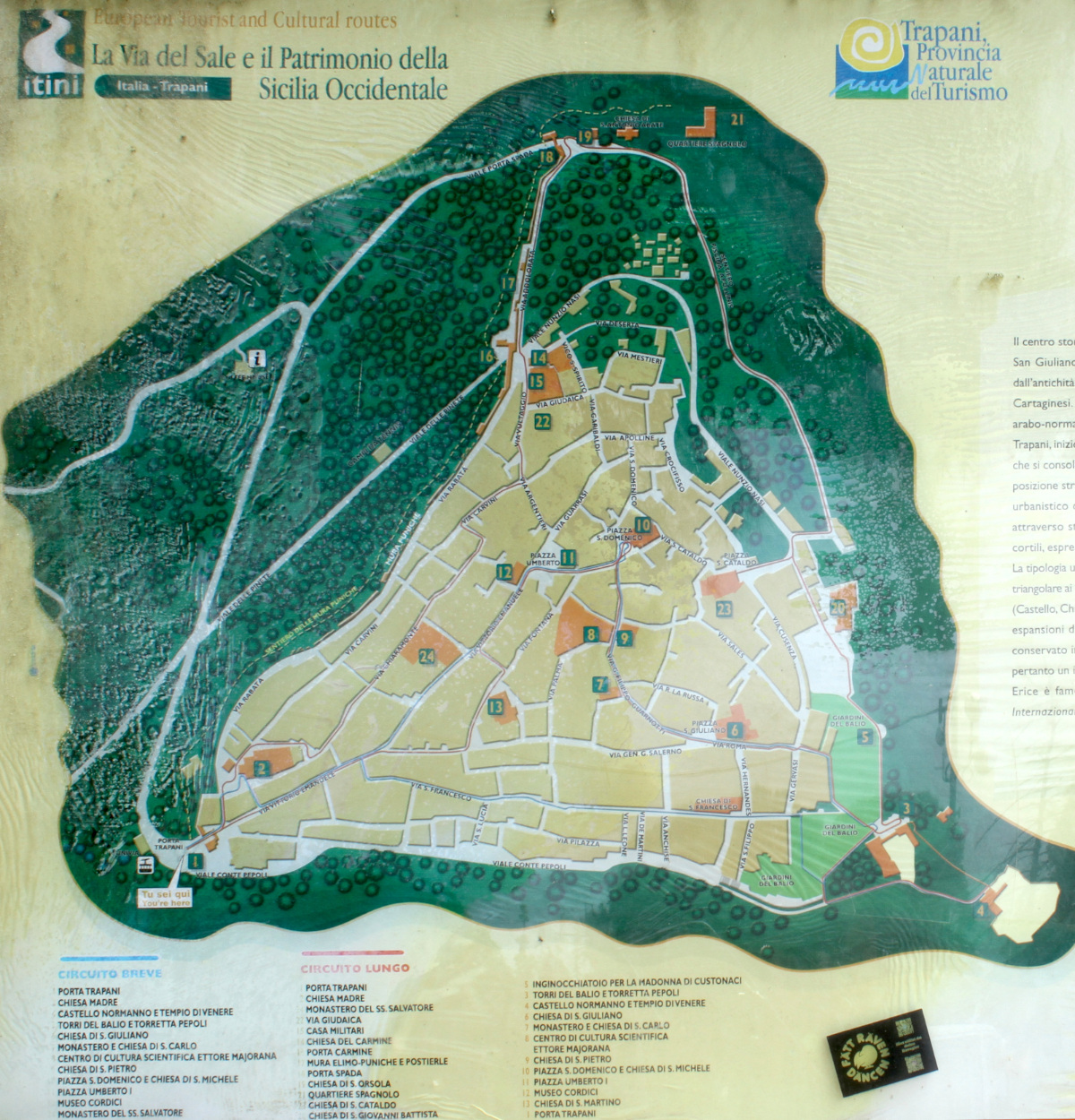
Tourist map of Erice
FAQ – Practical information
- Access to Erice and getting around
Erice can be reached by road from Trapani or via the Seggiovia Trapani-Erice cable car. The main car parks are located at the entrance to the town, as the historic centre is entirely pedestrianised. - Recommended period and visiting time
Spring and autumn offer pleasant conditions and fewer crowds.
Allow at least half a day, with a full day being more suitable for visiting the main sites. Periods of religious feasts attract many visitors. - Accommodation in Erice and surroundings
Hotels, guest houses and B&Bs are available in the centre and its surroundings, with more options in Trapani. Booking in advance is recommended in high season or during events.
→ Find accommodation in Erice
→ Find accommodation in Trapani
Information
Articles in the Erice Category
- Visiting Erice
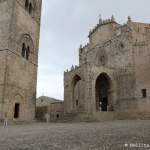
 The historic centre of Erice is exceptionally well preserved, with a maze of paved alleys and stairways, of which two sites stand out: the Castle of Venus at the summit ...
 - Hotels in Erice
 Hotels in Erice in Sicily, a medieval town near Trapani. Apartments, bed and breakfasts, farm stays and other accommodations.
 - Around Erice
 Sicilian destinations near Erice, including the coastal town of Trapani a few kilometres away and the Egadi Islands offshore, the Gulf of Castellammare to the north, and ancient Segesta inland
External sites
- Tourism on the municipality’s website: www.comune.erice.tp.it
- Tourist sites: www.turismo.trapani.it
- Wikipedia page: en.wikipedia.org/wiki/Erice
Comments in other languages
Two pastry shops to recommend in Erice:
- L’Antica Pasticceria del Convento, with the typical little almond-based pastries, originally made by the nuns: genovesi, pasta reale, etc.
- Pasticceria Maria Grammatico is a historic address, also and above all for the famous genovesi, best enjoyed warm, following the recipe learned by Maria Grammatico herself in a local monastery.
The downside is the sometimes heavy crowds.