

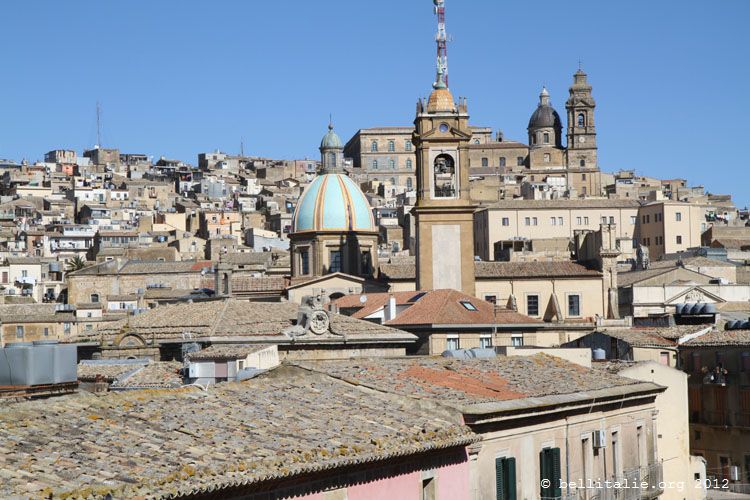
Long known for its pottery production, Caltagirone turned to artistic ceramics and terracotta sculpture. Its other activities are mainly related to agriculture, with vineyards, olive trees or peach trees.
Introduction to Caltagirone
A medium-sized town with about 37,500 inhabitants, in its charming medieval old centre you can see beautiful Baroque façades. But the town is particularly known for its abundance of colours and ceramics found almost everywhere, from the small streets to the large avenues.
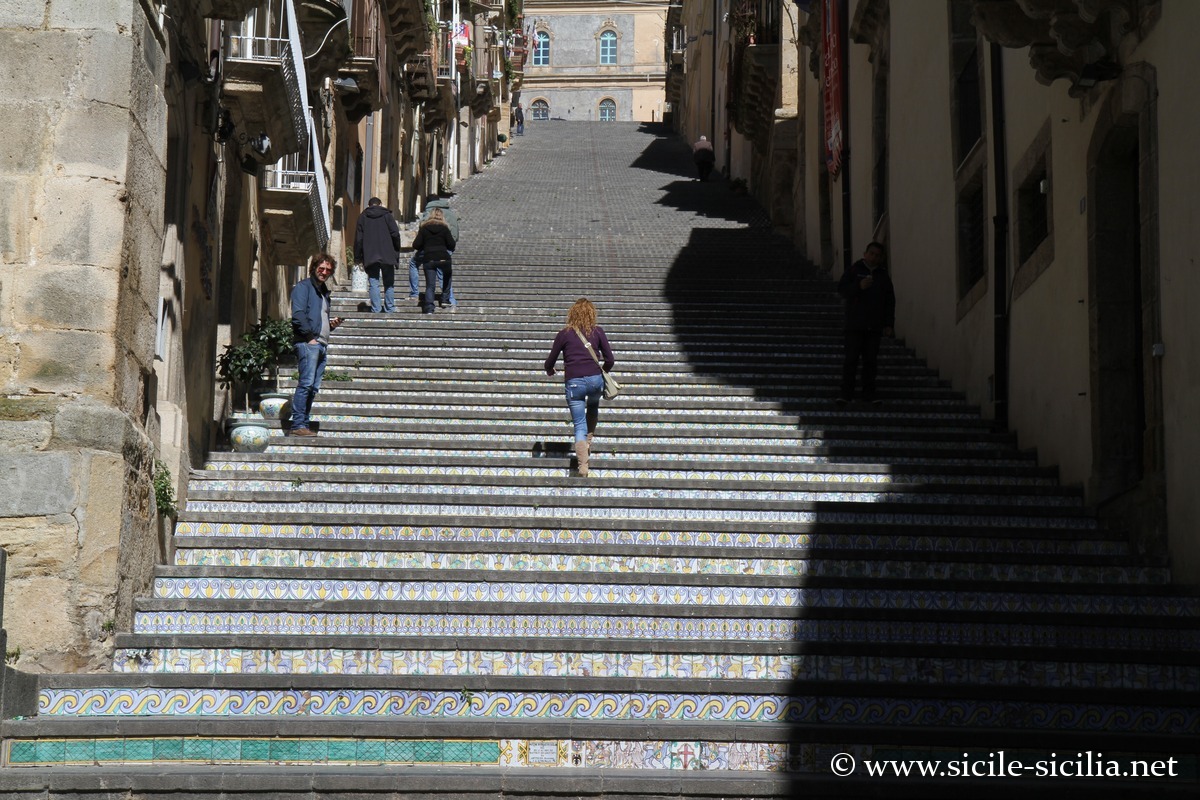
The main attraction of the town is the staircase of 142 steps of Santa Maria del Monte, built in 1608 in the old part of the city, where each of its steps is decorated with different handmade ceramics.
Once a year, on the feast of the town’s patron saint (San Giacomo, 25 July), the staircase is lit with coloured candles arranged to form a large design (find out more by consulting the Caltagirone visit).

Scala Santa Maria del Monte
What to see above all in Caltagirone
- The Scala de Santa Maria del Monte : this emblematic staircase of 142 steps, entirely decorated with polychrome ceramic tiles, is the symbol of the town.
- The church of Santa Maria del Monte : located at the top of the staircase, this former Baroque church offers a viewpoint over the whole town and houses interior frescoes.
- The Regional Museum of Ceramics : a must for understanding the history of Caltagirone’s ceramic art, with around 2,500 pieces tracing production from prehistory to the present day.
- The Cathedral of Saint Julian (San Giuliano) : a remarkable Baroque building, its dome is covered with ceramic tiles — the interior features frescoes by Giuseppe Vaccaro.
- The Public Garden (Villa Comunale) : a peaceful English-style space where greenery, a Moorish ceramic kiosk and views over the town mix, perfect for a relaxing stop.
→ Also read the page about the Caltagirone visit
Historical overview
Its name comes from the Arabic Qalaat-al-Ghiran (“the hill of the Jars”).
The site has been inhabited since prehistory, as evidenced, among other things, by two necropolises from the 2nd millennium BC.
It was later populated by the Sicels, before the Roman occupation.
During their occupation of Sicily, the Arabs built a castle here and developed ceramic production, thanks to the local clay and wood to fuel the kilns. They also left many traces in the local dialect.
The town subsequently prospered under the Normans and the Hohenstaufen, becoming renowned for its ceramics.
It was in the 15th-17th centuries that the town experienced its golden age, when it was enriched with churches, colleges and convents, the Jesuit university and a hospital.
Almost entirely destroyed by the earthquake of 1693, many buildings were rebuilt in Baroque style, and Caltagirone was inscribed as a UNESCO heritage site along with towns in the region such as Noto.
With the reconstruction, the art of ceramics flourished with new productions and decorations, vases, basins, architectural decorations, tiles and more. Then from the 19th century onwards, the manufacture of figurines, such as nativity scene characters, flourished.
Over the course of history, various communities settled in the town and left their mark on its development, such as Genoese, Catalans, Amalfitans and Jews.
Gastronomy and traditions in Caltagirone
Gastronomy and local products
The Caltagirone area has long been worked by large estates producing wheat, but olive trees also grow in the Iblei mountains, as well as vines around the Nero d’Avola and Cerasuolo di Vittoria grape varieties. Almond trees, prickly pears or peach trees are also found.
People eat broad beans, particularly with maccuverde, a soup of fresh broad beans, wild fennel and onion.
The local cheese is pecorino.
Sweet pastries are based on local ricotta, such as cassatedde and the better-known Sicilian cannoli.
The cubaita of Arabic origin is a soft nougat made with candied orange, cooked wine and honey.
On the Immaculate Conception of 8 December, it is traditional to make muffulette, simple warm breads with wild fennel.
The cuccìa is also a special bread, with whole wheat grains, and the addition of various flavourings, which is eaten in various ways, savoury or sweet.
During Holy Week, people enjoy agnelli (almond pastries), palumeddi made from sugar and egg whites, and the traditional Arab pastries in the shape of little sticks.
Festivities
On the nights of 24 and 25 July, during the feast of the town’s patron saint, Saint James of Zebedee, thousands of olive oil lamps illuminate the staircase of Santa Maria del Monte, forming designs. The feast is opened by a parade of horses and carriages.
In mid-August, the staircase is illuminated again.
In June the staircase is decorated with floral tapestries in honour of the Madonna di Conadomini.
In the category Caltagirone
- Visiting Caltagirone: what to see and itinerary
 In the charming medieval-old centre of Caltagirone, beautiful baroque façades intersect. But the town is especially known for its abundance of colourful ceramics that decorate both the main avenues and ...
 - Militello in Val di Catania
 Set in the hills between the plain of Catania and the north of the Hyblaean Mountains, the beautiful town of Militello is one of the eight municipalities inscribed by Unesco ...
 - The Calatino
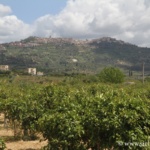
 The Calatino, a historical region of southern Sicily centered on Caltagirone, is little known to international tourism compared to the coastal towns or the Baroque sites of the Val di ...
 - Hotels in Caltagirone
 Hotels in Caltagirone and accommodations in its surroundings, bed & breakfasts, guest rooms.
 - Destinations near Caltagirone
 Sicilian destinations near Caltagirone, with Piazza Armerina and the Roman villa of Casale to the northwest, and the Hyblaean Mountains and Palazzolo Acreide to the southeast.
Where Caltagirone is located: map
If you see this after your page is loaded completely, leafletJS files are missing.
Information
External sites
- Tourism section of the municipality’s website: www.comune.caltagirone.ct.it/it/vivere/luoghi
- Wikipedia page
- Facebook page of the tourist office
Comments in other languages
Make no mistake, the Regional Museum of Ceramics is indeed located in the Villa Comunale park and not at the address given on Google Maps and elsewhere, which is the administrative office.
It is housed in a 19th-century building set in a kind of theater with terraces decorated with faience. The entrance is there, but it is not clearly marked!