
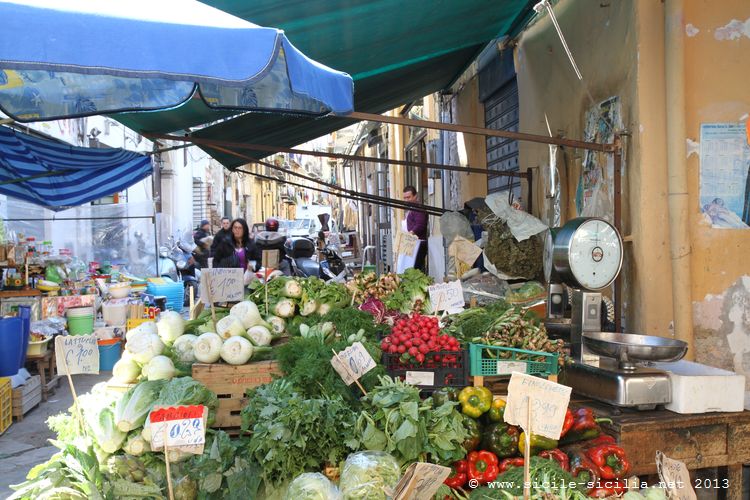
One can explore Palermo according to geographical, historical or architectural themes, so numerous and varied are its riches. But one can just as well simply stroll through it and discover at random places often overlooked by the guides.
The heart of the city, the Quattro Canti, is a baroque square at the intersection of the two great central avenues, via Vittorio Emanuele and via Maqueda. The most prestigious buildings are on the west side, with the church and former Arab-Norman mosque of the Church of Saint John of the Hermits, the splendid Cathedral of Palermo, and the Palace of the Normans with its Palatine Chapel.
Here is a suggestion for discovering Palermo by neighbourhood or area:
1. The suburbs west of Palermo: Norman palaces and catacombs
Access to the city, descending the mountain by the Corso Calatifimi, passes before entering the city by the Norman palace of the Cuba (Qubba), near the Capuchin Catacombs in the monastery of the same name further north, famous for their embalmed bodies, and a little further on the Palace of the Zisa, the most interesting place in this neighbourhood. This Norman palace of Arab architecture was a residence of the Norman kings who governed Sicily there, built within a vast park embellished with gardens, fountains and pools.
2. Corso Calatafimi: From the Palace of the Normans to the cathedral
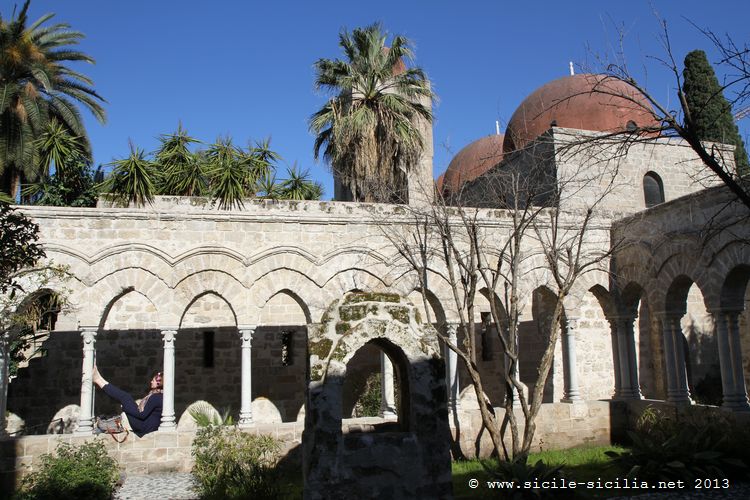
Saint John of the Hermits
The Corso Calatafimi enters the historic centre of Palermo through the Porta Nuova erected in the 15th century, after which begins the main artery of the centre, the Corso Vittorio Emanuele. On the right stands the splendid Palace of the Normans and its famous Palatine Chapel. And a few steps further south, one cannot miss the surprising church of Saint John of the Hermits.
The avenue Vittorio Emanuele joins further on the villa Bonnano in the centre of piazza Vittoria, rectangular, with the Palazzo Sclafani of the 14th century in one of the corners, as well as the hospital and barracks of San Giacomo.
Further on, on the left stands the majestic Cathedral of Palermo, which has changed greatly over the course of history, from its early Christian origin, the time when it was an Arab mosque, then a Norman cathedral, or with the later Spanish alterations. Opposite the sanctuary, archways connect the Archbishop’s Palace housing the Diocesan Museum.
3. The heart of the city: churches and squares
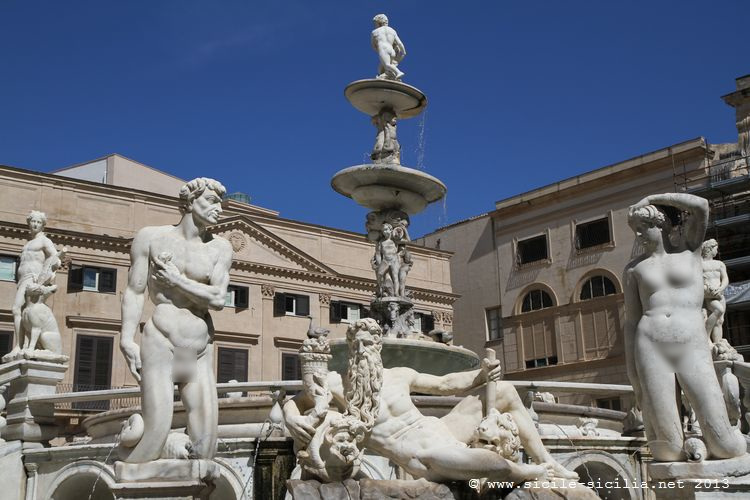
Piazza and Fountain Pretoria
Along avenue Vittorio Emanuele stand several prestigious palaces and churches such as the Palazzo Castrone, the church of the Santissimo Salvatore, the Palazzo Riso (museum of contemporary art), or the baroque church of San Giuseppe dei Teatini.
Then the corso joins the Quattro Canti, also called Piazza Vigliena, at the intersection with the Via Maqueda, where on each of the four corners rises an 18th-century concave façade, whose three storeys host the statues of the four seasons, of Spanish kings and of Palermo’s saints.
The nearby Piazza Pretoria develops around the beautiful Fountain Pretoria, with the senatorial palace and the remarkable baroque church of Saint Catherine.
On the neighbouring Piazza Bellini stand the former theatre, and the two beautiful churches of Norman origin La Martorana with its Byzantine mosaics and the more sober church of San Cataldo.
4. South side of the corso: Kalsa neighbourhood
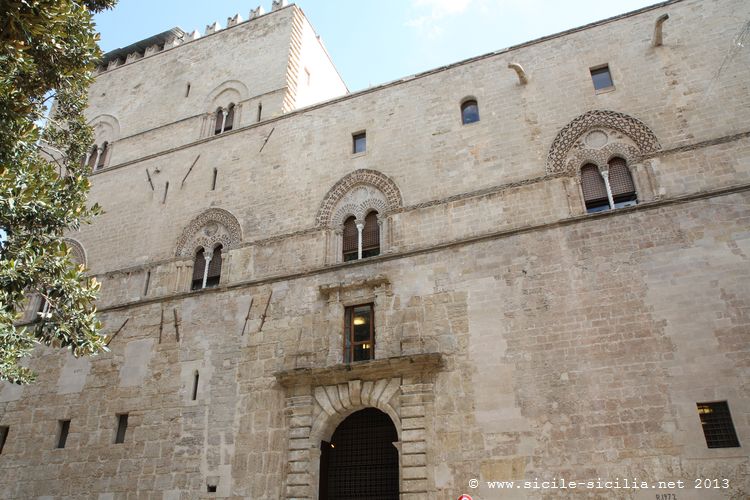
Chiaramonte Steri Palace
By taking Via Maqueda southwards, one can reach the surprising baroque church of Gesù, in the Ballaro district (or Albergheria) where one of the city’s most popular markets is held, close to the pretty Tower of Saint Nicholas of Bari, and dominated by the pretty dome of the Chiesa del Carmine.
If one takes Via Roma further east towards the south, one of the main thoroughfares, beyond Piazza Bellini one finds the Comitini Palace, the Gangi Palace, the Corvino Palace, or the Gallery of Modern Art of Palermo within the Bonet Palace. Then further on, one encounters the Museum of Majolica Stanze del Genio, or the Norman Magione Church with its charming cloister.
Further east still, always on the south side of the corso, one can make a detour via the Church of Saint Francis of Assisi and the Oratory of San Lorenzo.
Heading towards the Porta Felice which precedes the coastline, on the right is the Piazza Marina where the Chiaramonte Steri Palace stands, and nearby the Mirto Palace, the Abatellis Palace with the Regional Gallery museum, and not far away the International Puppet Museum, with examples from all over the world including those of the pupi and their shows, typical of Palermo.
If one heads further south, one discovers the Piazza Kalsa with the Forcella de Seta Palace, the ruins of the Church of Santa Maria dello Spasimo, before reaching the Botanical Garden of Palermo and the Villa Giulia.
Past the Porta Felice, the green esplanade stretches along the coastline known as the Foro Italico.
5. North side of the corso: Castellammare
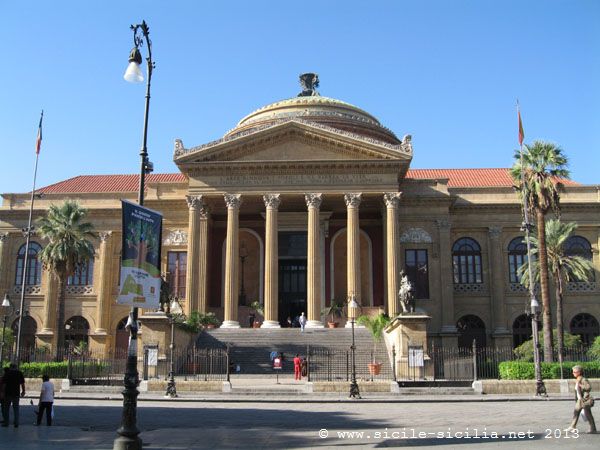
Massimo Theatre
If one returns to the corso Vittorio Emanuelle, the district after the intersection with Via Roma, before the Porta Felice, is that of Castellammare (or la Loggia), with the Vucciria and its historic market around Piazza Caracciolo and Via Argenteria.
Close to the Porta Felice and the small port, there is the Church of Santa Maria della Catena.
Via Roma heads north, first passing in front of the Church of Abbot Saint Anthony (Saint’Antonio Abate), then near the Alliata Palace on the left, and reaches the Archaeological Museum of Palermo, close to the Oratory of the Rosary of Santa Cita and the Church of Saint George of the Genoese (San Giorgio dei Genovesi).
Further on, Via Roma leads to the two great theatres of Palermo, of neoclassical construction, first the Grand Theatre Massimo from the 19th century, dedicated to opera, then the Politeama Theatre intended to host varied and more popular shows.
Museums and palaces
Among the museums of Palermo, let us first mention the Archaeological Museum of Palermo which gathers objects from archaeological sites throughout Sicily; the Gallery of Modern Art of Palermo (GAM); the Diocesan Museum of Palermo; the Regional Gallery at the Abatellis Palace with its beautiful collections, and many others which are housed in historic palaces, such as the Conte Federico Palace, the Mirto Palace, Chiaramonte Palace or the Gangi Palace.
→ See the sections: Museums of Palermo and Palaces of Palermo.
Surroundings of Palermo
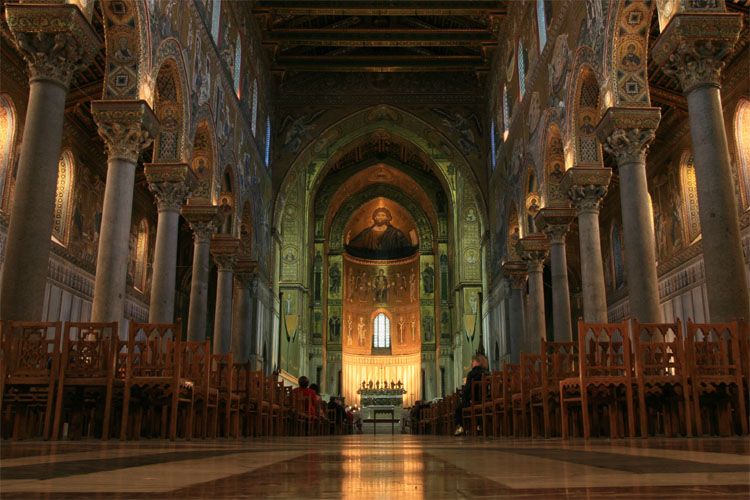
Cathedral of Monreale
Just north of the centre of Palermo stands the characteristic Mount Pellegrino, from which one discovers panoramas and nature trails, as well as the much venerated Sanctuary of Saint Rosalia., or the Utveggio Castle massif.
At the foot of its western slopes the singular oriental-style palace Palazzina Cinese (Chinese Palace in English), was built by King Ferdinand II of Sicily at the end of the 18th century. Nearby is the Giuseppe Pitre Ethnological Museum, the extensive Parco della Favorita.
On the other side of Mount Pellegrino, one reaches the bay with the beach of Mondello, a prestigious seaside resort, popular in summer. And even further north, the beautiful nature reserve of Capo Gallo.
On the heights of the inland towards the west, about 10 km from the centre, Monreale is a small town that was built around an exceptional Arab-Norman Cathedral of Monreale, with its monastery and impressive cloister.
Towards the south-east of Palermo, at Bagheria a Palermitan nobleman built in the 18th century the Villa Palagonia, a picturesque baroque palace decorated with sculptures of grotesque figures. Other luxurious villas were subsequently built in the town. Nearby, the suggestive remains of the ancient city of Solunto dominate one of the slopes of Mount Catalfano.
Let us also mention in the immediate surroundings, along the Oreto river south-east of Palermo, several notable Norman edifices: the Norman church of Saint John of the Lepers and the Admiral’s Bridge , as well as the Church of the Holy Spirit within the Sant’Orsola cemetery.
Monuments of Palermo
Information
Suggested visits
Sources and external sites
- Tourism section of the municipality: turismo.comune.palermo.it
- Wikipedia page: fr.wikipedia.org/wiki/Palerme
- Tourism portals and blogs: viaggi.corriere.it, www.palermoviva.it