

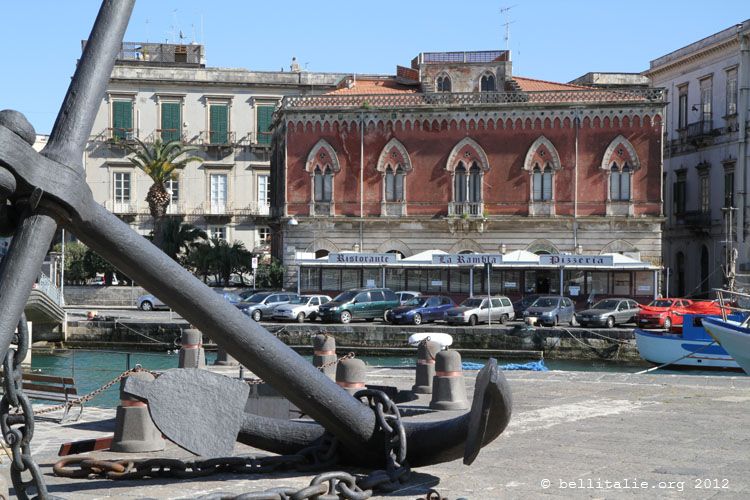
Founded in 734 BC by settlers from Corinth, Syracuse quickly established itself as one of the most powerful cities in the Greek world. A few centuries later, Cicero described it as the most beautiful of Greek cities (in the 1st century AD). For many, it still is.
Today it is the fourth largest city in Sicily, with a population of around 115,000 (2025), whose historic centre is surrounded by the sea on the island of Ortygia (Ortigia in Italian).
A lively port city, Syracuse is certainly touristy, but it retains a Mediterranean pace, an atmosphere, a culture and a cuisine that is discovered through its markets, its port and its cafés facing the sea.
Discover below an overview of the city and the articles dedicated to Syracuse, including the visit of the whole city, from the heart of Ortygia to its surroundings, coastal and natural, passing through the catacombs or the ancient remains.
An exceptional heritage, from Greek Antiquity to Sicilian Baroque
For many travellers, it is the most captivating city in Sicily, largely thanks to the charm of Ortygia and its great archaeological park. Thanks to its archaeological, historical and architectural riches, Syracuse has been a UNESCO World Heritage Site since 2005 (along with the neighbouring necropolises of Pantalica).
Many monuments bear witness to its long history, from the ancient Greek and Roman remains, including the temple of Athena (which became the cathedral) and the fountain of Arethusa in Ortygia; the archaeological site of Neapolis with the Hellenistic theatre and the Roman amphitheatre; the catacombs and the early Christian churches of Santa Lucia and San Giovanni from the 2nd and 3rd centuries AD; Arab-Norman remains; or the expression of the Baroque revival with its palaces, churches and fascinating cathedral.
→ See also: tourist sites on the map of Syracuse
The surroundings also offer remarkable natural landscapes, with pretty coastlines but above all the inland areas with the Necropolises of Pantalica in the Hyblaean Mountains or the Cavagrande Nature Reserve.
What to see first in Syracuse
- The island of Ortygia : The historic and lively heart of the city, it concentrates most of the major monuments: the temple of Athena transformed into a Baroque cathedral (Santa Maria delle Colonne), the fountain of Arethusa and the noble palaces. Its medieval alleys and luminous squares form a remarkably coherent urban ensemble.
- The Archaeological Park of Neapolis : It brings together the most impressive ancient remains of Syracuse: the Greek theatre, still used for performances, the Roman amphitheatre, and the Latomia del Paradiso, including the famous Orecchio di Dionisio (Ear of Dionysius), and also the important Paolo Orsi Archaeological Museum.
Tourist map of Syracuse
 Show interactive map
 FAQ – Preparing your visit to Syracuse
What is the best time to visit Syracuse?
The best time to visit Syracuse is from April to June and from September to October. The climate is mild, the sites are less crowded than in the height of summer and the days remain long. July and August are often very hot months.
How much time is needed to visit Syracuse?
Two days allow you to discover the main sites: the island of Ortygia, the archaeological park of Neapolis and the Paolo Orsi museum. In three to four days, you can explore the surroundings, such as the necropolises of Pantalica, the Cavagrande nature reserve, the beaches, but also less frequented places such as the catacombs.
How to get to Syracuse from Catania or Palermo?
From Catania (65 km away), Syracuse can be reached by train or bus in about 1h15. From Palermo (260 km away), the journey takes 3 to 4 hours depending on the means of transport. The car remains the most flexible option for visiting the region and the surrounding sites.
Where to stay in Syracuse?
The island of Ortygia offers the most charming setting, with accommodation in former palaces or renovated houses (see the accommodation offers in Ortygia and surroundings). For a more practical or economical stay, the neighbourhoods inland or near the archaeological park or the station are good alternatives. The surroundings also offer pleasant farm stays and hotels with sea views.
What to see around Syracuse?
Around Syracuse, several sites are worth the detour: Noto and its Baroque architecture, the necropolises of Pantalica listed by UNESCO, the Cavagrande nature reserve, and more broadly the Hyblaean Mountains, and along the coast of the province : the nearby beaches such as Fontane Bianche or sites such as the Vendicari nature reserve.
Suggested visits in Syracuse
Articles about Syracuse
Where is Syracuse: map
If you see this after your page is loaded completely, leafletJS files are missing.
Information
External sites
- Tourism section of the municipality website: www.comune.siracusa.it
- Sites dedicated to Syracuse: www.siracusaturismo.net
- Wikipedia page
Comments in other languages
In the morning, take a quick walk through the little Ortygia market near the island’s entrance, around Via De Benedictis, for the atmosphere and to treat yourself to local products: sandwiches with freshly grilled tuna, bluefin tuna bottarga, cheeses from the Hyblean Mountains, etc.
The Eurialo Castle, often overlooked, is one of the best-preserved Greek military works in Sicily, with a partly visitable system of underground galleries. However, it was not open recently in 2025.
It could be added that in summer the archaeological park of Neapolis is best visited very early in the morning or late in the day. Some areas, such as the Latomies, are in full sun.