

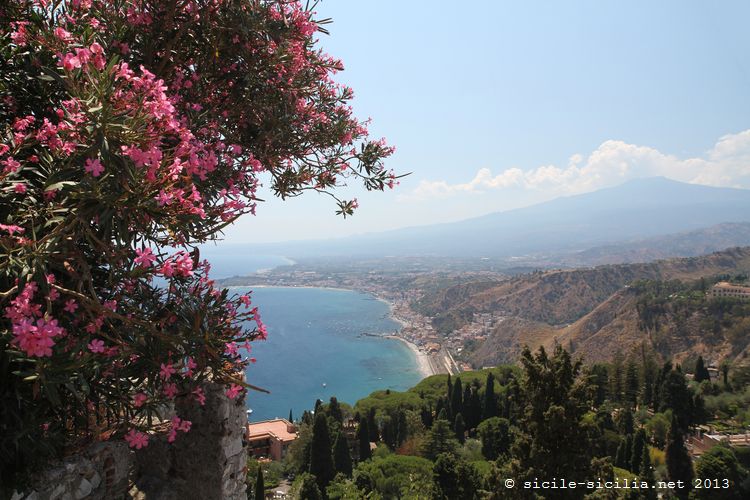
A charming tourist destination
Located in a magnificent setting, between sea and mountain, on a terrace overlooking the Mediterranean Sea from 200 metres above, and dominated by the majestic Etna volcano, Taormina is undoubtedly the most famous Sicilian seaside resort.
Thanks to its beauty and its heritage, Taormina was mentioned by Goethe in his Italian Journey (1787-88) and in the 19th century, during the era of the “grand tour of Italy”, it attracted many artists, writers, wealthy entrepreneurs, nobles and scholars.
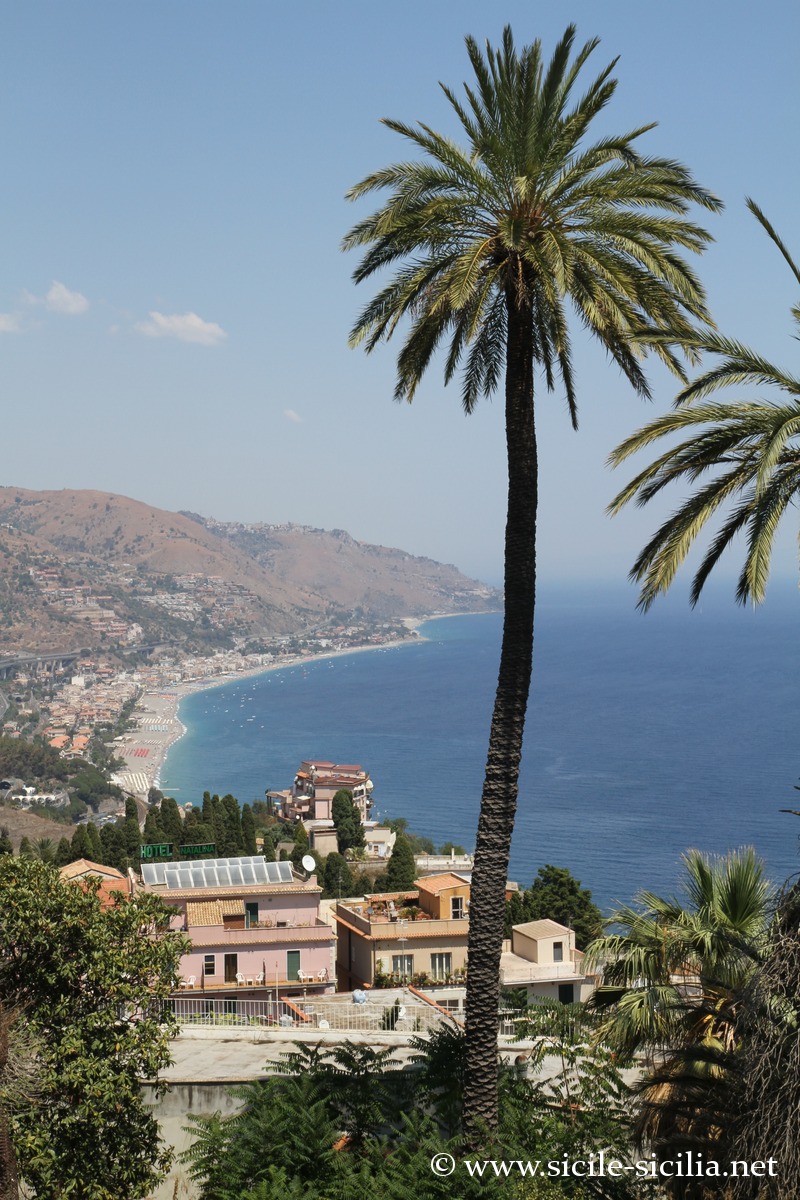
Panorama from Taormina
Very busy in summer, and not very affordable (high prices), it is somewhat the Sicilian Saint-Tropez, attracting the jet set and tourists. The peak of crowds occurs between May and September.
This town therefore does not resemble a typical village of the Sicilian inland, but it is nonetheless one of the most beautiful destinations in Italy with the charm of its medieval monuments, its Greek remains, its colours, its vegetation and its scents typical of the Mediterranean. International cultural events are also held there.
Heritage of Taormina
The historic centre of the town has several characterful narrow streets, where many old buildings house hotels and shops. Jewellery made from lava stone and typical Sicilian products such as Etna wines are traded there. Luxury shops are not to be outdone, with the most prestigious brands.
Its very beautiful Greek theatre (3rd century BC) has become the symbol of the town. It is the second largest in Sicily after Syracuse. Nestled among cypresses and prickly pears, it was carved into the rock by the Greeks and then remodelled by the Romans with a stage wall. Its setting is splendid, in a magnificent backdrop between the sea and Etna, where the view extends as far as Calabria.
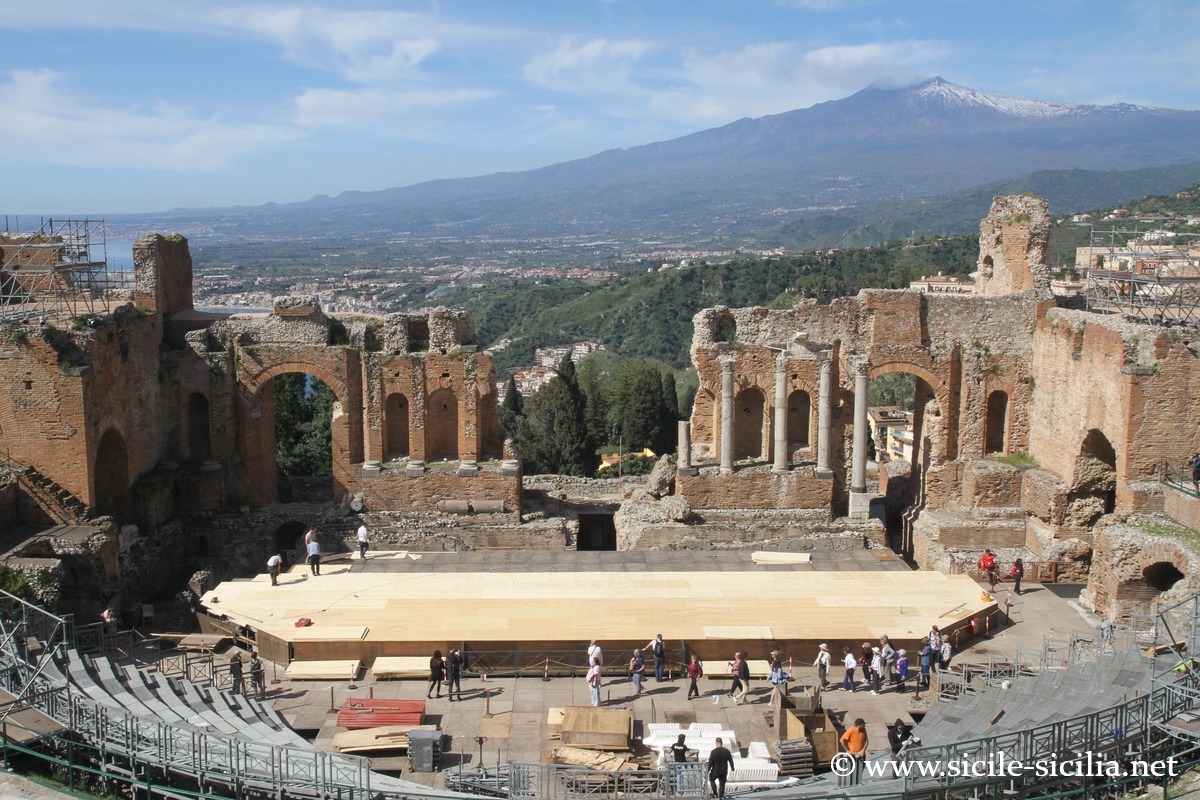
Roman theatre of Taormina
The town has kept its beautiful narrow streets and its Middle Ages palaces, an era when it was for a time the capital of Byzantine Sicily. Along with the ancient theatre, its most famous buildings include the cathedral, the Church of Saint Joseph, the odeon, the Palazzo Corvaja or the islet of Isola Bella with its beach.
In summer, beach tourism is found at Giardini-Naxos or on the beaches of Mazzarò (reachable from Taormina by cable car), Mazzeo or Lido Spisone. The latter turns into a nightclub in the evening. A magnificent small island in the bay of Taormina, Isola Bella is a protected natural area where there is also a beach. A strip of land, visible at low tide, connects it to the coast.
From June to August, shows are held in the Greek Theatre with Taormina Arte, whose programme offers music, theatre and dance. In June, the Taormina FilmFest is held, an important Italian film festival dating back to 1955.
→ See the page dedicated to the visit and monuments of Taormina including the tourist map of Taormina
What to see/do as a priority in Taormina
- Visit the Ancient Theatre of Taormina not only for its Hellenistic and Roman architecture but also for its unique panorama over Etna and the sea.
- Stroll along Corso Umberto I, the central pedestrian street filled with shops, cafés and terraces offering views over the medieval narrow streets. Enjoy Piazza IX Aprile, famous for its panoramic balconies and its clock “Torre dell’Orologio”.
- Go down (or take the cable car) to Mazzarò beach or the islet of Isola Bella for a moment of swimming in crystal-clear water and a protected natural setting.
- Attend a show or concert in the evening in the ancient theatre (during the summer season) to experience history and culture in a unique setting.
Gastronomy and Tradition in Taormina
Taormina, perched between Etna and the Ionian Sea, combines the riches of the Sicilian terroir: citrus fruits, olives, pistachios, fresh fish and volcanic wines. There you can taste, for example, lemon granita made with Sicilian lemons on a sunny terrace, or pasta alla norma, an emblematic dish combining aubergines, tomato and salted ricotta.
Do not miss the red or white Etna D.O.C. wine, produced on the slopes of the volcano, with unique mineral aromas. In the morning, local markets offer prickly pears, roasted almonds and the famous vino alla mandorla (almond wine) in some historic bars.
Every summer, the village vibrates to the rhythm of gastronomic and musical events, and the cafés overlooking the sea offer a typically Mediterranean atmosphere: gentleness, conviviality and panorama.
Visit ideas and tickets in Taormina
Where Taormina is located: map
If you see this after your page is loaded completely, leafletJS files are missing.
Practical tips for visiting Taormina and FAQ
- What is the best time to visit Taormina?
The months of April, May, late September and October are the most pleasant: temperatures are mild, accommodation is more affordable, and the narrow streets are less busy than in the height of summer. In July-August, the heat and the crowds are high, but the cultural offering is denser. - Access to Taormina
Taormina is served by the Catania–Messina railway line: the nearest station is Taormina-Giardini, located about 3 km from the centre (connections by bus or taxi). By car, it is reached via the A18 motorway (Taormina exit). Regional buses also connect the town to Catania, Giardini Naxos and Letojanni. - Parking
The Lumbi car park is the most convenient: it has many spaces, a free shuttle to the centre and is about a ten-minute walk from Porta Messina. The Porta Catania and Mazzarò car parks are closer but often full or expensive, especially in the summer season. - How to get to Isola Bella?
The island is accessible by cable car from the centre (departure near Porta Messina) to Mazzarò, then on foot in a few minutes. It is also possible to go down via a pedestrian path offering beautiful views over the bay (about 20 minutes). In summer, boat excursions allow you to approach the island from Giardini Naxos or the port of Mazzarò. - Where to stay in Taormina?
There are many accommodation options: panoramic hotels around Via Roma and Corso Umberto, guesthouses in the historic centre, and quieter establishments in Mazzarò or Letojanni. For a more authentic experience, some masserie (renovated old farms) in the hills offer a peaceful setting and beautiful views over Etna. - Where to eat local?
The trattorie in the centre serve regional specialities: pasta alla norma (with aubergines and salted ricotta), arancini, grilled fish, and pistachio or ricotta desserts. Vino alla mandorla (almond wine) is a local tradition served chilled at the end of the meal. For typical cuisine, favour family-run establishments outside Corso Umberto. - What are the main events in Taormina?
From June to August, the Taormina Arte festival brings concerts, dance and theatre to the Greek Theatre. Also in June, the Taormina FilmFest attracts many cinema personalities. At the end of summer, several religious festivals and craft markets bring the squares of the centre to life. - How much time should be allowed to visit Taormina?
One day allows you to discover the main sites: Greek theatre, Corso Umberto, cathedral, Isola Bella. To make the most of the beaches, museums and viewpoints, two to three days are ideal, especially if you wish to visit the surroundings (Giardini Naxos, Castelmola, or Etna).
Other information
External sites
- Municipality website: www.comune.taormina.me.it
- Wikipedia page
- Blogs and tourist sites: www.traveltaormina.com, viaggi.corriere.it/europa/italia/taormina
Comments in other languages
If you have the legs for it, walk up the stairs to the Madonna della Rocca, then to the old castle (the entrance fee is expensive for what there is to see: nothing apart from the view. In any case, everything is too expensive in Taormina). The staircase is fairly steep, but there are beautiful views, and the chapel half-carved into the rock is nice. Not too many tourists dare venture there either.
A practical point to know: access to the beaches from Taormina can become tedious in high season. The cable car linking the center to Mazzarò often has long queues, and the parking areas below fill up quickly. Many people prefer to go down in the morning when there is less of a crowd to head to the beaches, or they use the local buses, which are fairly frequent.
Also worth noting: Isola Bella is a nature reserve, with paid access and regulated protected areas.