
Driving in Sicily
Driving in Sicily is of course one of the most practical ways to visit the island, as many sites are difficult to reach otherwise.
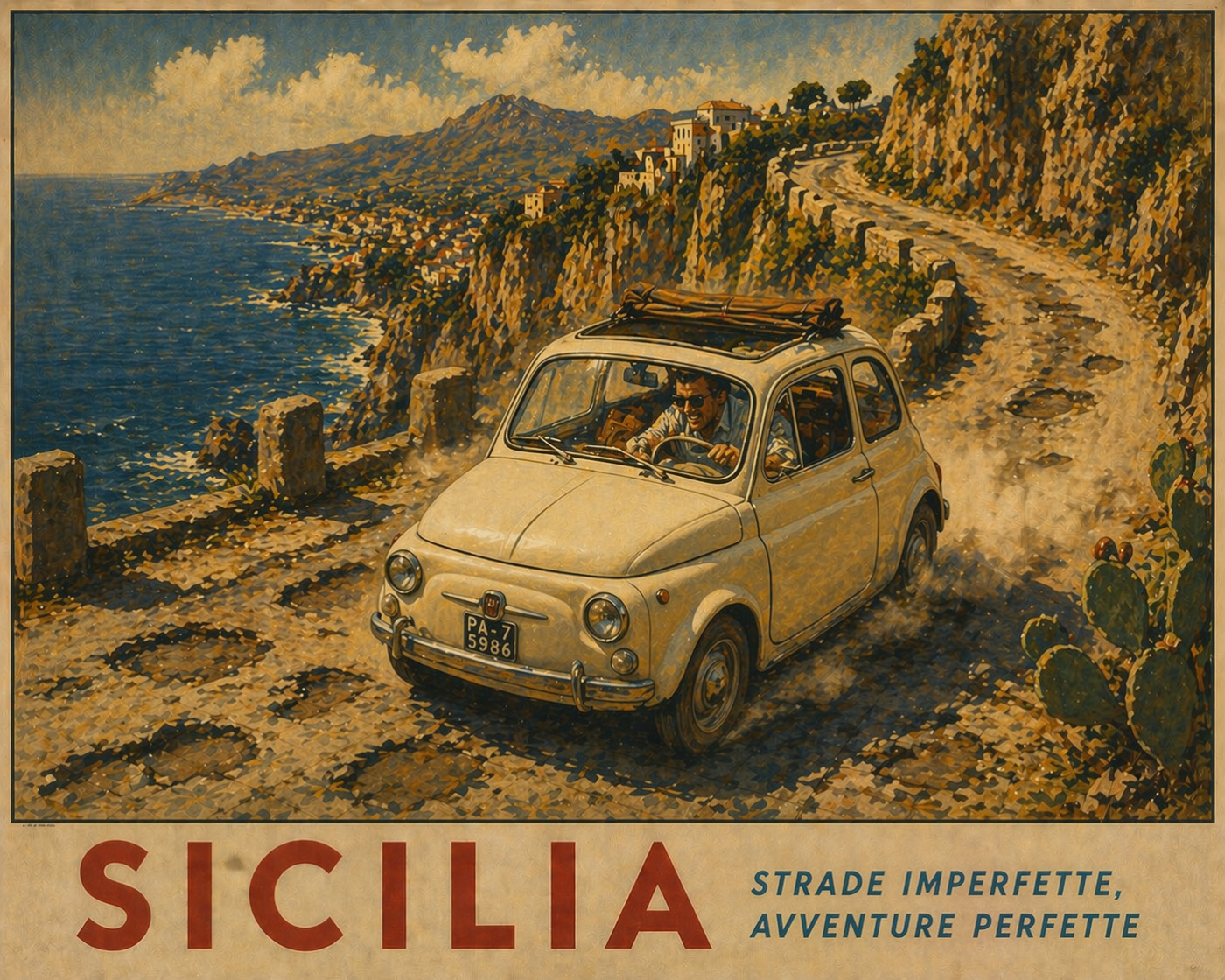
However, if you have no experience of driving in southern Italy or a similar country in Africa or the Middle East, it is better to arm yourself with caution and understanding, as the rules are not always very clear or respected, signage is sometimes sparse, and some secondary roads are almost abandoned, sometimes with potholes that could be renamed “wild boar holes”.
General driving conditions in Italy
 In Italy, road signage follows the following standardized color code: motorways (autostrade) are indicated in green, main national (SS) and regional (SR) roads in blue, and urban and local signage in white.
Most motorways are toll roads, with a toll system (entry and/or exit), automated in 98% of cases, where generally the toll lanes are indicated with yellow signs, those dedicated to bank cards are designated by blue signs, and those accepting cash (and bank cards in most cases) with white signs.
The historic centers of many cities include restricted traffic zones, called Zona a Traffico Limitato (ZTL), whose access is regulated by schedules and reserved for certain categories of vehicles. These zones are monitored by automated cameras with plate reading, resulting in fines in the event of an infraction.
Parking is also regulated by a color code: white lines (free or regulated with a time limit), blue (paid), yellow (reserved). It is not uncommon to encounter double-parking, or sometimes drivers leave their numbers or addresses to warn them. This phenomenon, partly understandable given parking problems, often generates long minutes of honking.
Very heterogeneous Sicilian roads
The main roads (SS and motorways especially) are properly maintained, but the secondary and rural network is much less so, with signs sometimes absent or barely visible, huge potholes, stones, etc.
The condition is worse following bad weather, where mud and rain can worsen the situation and stagnate.
During the day, it is enough to be careful and drive at a moderate speed, but at night, rural secondary roads become dangerous, as holes in the road surface are more difficult to spot.
On the secondary network, the average speed often hovers around 40 km/h.
You should use navigation systems like Google Maps with caution, for several reasons. First of all, suggested alternative routes (especially shorter ones) may use official but unpaved roads or roads in a condition barely passable for a standard vehicle, or even closed, particularly in rural or mountainous areas. In general, it is advisable to follow the route indicated by road signage if it is present.
Other typical navigator errors are suggested routes using one-way streets the wrong way in city centers, these areas being complex with a multitude of alleys, restricted traffic zones depending on schedules (ZTL), perhaps also because conditions change regularly or according to roadworks. In this case too, you must first follow road signage to find your way.
Customs and habits
Driving is a bit anarchic in Sicily, with the main rule being avoiding collision, official rules taking a back seat.
Some Sicilian drivers drive at excessive speed, probably due to bladders that are too small or capricious, or due to other emergencies. On the other hand, elderly people behind the wheel are frequent.
You must be careful in Italian service stations. Because in the absence of signage imposing a direction of traffic (which is often the case), vehicles can enter and drive in different directions, entering from one end or the other of the station.
However, this practice, frequent especially in southern Italy, relies on tolerance and not on an explicit rule of the highway code, and it engages the driver’s responsibility in the event of a dangerous maneuver or accident. It is always better to use the implicit direction even if it is not clearly indicated.