
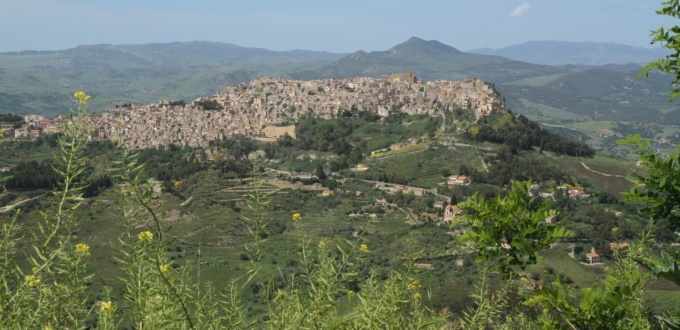
The heritage of the city of Enna is mainly concentrated along the Via Roma which crosses the historic centre for almost 2 km, from the Tower of Frederick II near the sanctuary of Papardura and Piazza Neglia to the Castle of Lombardy and the Rocca di Cerere, passing through the cathedral and other beautiful churches.
Visit of the historic centre
→ See also below the tourist map of Enna
Castle of Lombardy
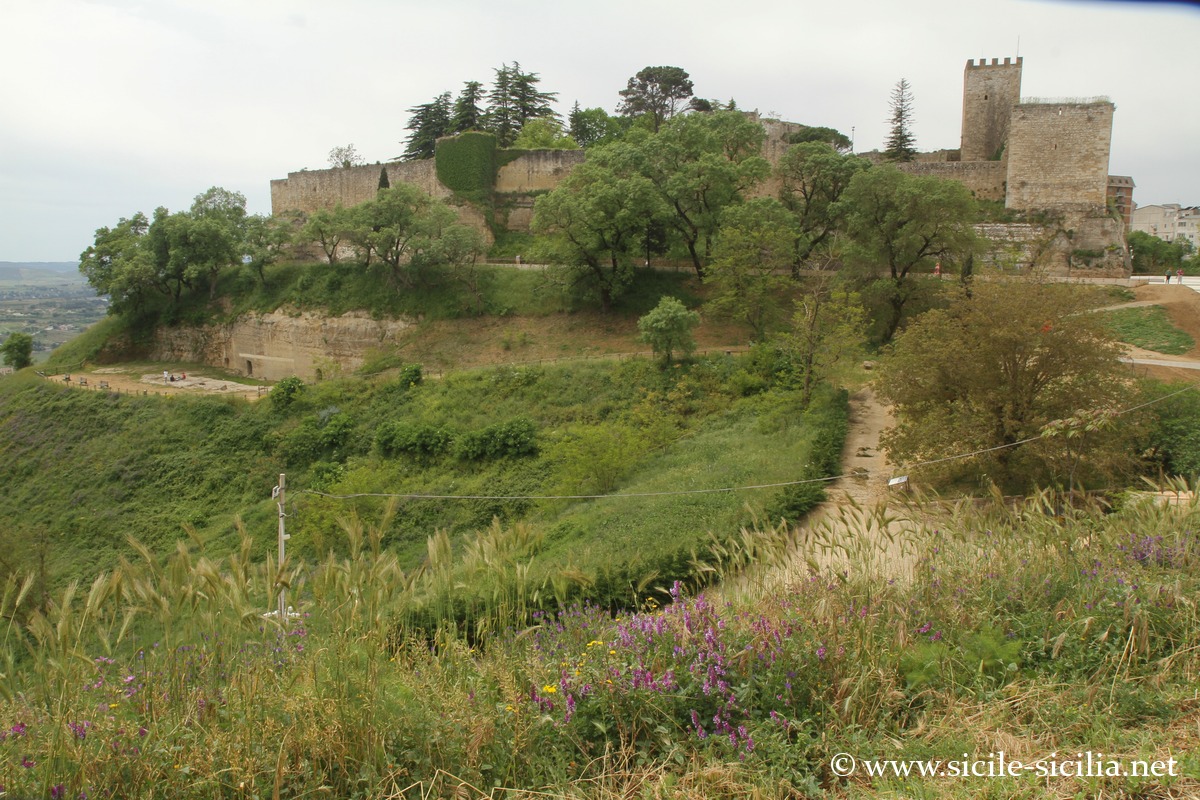
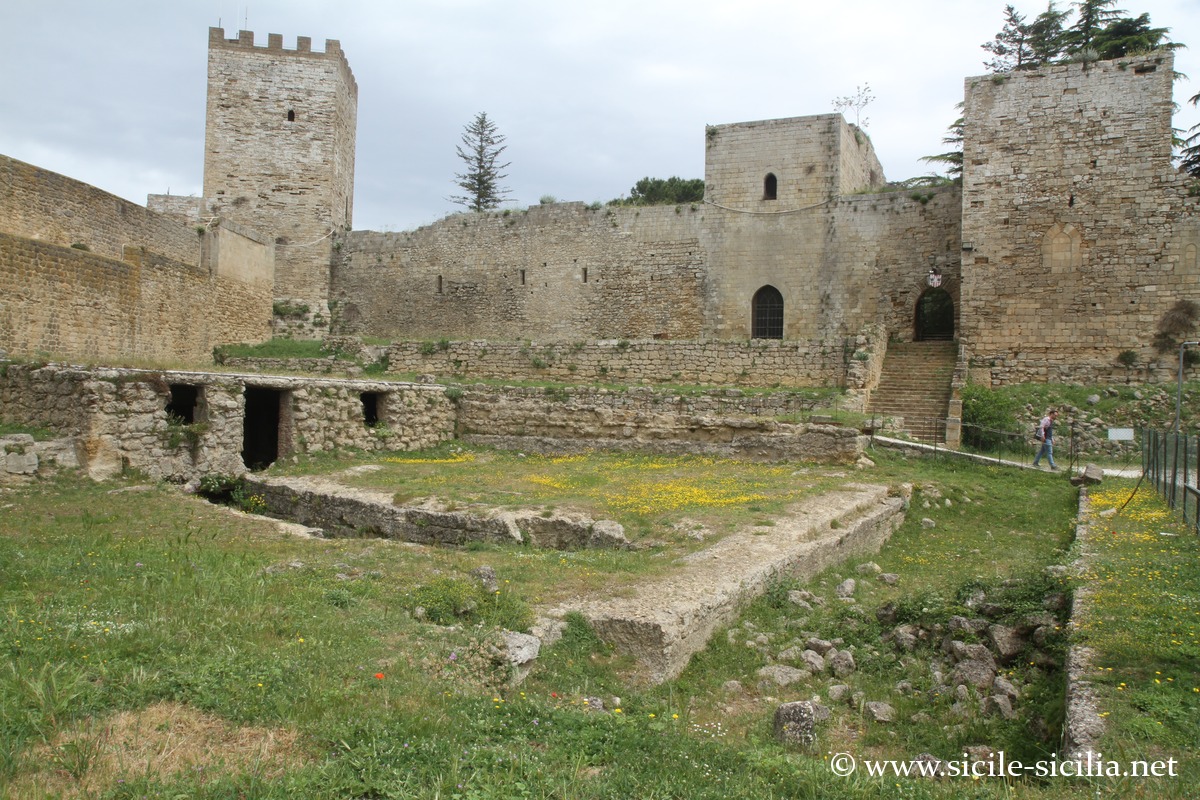
East of the historic centre, the Castle of Lombardy (Castello di Lombardia in Italian) is the most emblematic building in Enna, and one of the largest medieval castles in Italy. It stands towards the tip of the promontory, on the site where already in the 5th century BCE stood an important and highly venerated temple dedicated to Ceres, of which almost nothing remains. The disuse of the latter began even with the Romans, who stole an image of the goddess in 173 BCE.
The Byzantines built a fort, which long resisted the Arabs before giving way. The latter erected a true fortress there, which was subsequently embellished by the Normans of Roger II in the 12th century. Its name comes from that era, when it was neighbouring a Lombard colony.
The Swabians of Frederick II enlarged it, building 20 towers of which the only one entirely preserved is the Torre Pisana (along with five other towers). The latter is said to owe its name to the Pisan garrison to whom the Normans had entrusted its guard. A staircase leads to the top.
At the foot of the castle, the statue of Eunus erected in the 1960s commemorates the Syrian slave who in 132 BCE initiated the First Servile War, a slave revolt against the Romans.
Cultural events are organised there, notably concerts in the castle courtyard in summer.
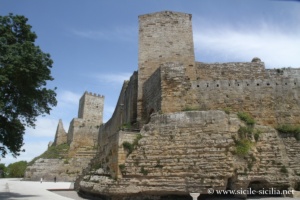
Castle of Lombardy 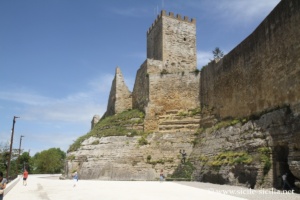
Castle of Lombardy 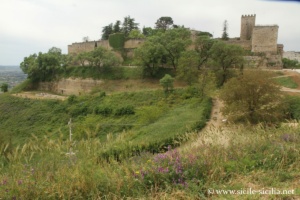
Castle of Lombardy 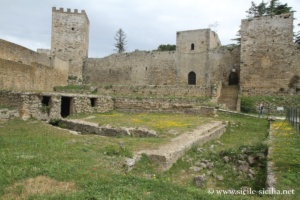
Castle of Lombardy 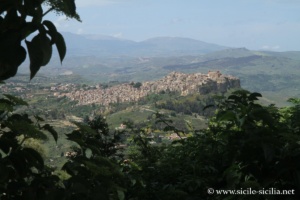

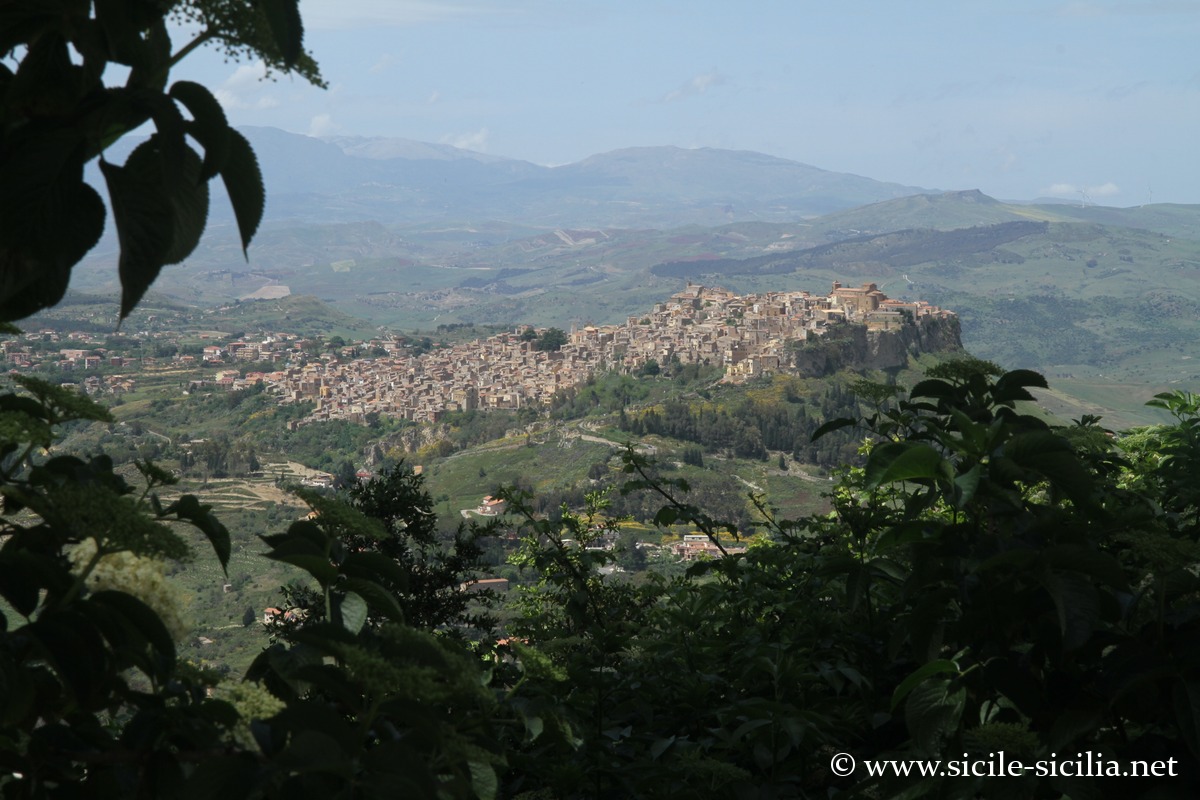
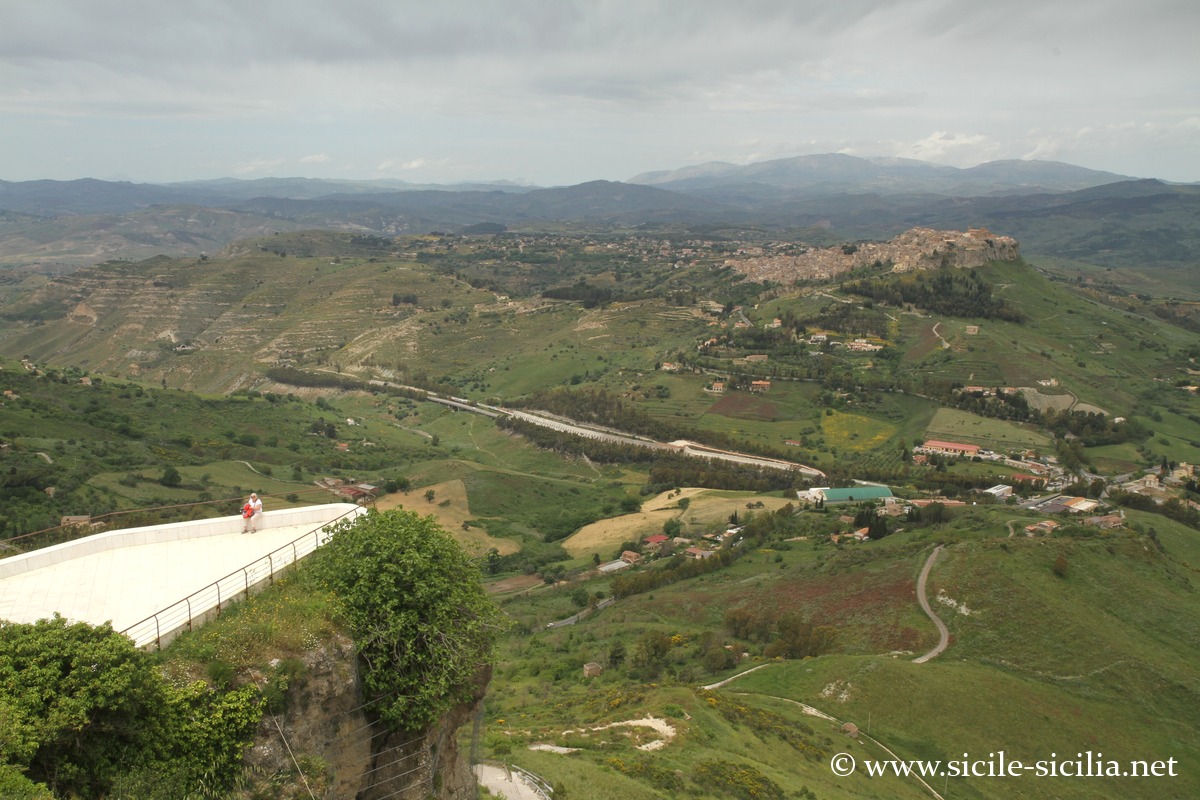
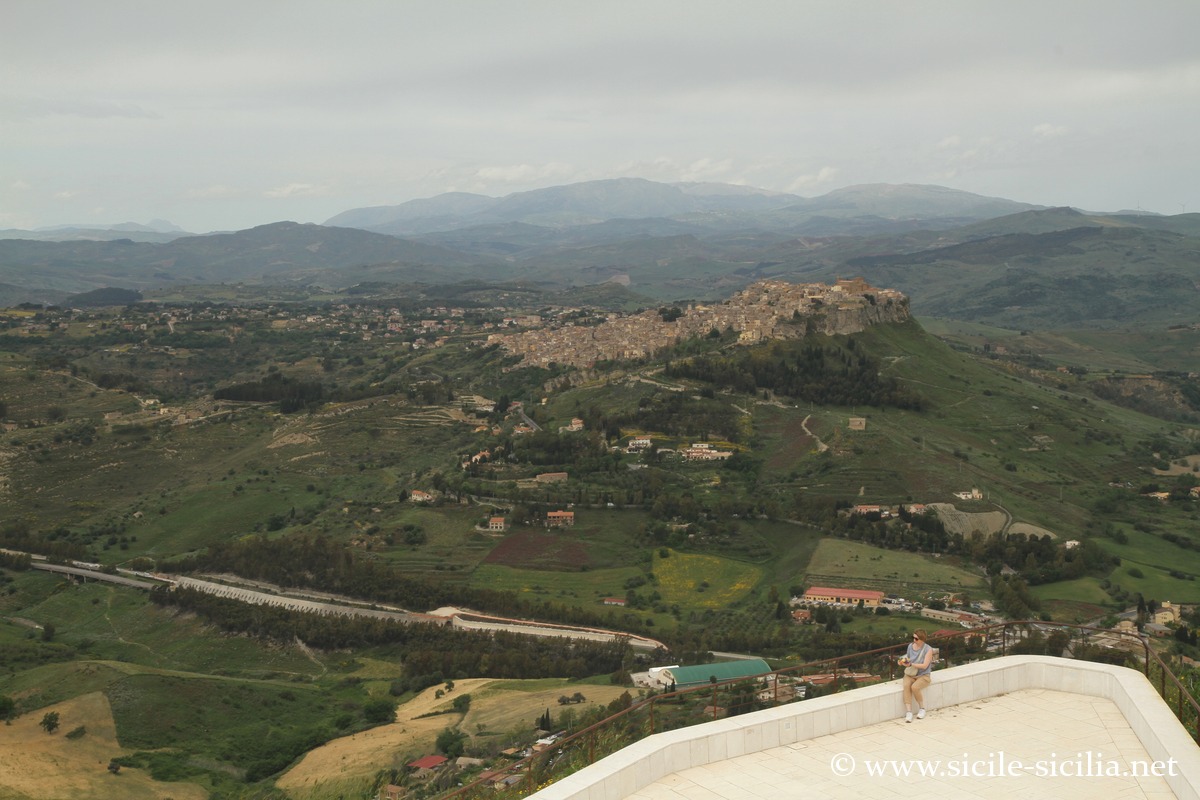
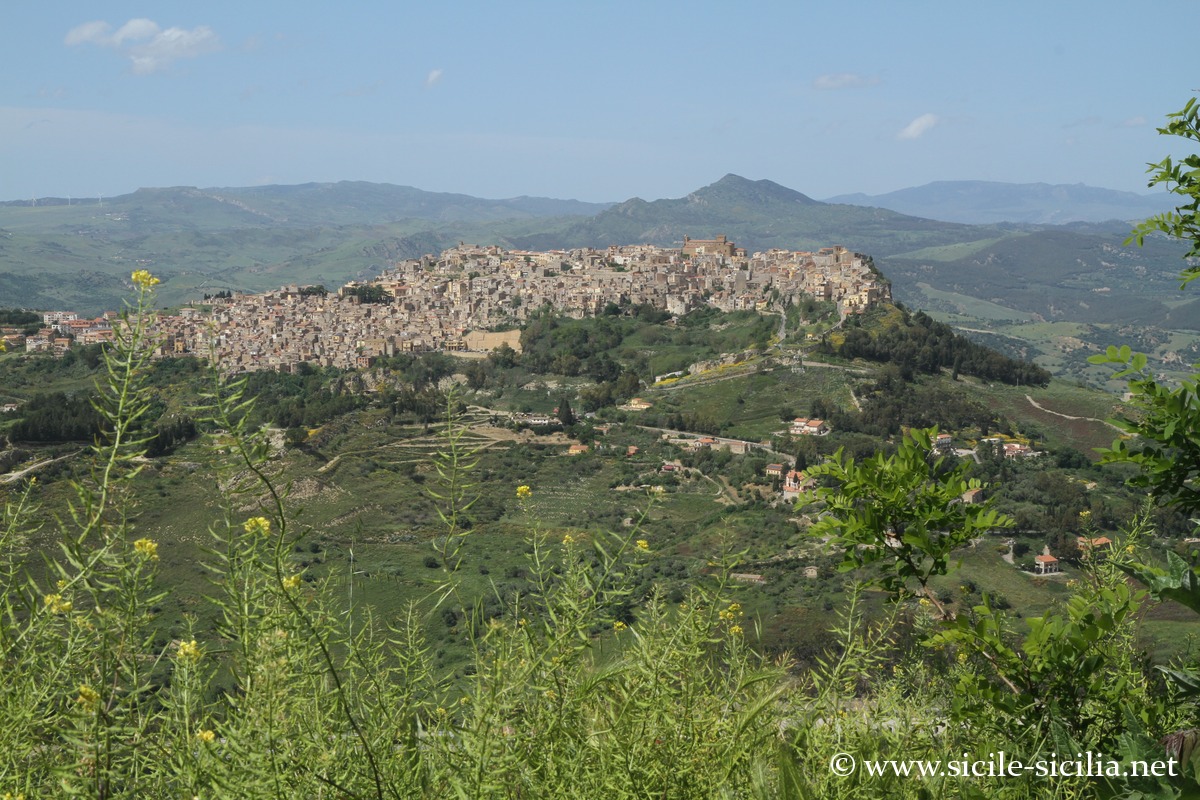
Panorama towards Calascibetta
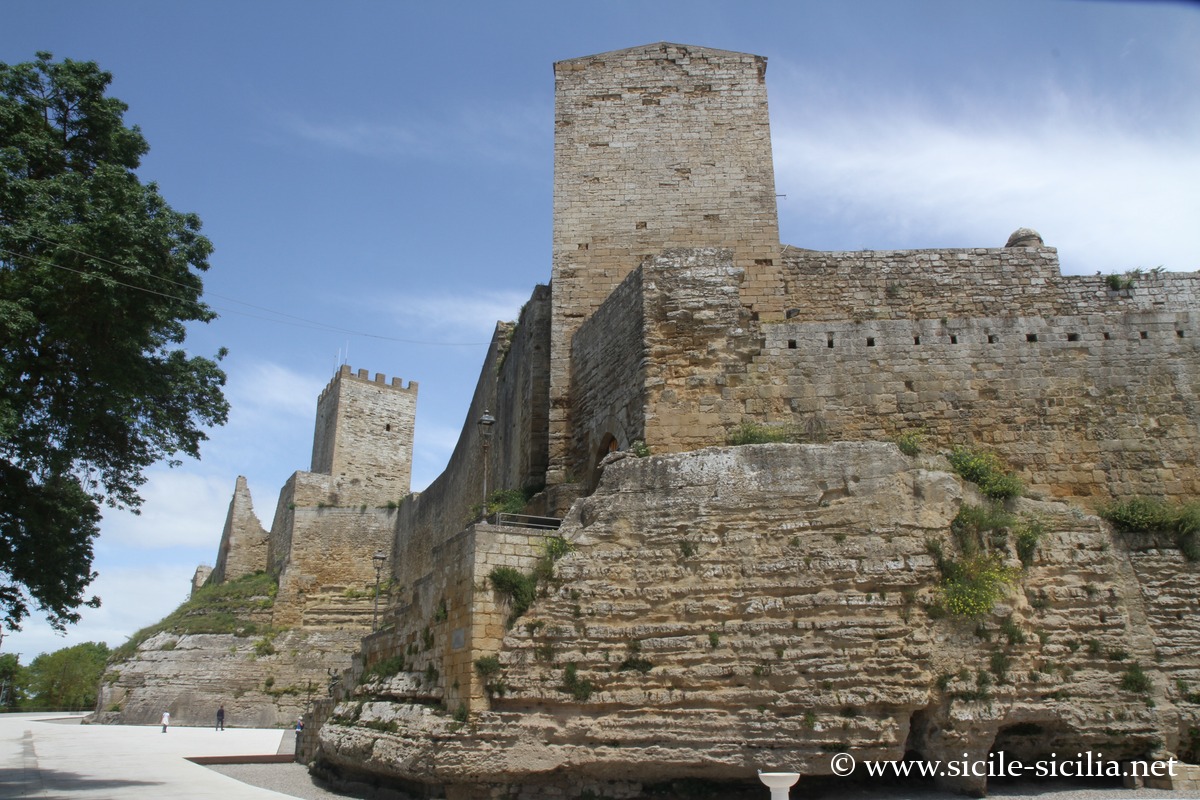
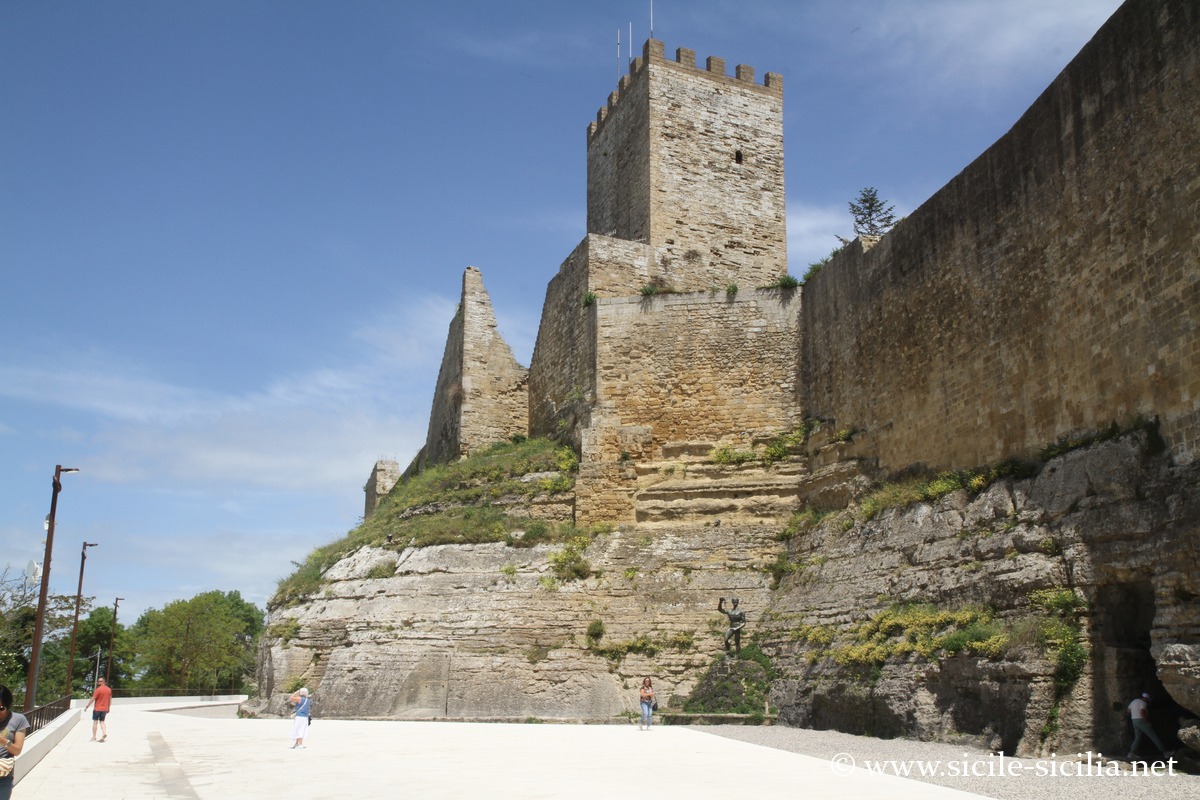
Rocca di Cerere
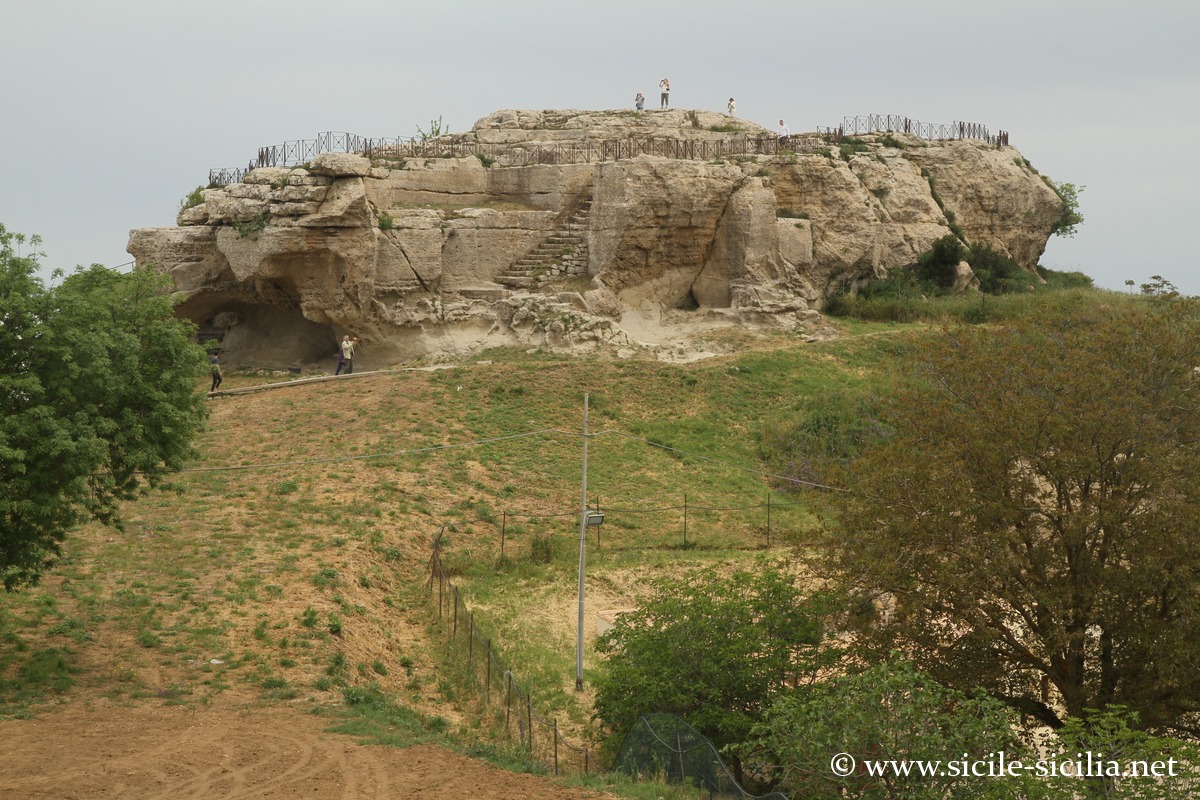
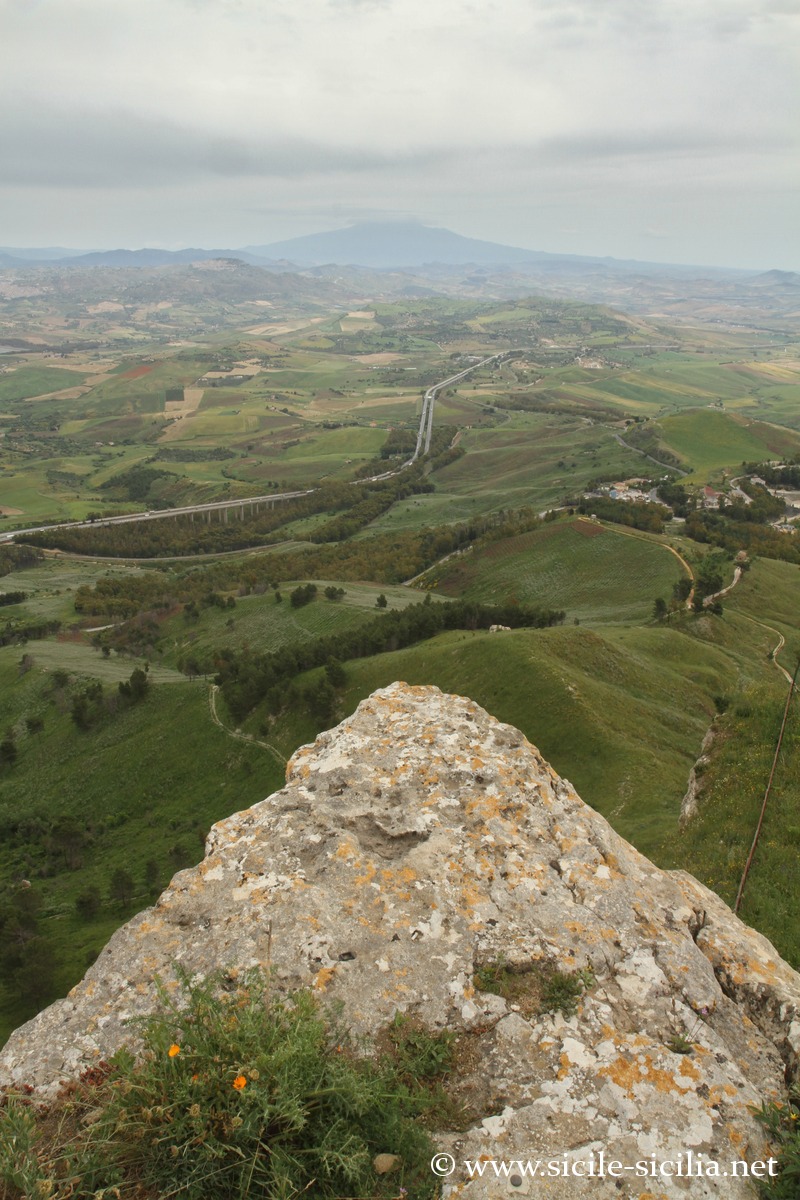
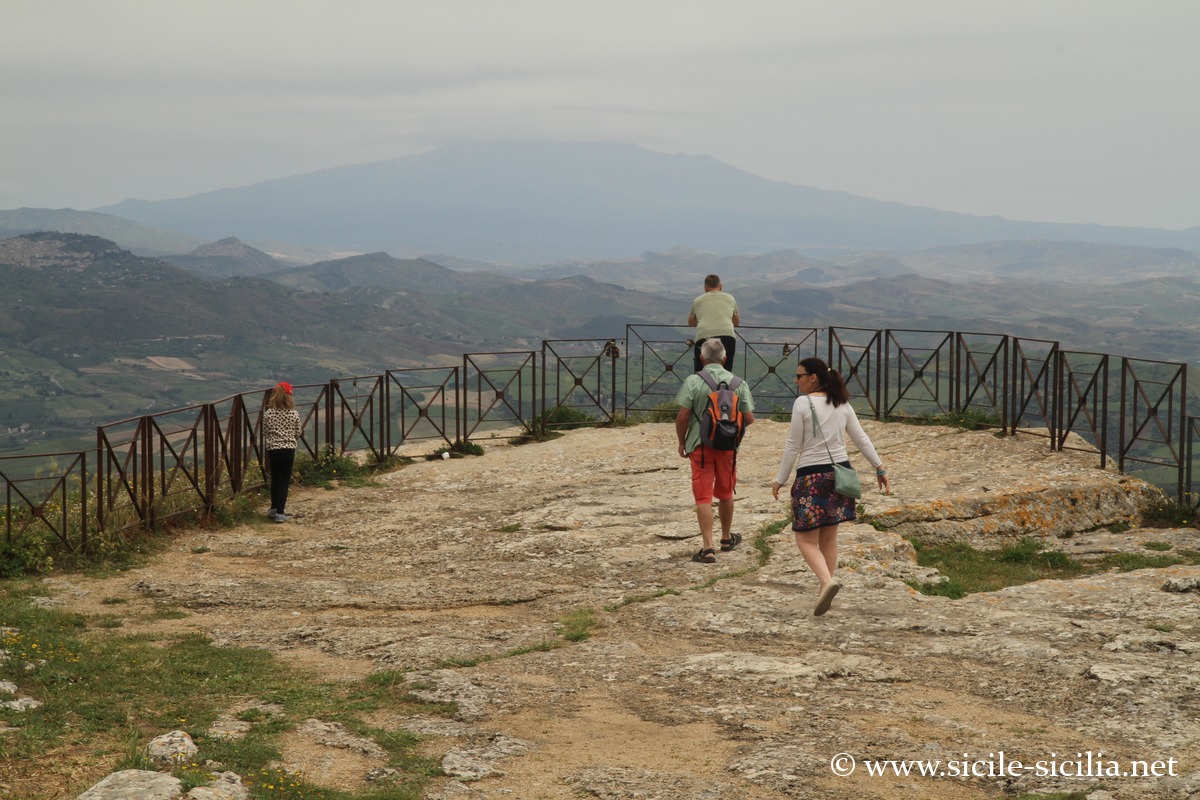
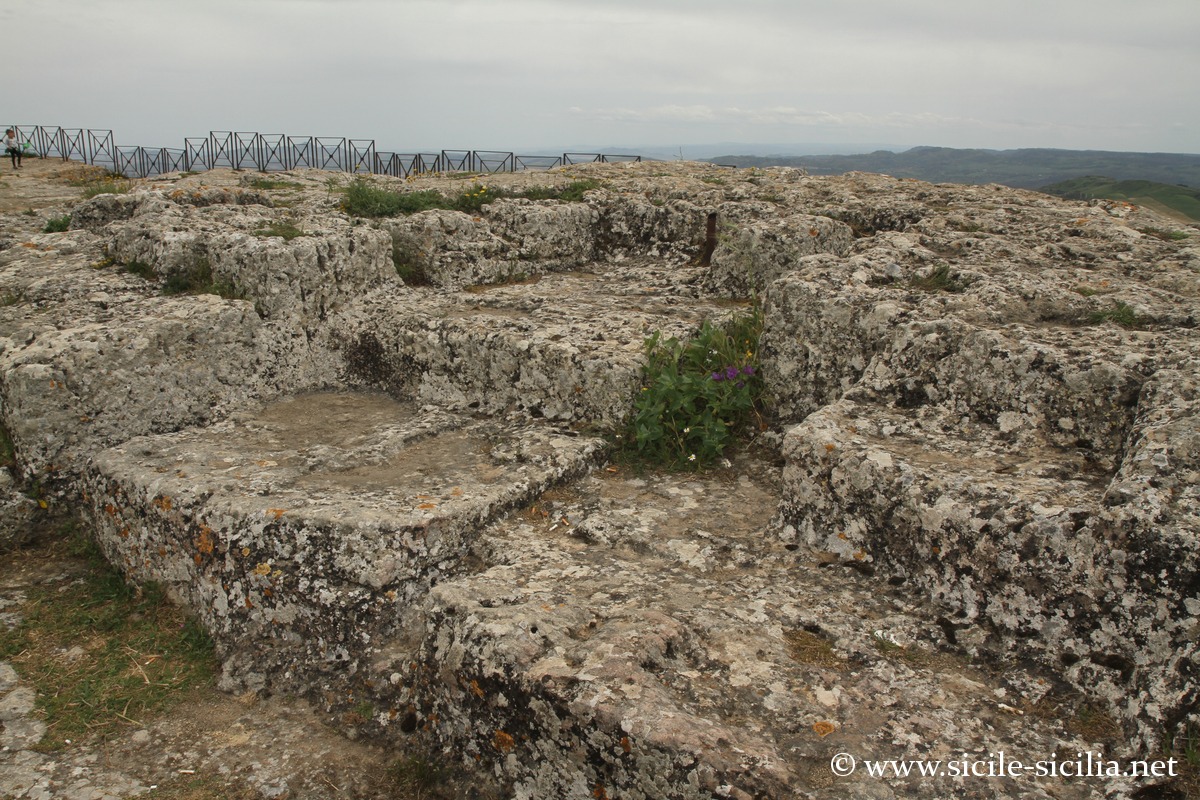
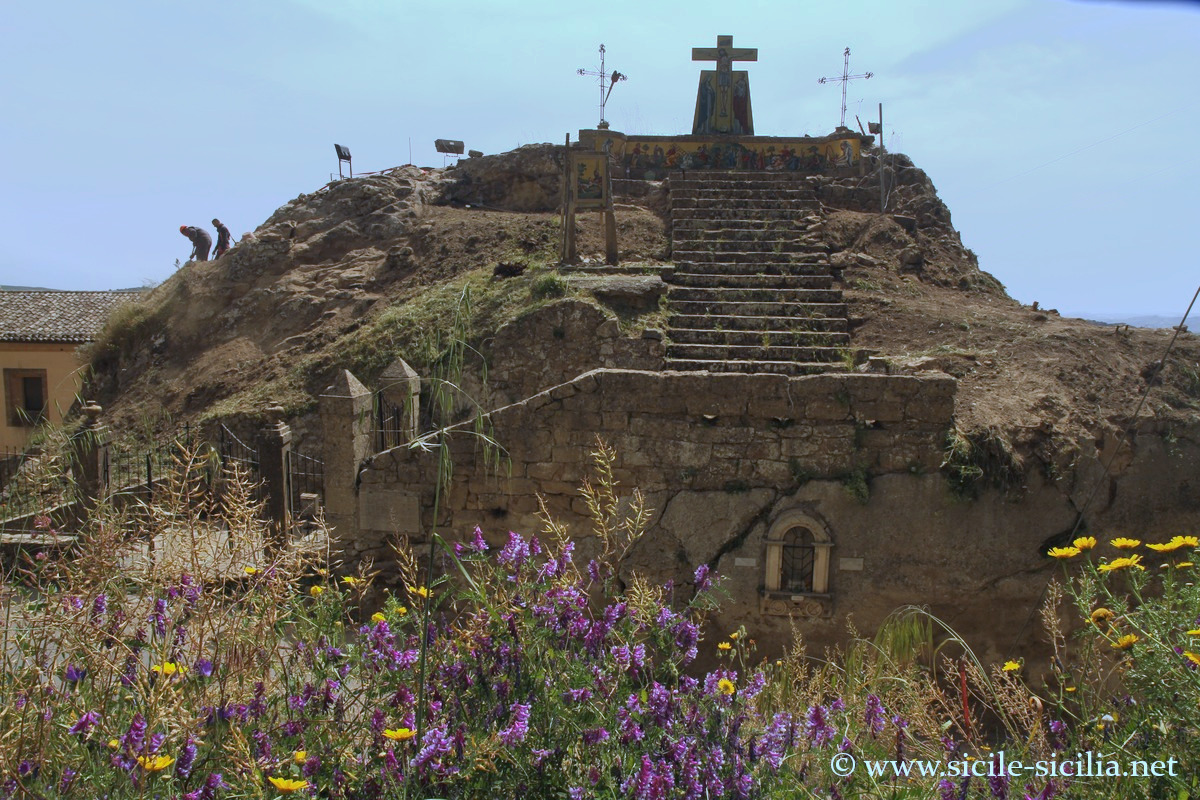
Below the castle, the Rocca di Cerere (the Rock of Ceres in English) is the end of the rocky spur, offering a magnificent panorama over Sicily, from Etna to the Madonie mountains, and the surrounding lakes. This place was part of the ancient sanctuary dedicated to Demeter, where a sacrificial altar and a few traces remain.
There also remain hypogea (caves carved into the rock), bell-shaped cisterns from the Greek period and late funerary deposits.
Rock of Ceres 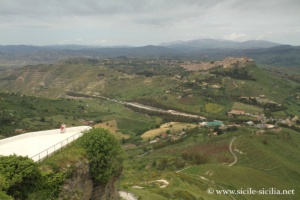
Panorama from the Rock of Ceres 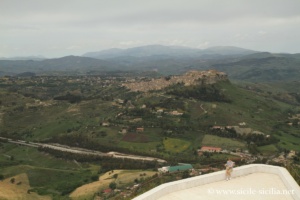
Panorama from the Rock of Ceres 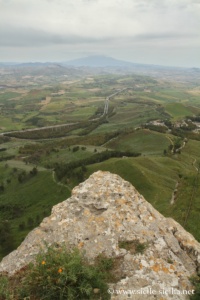

Panorama from the Rock of Ceres 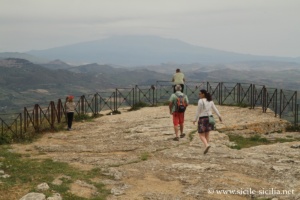
Terrace of the Rock of Ceres 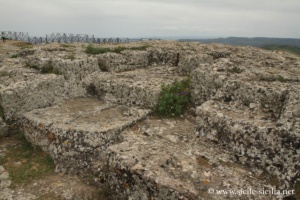
Rock of Ceres
Cathedral of Enna
In the historic centre of Enna, the cathedral of Santa Maria Assunta stands out, dating from the 14th century and built at the request of Queen Eleanor of Anjou in 1307, wife of Frederick II of Aragon, on the remains of an ancient church itself built on the remains of a Roman temple dedicated to Proserpina.
It was rebuilt after a fire in 1446 that devastated part of the naves and the roof. To finance the reconstruction, a seven-year jubilee was granted by Pope Eugene IV. A walled-up “Holy Door” on the transept commemorates this event. The bell tower of the reconstruction collapsed in 1619, and the new one was never completed. The roof of the transept was redone in 1659.
This medieval construction was later renovated in a Baroque style. Only parts of the original Gothic structure remain (notably the external apse and a side apse).
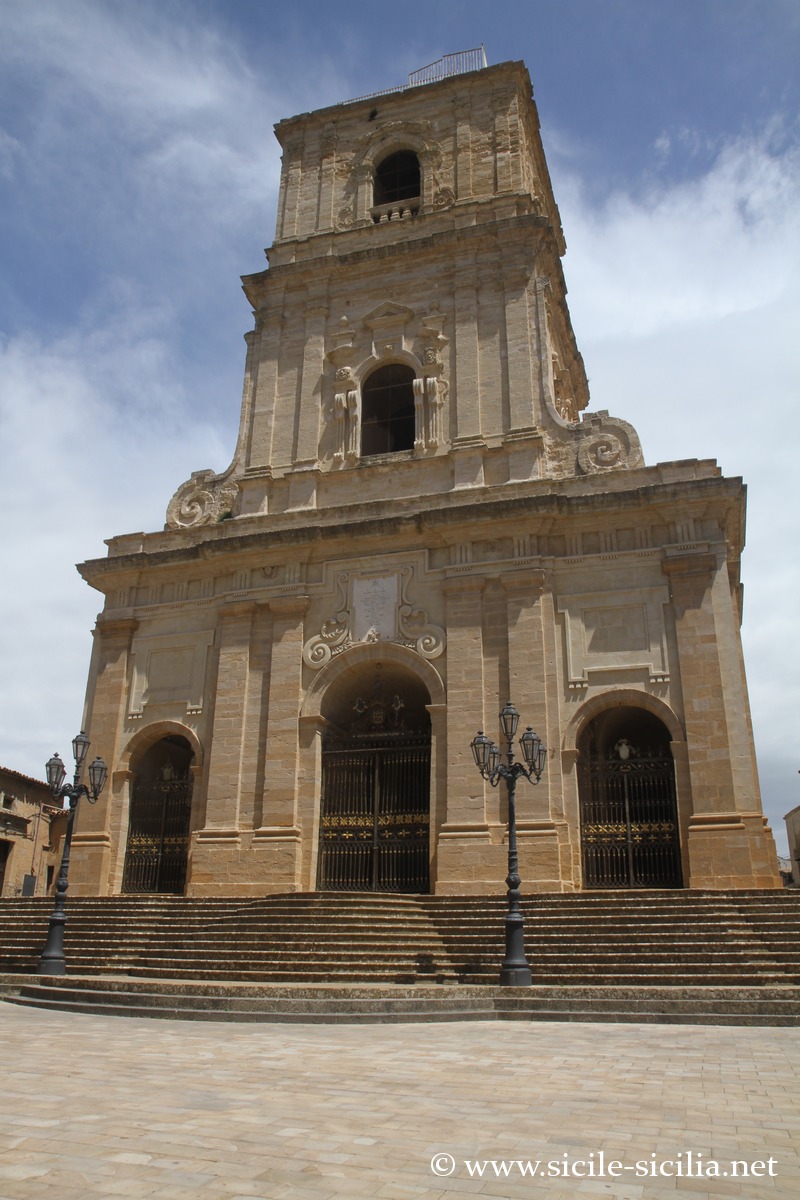
Cathedral of Enna 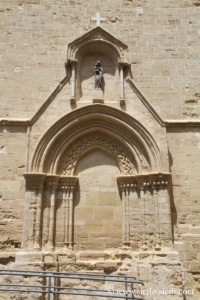
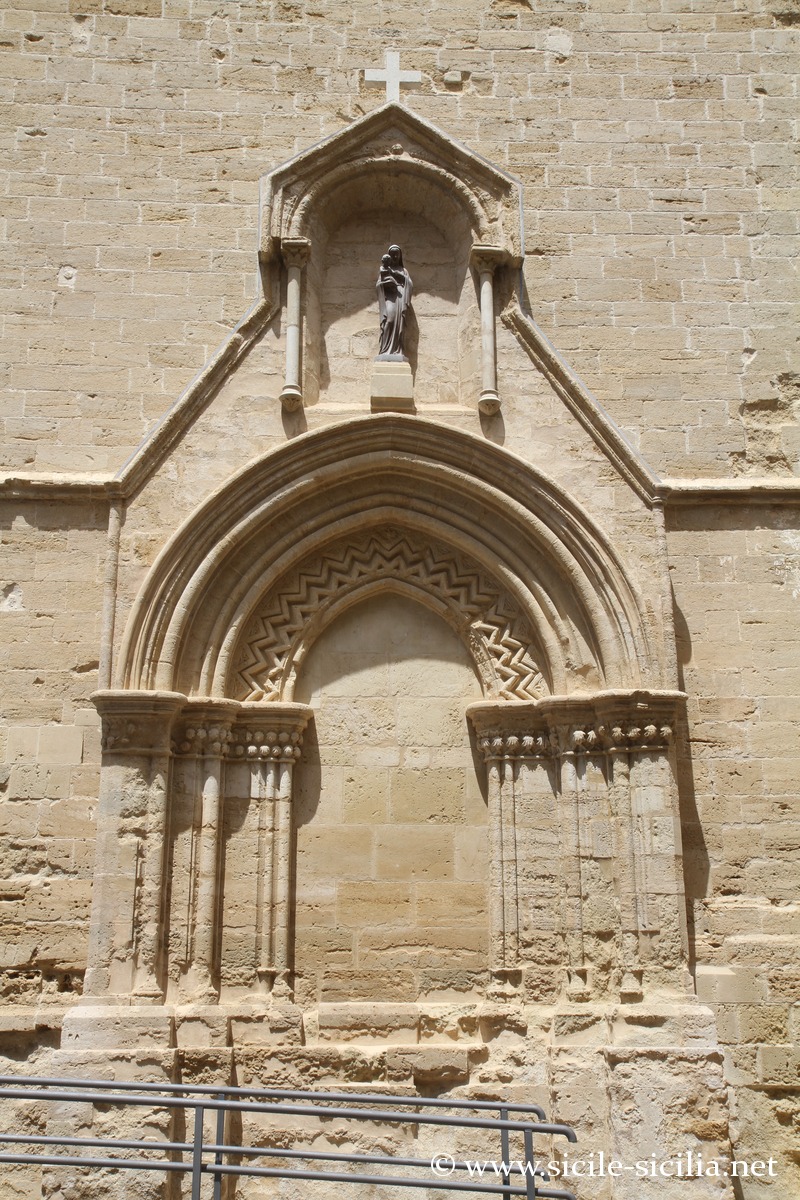
Jubilee Door 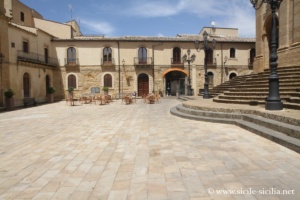
Piazza Duomo
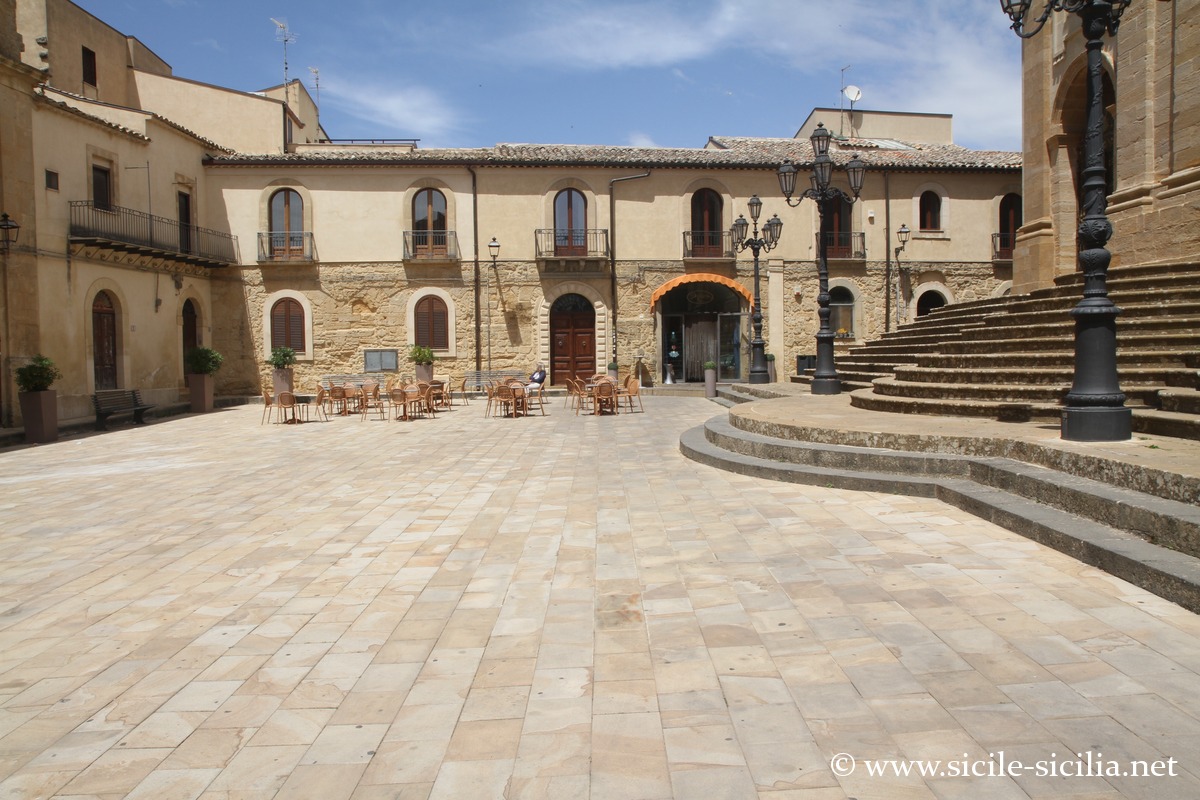
Architecture and exterior
Preceded by a monumental 18th-century staircase on the small Piazza Duomo, the cathedral has a basilical plan with three naves and a transept, originally built in 1307. A few Gothic windows remain, often with pointed arches.
Its facade, remodelled with Baroque elements, retains a massive and sober appearance.
The Porta Sottana (low door) on the south facade dates from 1447 and features a marble bas-relief depicting Saint Martin sharing his cloak. The Porta del Giubileo (or Holy Door) of the Cathedral of Enna, now walled up, was erected after the fire of 1446 to mark the jubilee granted by Pope Eugene IV. This Gothic door is surmounted by a statue of the Virgin and Child.
The main bell tower, unfinished, rises but remains lower than planned due to unstable foundations. It houses a bronze bell weighing about 10,100 kg, dating from the 17th century.
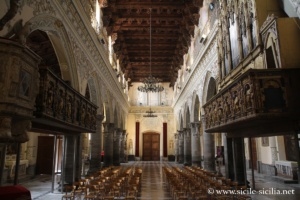
Central nave, Enna Cathedral 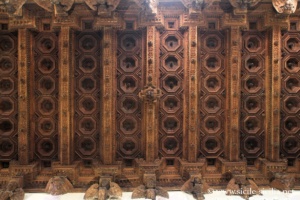
Wooden ceiling, Enna Cathedral 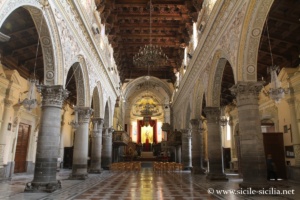
Central nave, Enna Cathedral
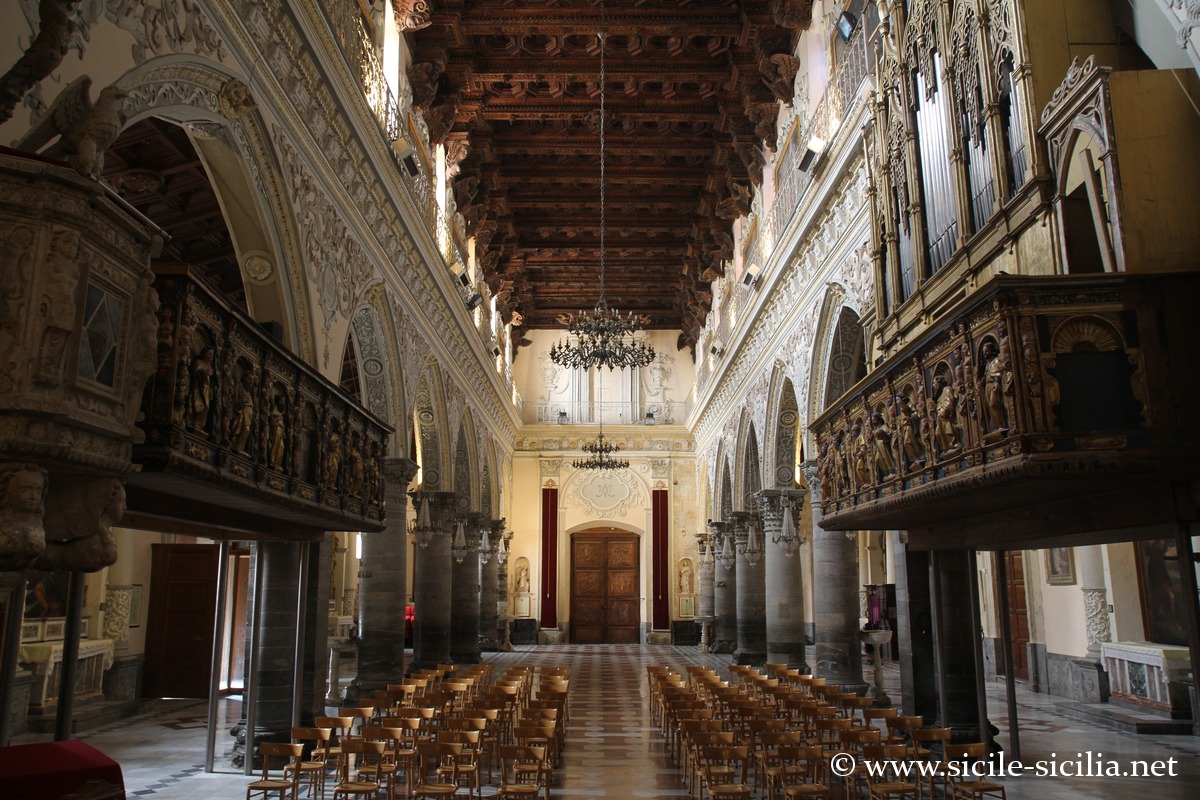
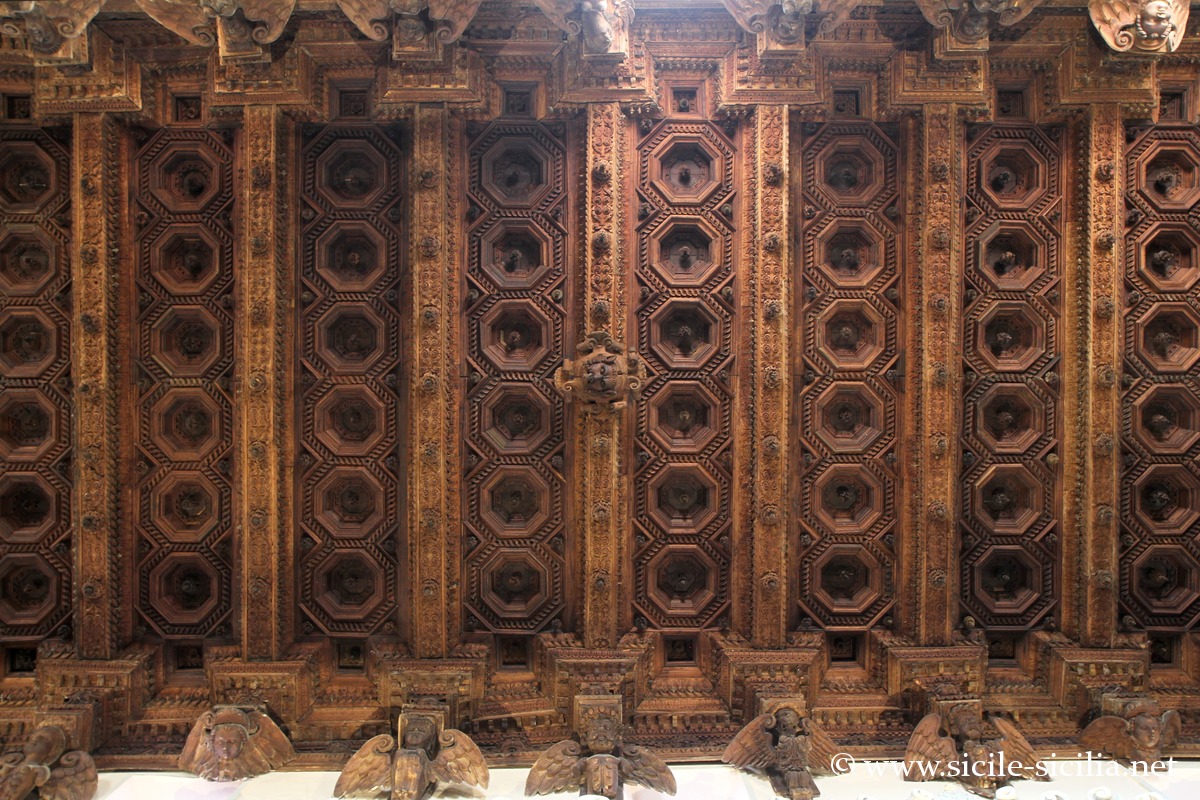
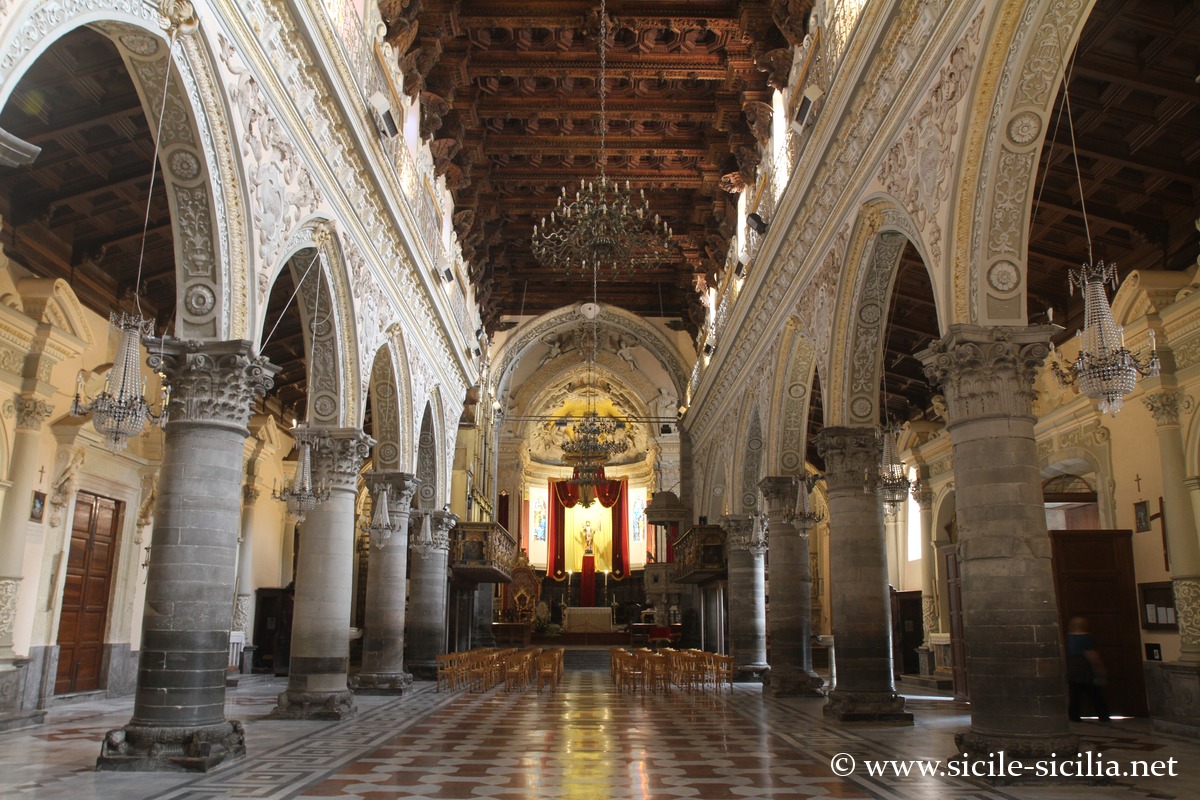
Interior of the cathedral
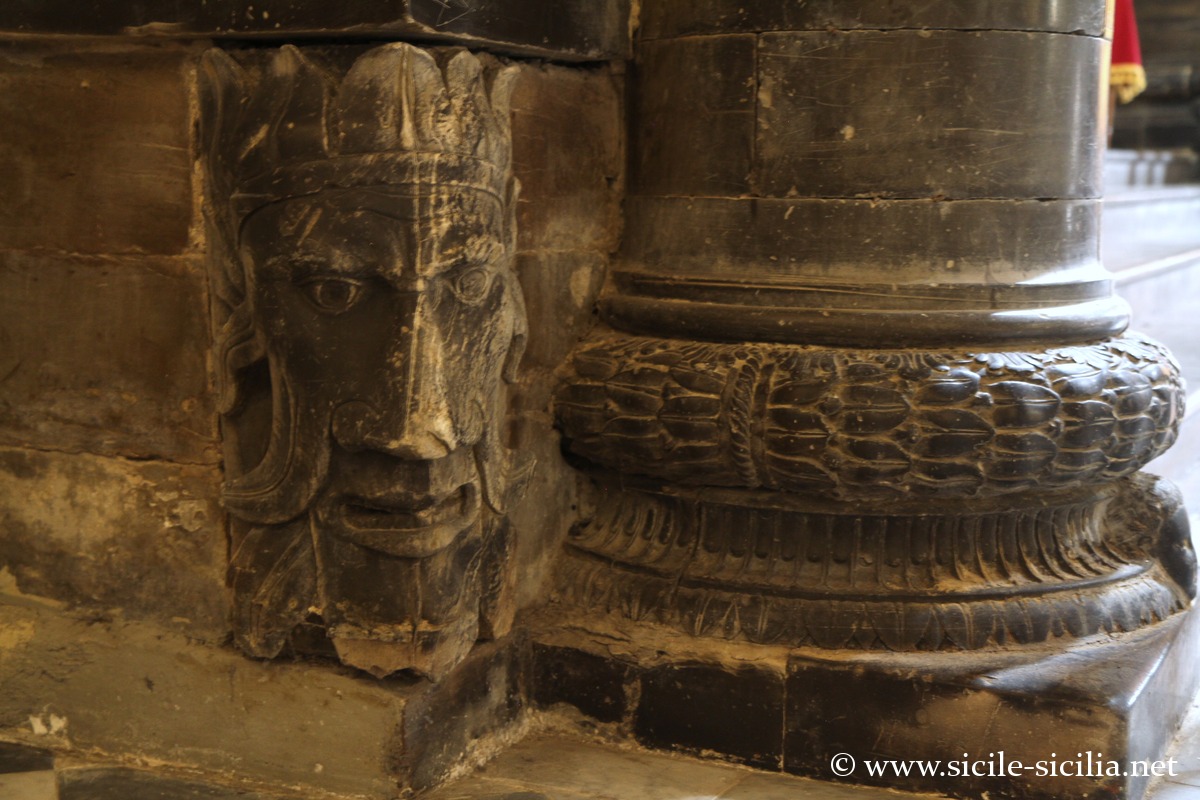
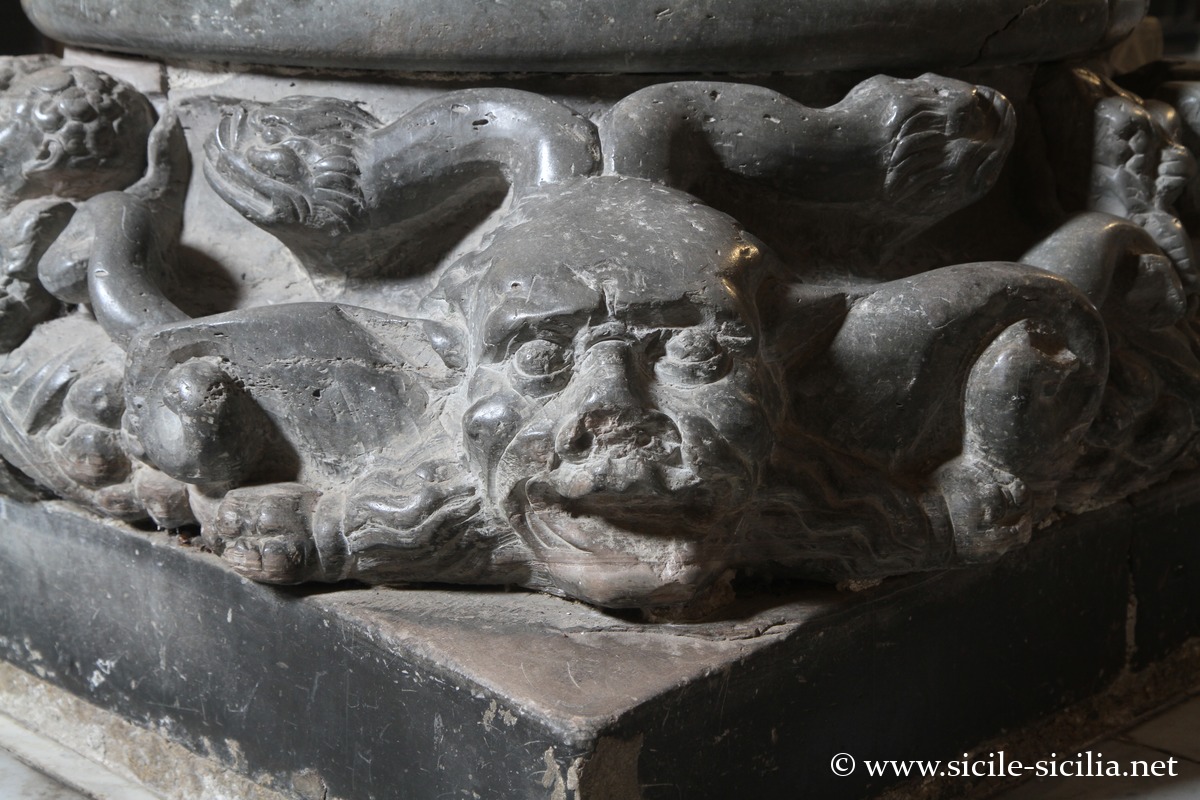
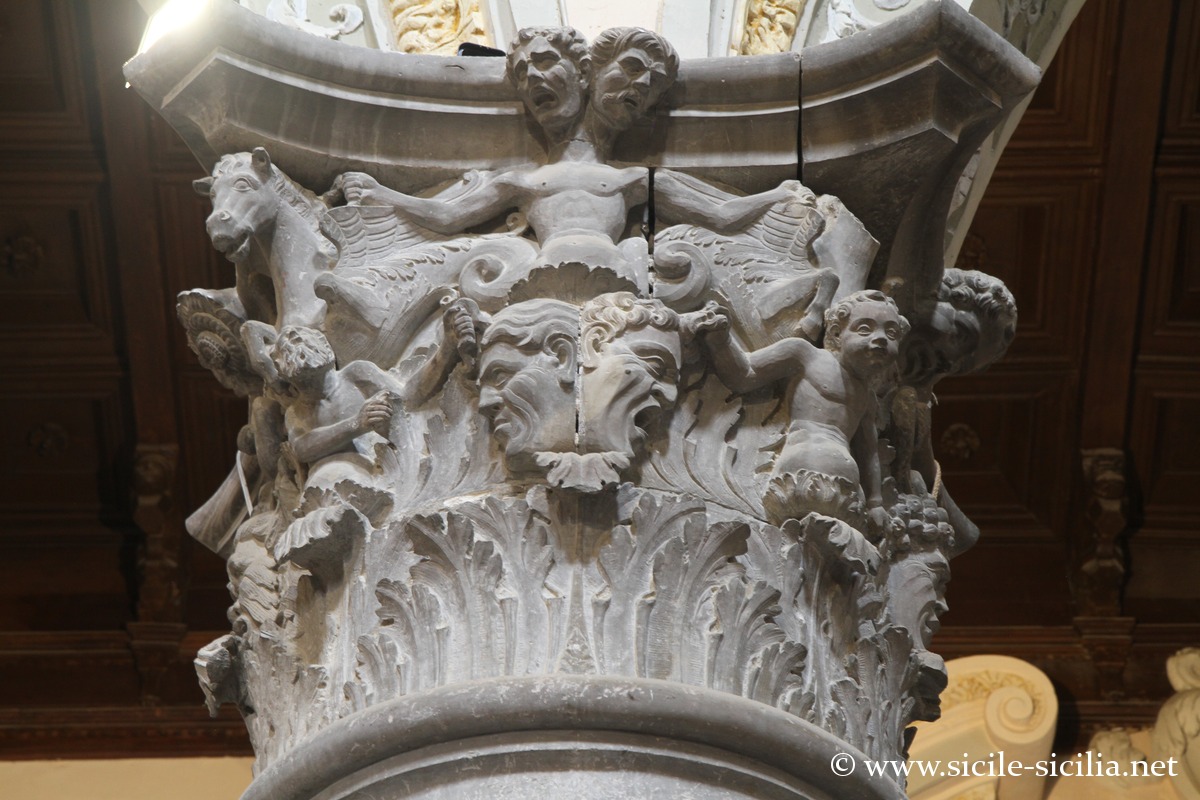
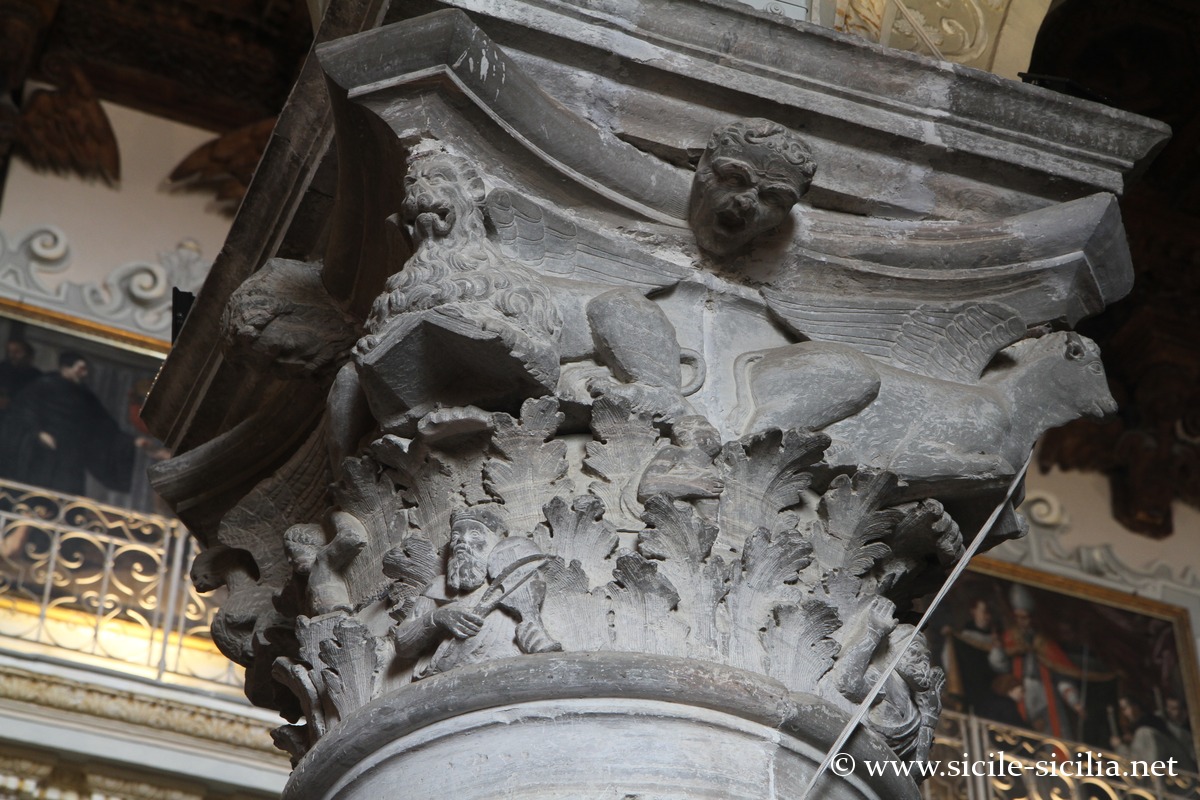
The naves feature powerful and beautiful columns with Corinthian capitals, some of whose column bases are in grey basalt with grotesque motifs (serpents, grotesque figures), probably from the ancient temple of Demeter. The capitals sculpted by Gian Domenico Gagini date from the 16th century.
The very beautiful coffered wooden ceiling was made by Andrea Russo da Collesano between 1602 and 1615.
The wooden choir stalls, placed on either side of the triumphal arch, are the work of Scipione di Guido, made in the 17th century.
The transept is decorated with stuccoes designed by Vincenzo Trimoglie (with Giovan Calogero Calamaro) and paintings by Vincenzo Ruggeri, made in the 17th century.
The central apse is richly decorated with Baroque stuccoes made by Pietro Rosso da Bologna in the 17th century.
The five large canvases by Filippo Paladini, depicting the Presentation of Mary in the Temple, the Immaculate Conception, the Visitation to Elizabeth, the Presentation of Jesus and the Assumption, were painted around 1590–1600. The wooden crucifix is probably from the 16th century.
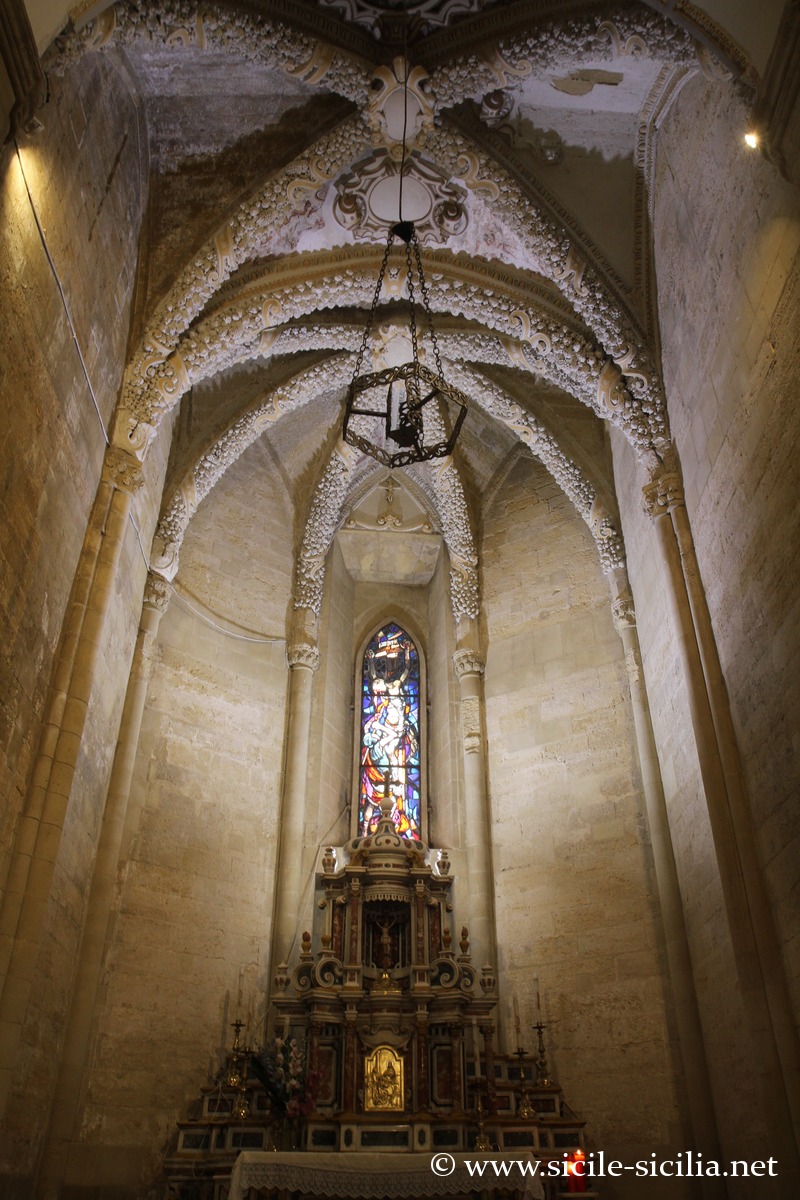
The left side apse is dedicated to the Blessed Sacrament, with ribbed Gothic vaults dating from the 14th century. The right one is dedicated to the Virgin of the Visitation, decorated with polychrome marbles according to a Baroque design by Andrea Amato, 17th century.
The processional statue of the Virgin of the Visitation, made in a Venetian workshop, dates from 1474.
The sacristy houses a chest-like piece of furniture illustrating scenes from the life of Jesus (17th century), a marble holy water font from 1648, and a Sicilian majolica floor depicting motifs from the New Testament (17th century).
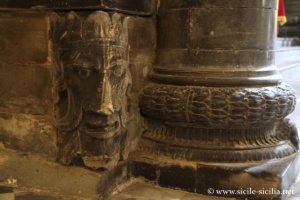
Column base 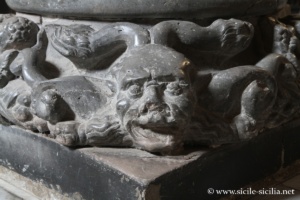
Column base 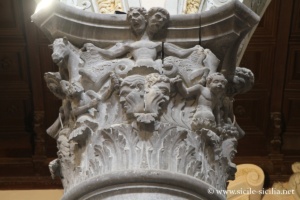
Column capitals 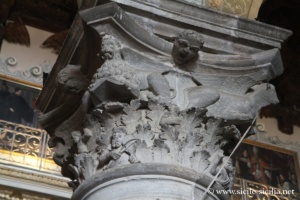
Column capitals 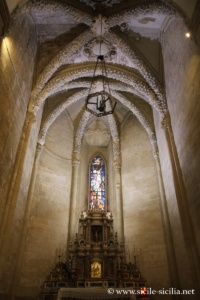
Cappella del Sacramento 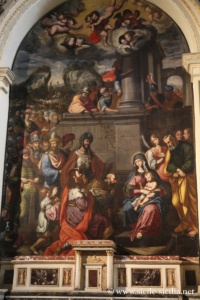
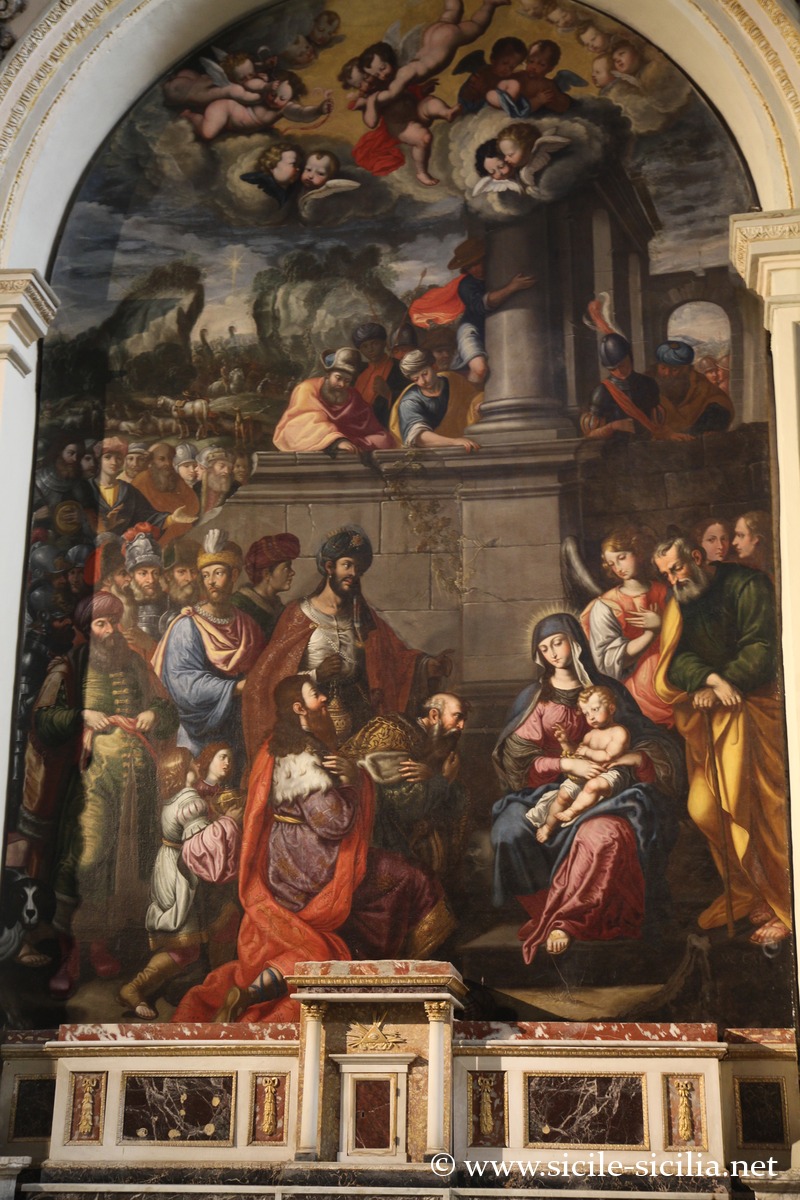
Adoration of the Magi, Ruggeri
Tower of Frederick II
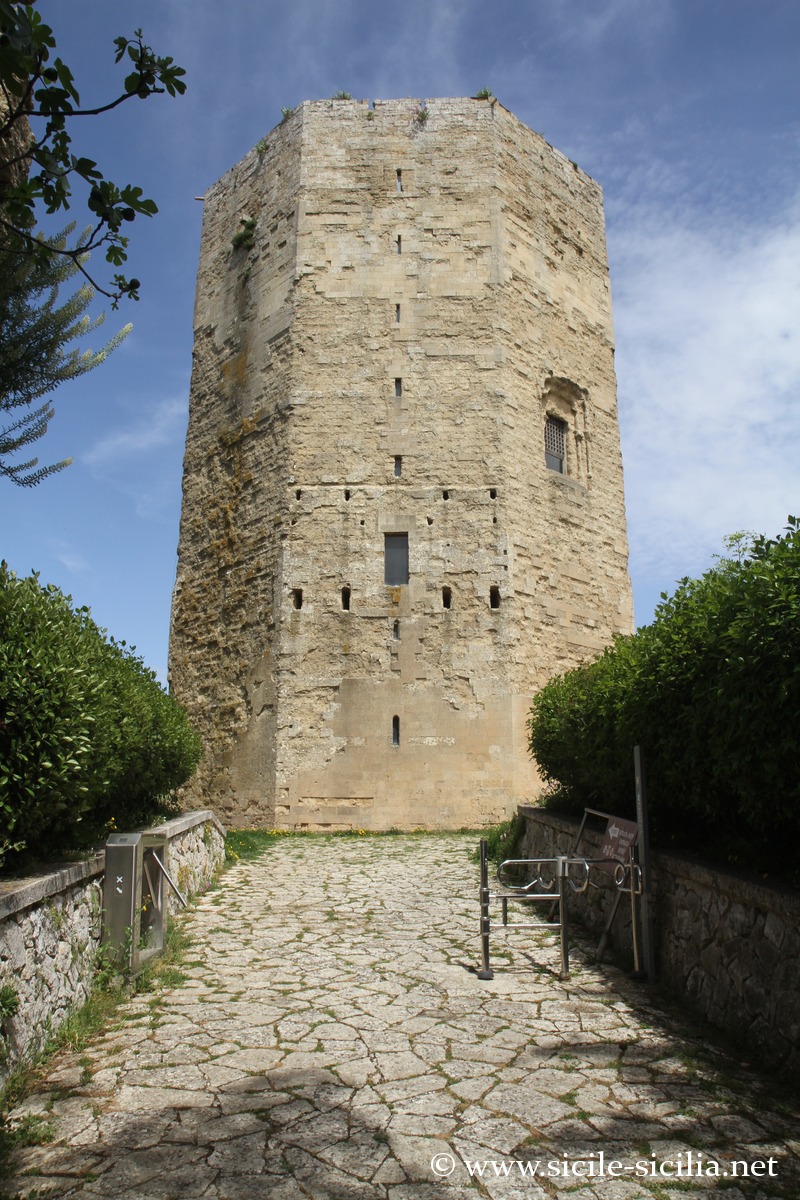
In the western part of Enna, the Tower of Frederick II, built in the 13th century (according to some sources) under the impetus of Frederick II of Swabia, rises on a wooded hill about 27 metres high.
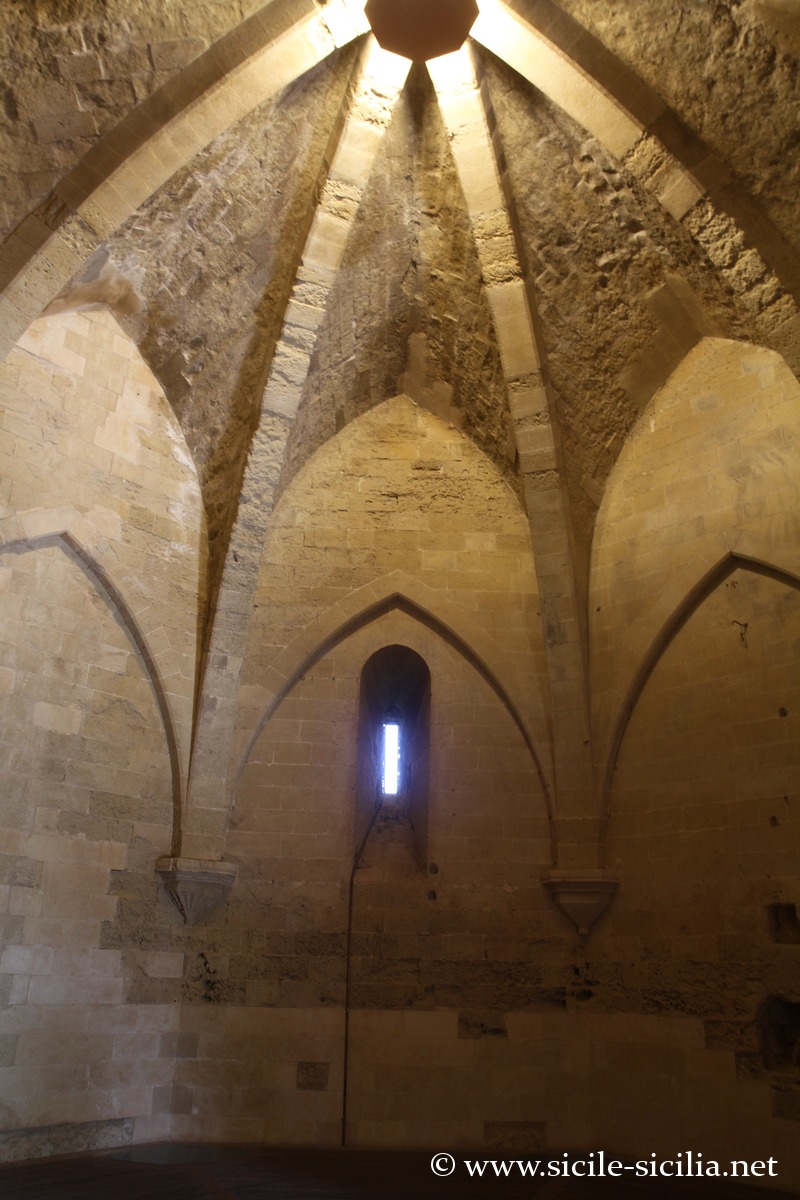
Its plan is octagonal and its internal architecture comprises three levels linked by a spiral staircase; there is also a partially excavated underground passage that led towards the Porta di Papardura.
Surrounded by a public park, the tower today offers a viewpoint over the city.
It is generally open from 9 a.m. to 5 p.m.
Tower of Frederick II 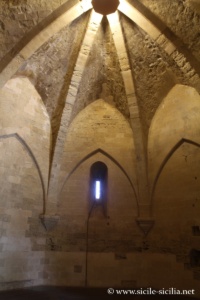
Tower of Frederick II 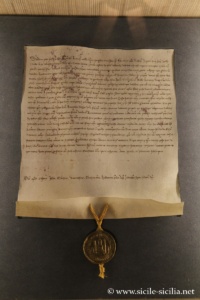
Tower of Frederick II
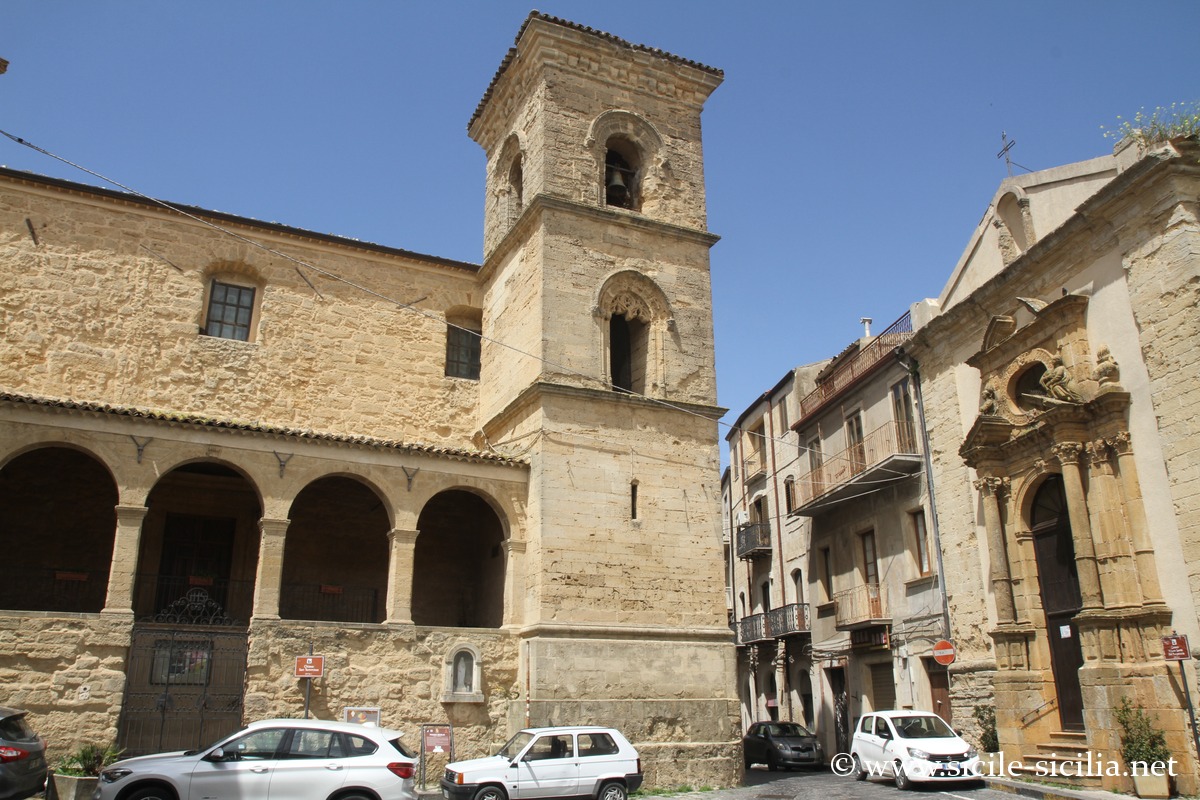
Piazza Neglia and the Church of Saint Thomas in Enna
The Piazza Francesco Paolo Neglia (formerly Piazza San Tommaso) is bordered by the church of San Tommaso dating back to the 12th–13th centuries, with a Romanesque portico with six pillars and round arches, and a Gothic-Catalan bell tower dating from the end of the 15th century, a remnant of an old 10th-century defensive watchtower.
Inside, the main altar has a marble altarpiece sculpted by Giuliano Mancino between 1500 and 1515, in four niches housing statues of saints (including Saint Thomas, Saint Agatha, Saint Catherine and Saint Nicholas), framed by 17th-century stuccoes.
On the square also stands the church of the Holy Souls of Purgatory (Chiesa delle Anime Sante), from 1671, with a Baroque facade in red stone with Corinthian columns.
The vault is adorned with works by Guglielmo Borremans (around 1720–1723), and the floor of the choir is covered with majolica.
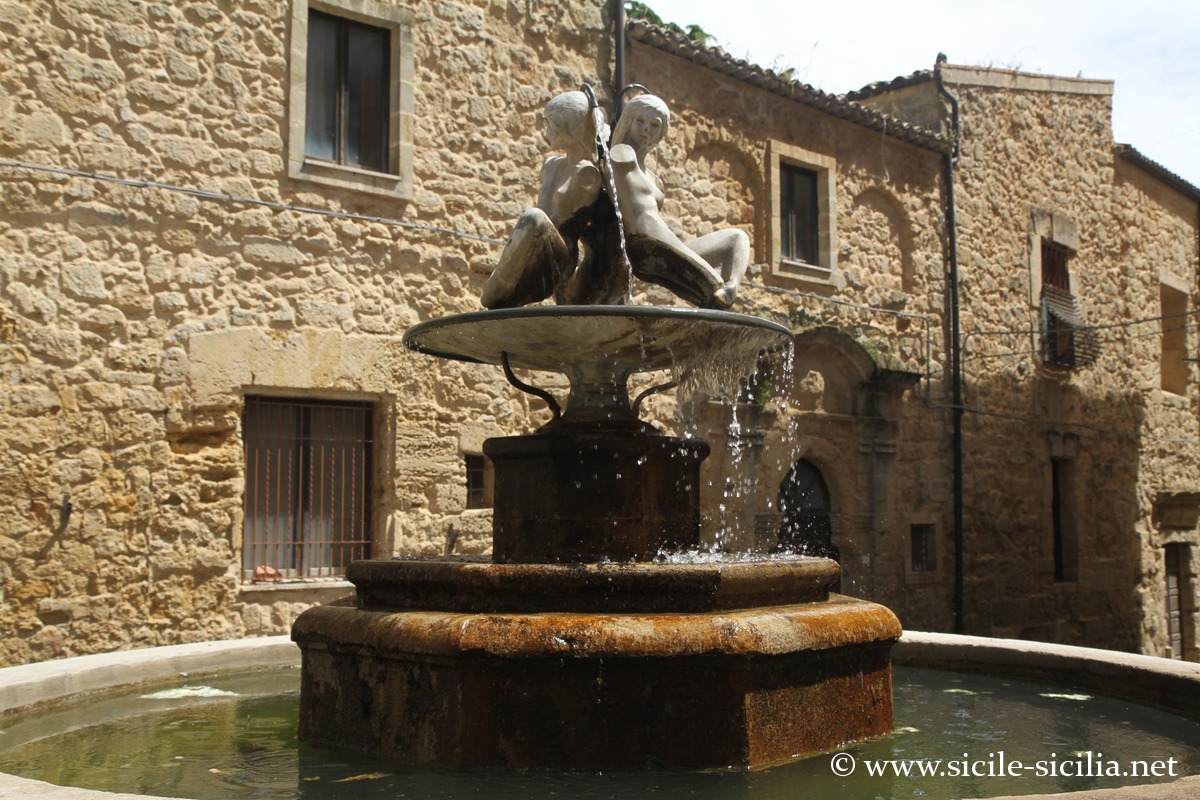
In the centre of the square, there is a modern fountain called the Fontana di San Tommaso, with three bronze sirens sculpted by the artist Mario Termini, installed in 1989.
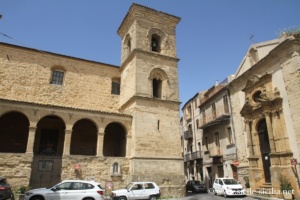
Piazza Neglia: San Tommaso and Anime Sante 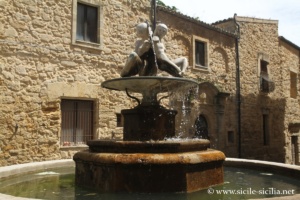
Piazza Neglia
Sanctuary of Papardura
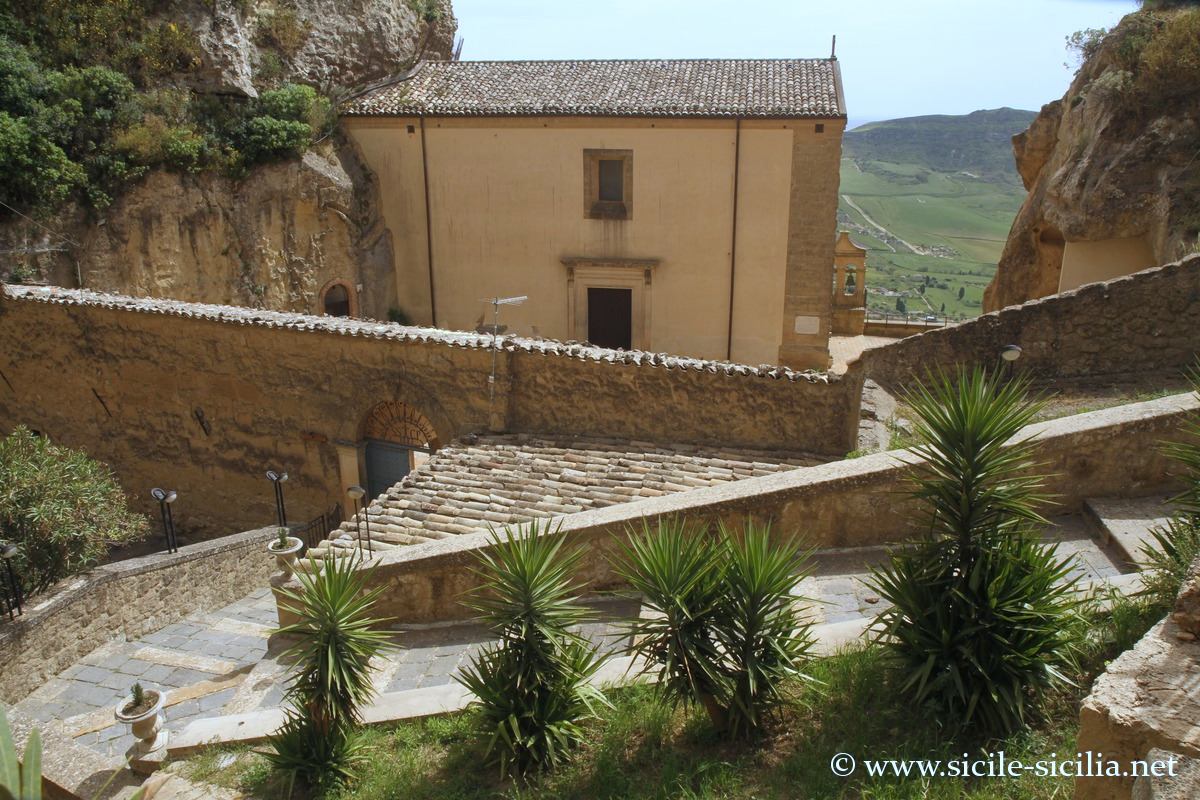
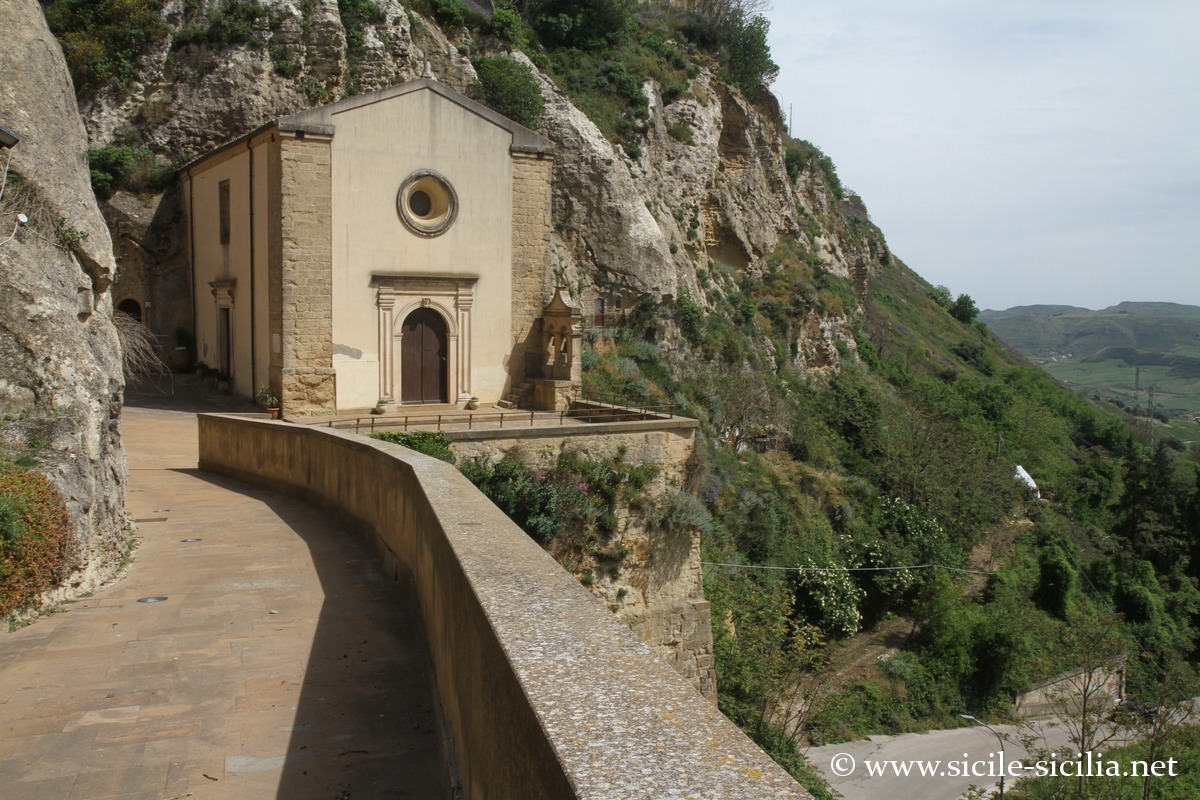
Against a cliff to the west of the plateau occupied by Enna, the Sanctuary of Papardura is an austere church clinging to the rock, next to natural caves. Outside one can see a beautiful rose window, while the interior benefits from rich Baroque decoration, a carved wooden ceiling, statues of the apostles, paintings and 17th-century stuccoes.
Alessi Museum
Right next to the cathedral is the Alessi Museum, which houses the “Treasure of the Duomo”.
The treasure includes a great many pieces of goldsmith’s work (crowns, jewels, pendants, a monstrance sculpted like a Gothic cathedral), among them the crown of Mary Most Holy of the Visitation, a major piece in gold inlaid with precious stones.
The museum also has a vast numismatic collection (more than 4,000 Greek, Roman and Sicel coins) from ancient Henna.
In the “Pinacoteca” section, one can see old canvases, notably depictions of the Virgin and Child
Varisano Archaeological Museum
The Varisano Regional Archaeological Museum in Enna houses numerous archaeological finds from sites around Enna, from prehistory to the Middle Ages.
Regional Archaeological Museum – Palazzo Varisano: housed in the Palazzo Varisano (Piazza Mazzini), it displays artifacts ranging from Prehistory to the Middle Ages, from local excavations (Calascibetta, Pergusa, Rossomanno, etc.).
Sanctuary of Papardura 
Sanctuary of Papardura 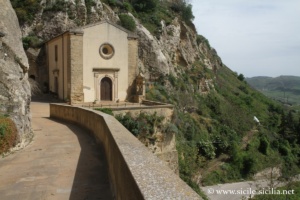
Sanctuary of Papardura
San Francesco d’Assisi and Chiaramonte Palace
The Church of Saint Francis of Assisi (Chiesa di San Francesco d’Assisi), Piazza Vittorio Emanuele II, is part of the Franciscan complex, dating back to the 13th–14th century, adjacent to the Chiaramonte Palace.
It preserves a stratification in which medieval elements survive (including the apse, formerly the tower of the Chiaramonte family with vaults characteristic of Sicilian-adapted Catalan Gothic) absorbed by 16th–17th-century renovations.
The interior with its nave is sober, whose 17th–18th-century decorations include the frescoes by Simone de Wobreck and Francesco Ciotti da Resuttano, as well as the 17th-century wooden choir.
The adjacent Franciscan convent historically housed the Franciscan community and preserves conventual spaces (cloister, cells) transformed or repurposed over time.
The Chiaramonte Palace is a late-medieval monumental complex (14th century) built by the Chiaramonte family and considered one of the main palaces of Enna.
The palace, which can be visited, incorporates a chapel (San Francesco) and vaulted halls, and has recently been repurposed for cultural functions.
Architecturally, it bears witness to the transition between feudal architecture and urban seigneurial housing, with Gothic-Catalan elements still legible.
Church of San Francesco d’Assisi 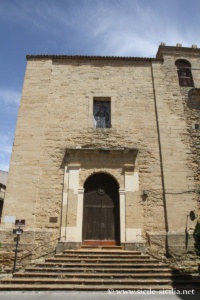
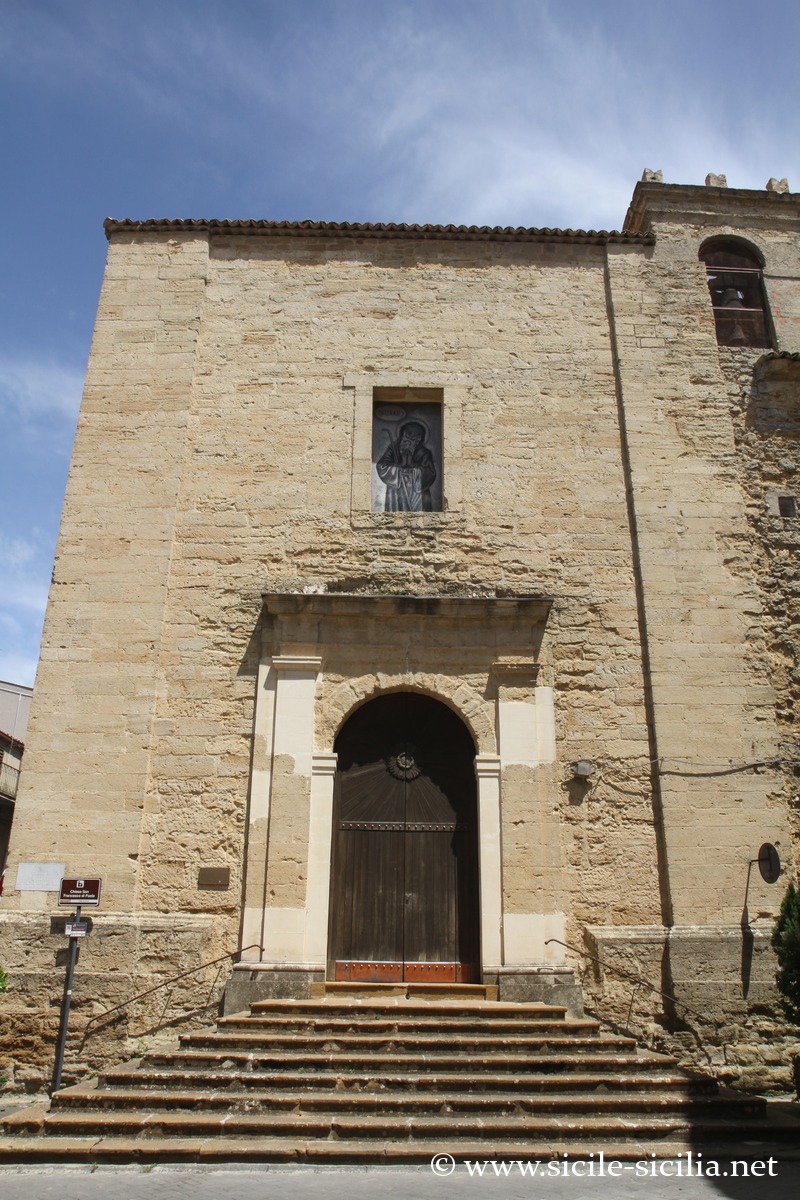
Church of San Francesco di Paola 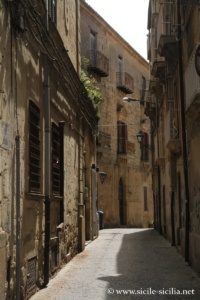
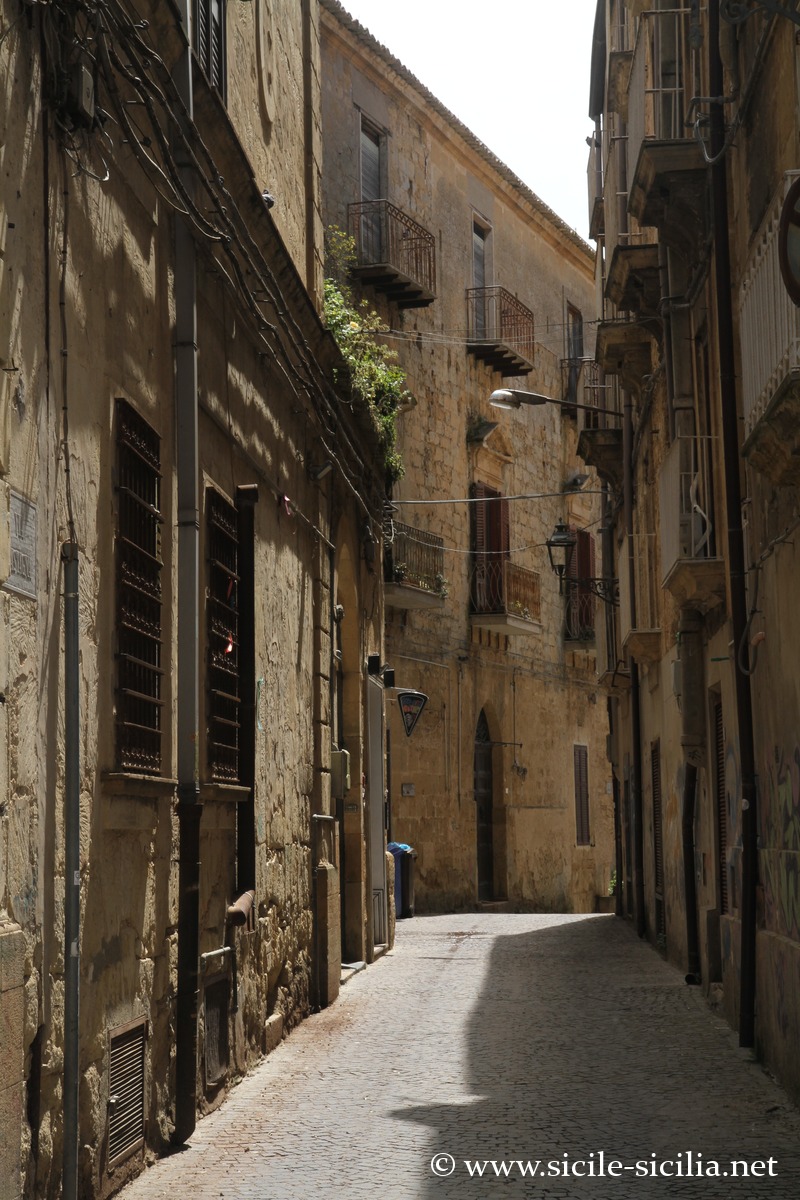
Medieval street in Enna 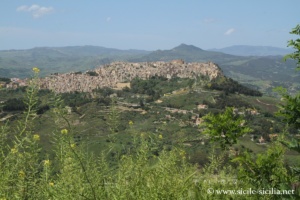
Belvedere of Enna
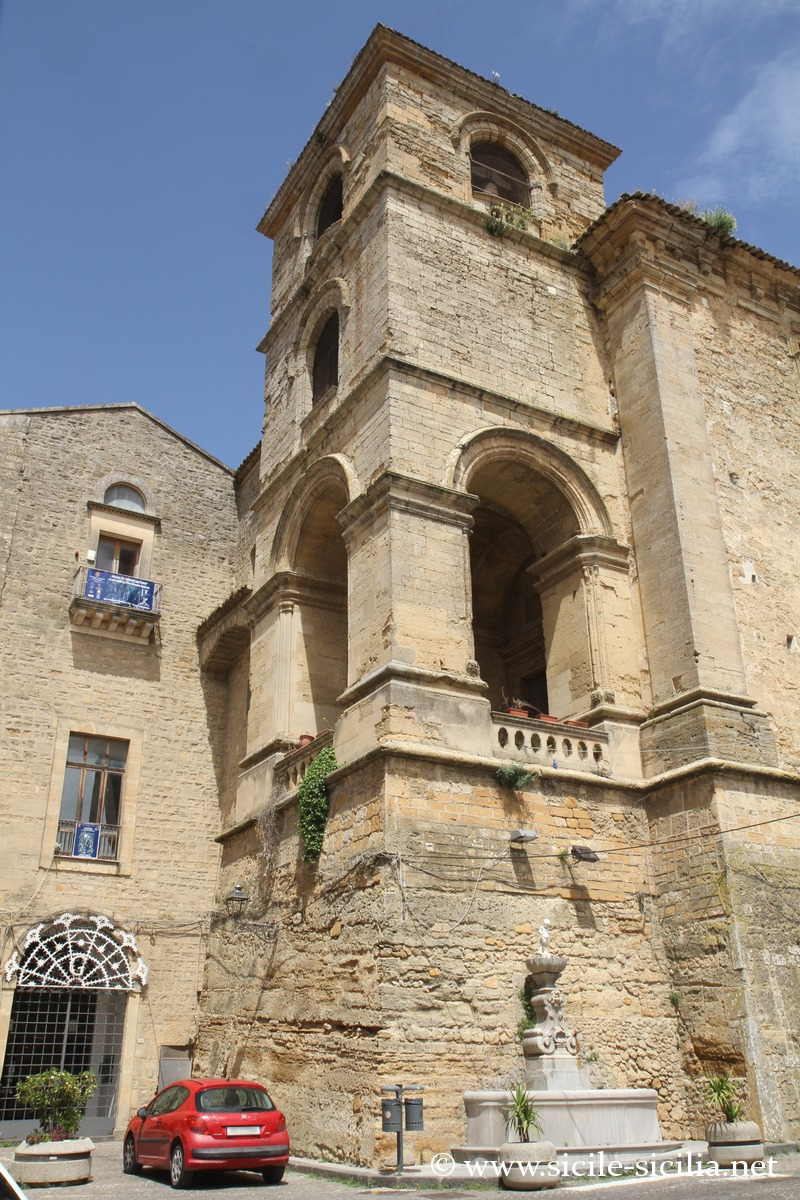
Other sites in Enna
Belvedere (Piazza Francesco Crispi / Marconi)
The Belvedere of Enna is a major panoramic viewpoint: from this rectangular piazza, one looks out over a vast panorama stretching from Calascibetta to the Madonie mountains.
At the center of the square, the famous Fountain of the Rape of Proserpina is a bronze statue inspired by Bernini.
Piazza Colajanni, Santa Chiara and Pollicarni Palace
The Piazza Napoleone Colajanni (formerly Piazza Santa Chiara) owes its name to the Enna politician Napoleone Colajanni, for whom a statue was erected at its center, the work of the sculptor Ettore Ximenes.
Around this square stand historic buildings: the Palazzo delle Benedettine, the church of Santa Chiara and the Palazzo Pollicarini.
The Palazzo Pollicarini, located on Via Roma just next to the piazza, is a Gothic-Catalan fortified residence dating from the 15th–16th century: it has an arcaded portico, a monumental staircase leading to the noble floor and a large cornice decorated with arabesques and arcades.
The church of Santa Chiara, formerly a Jesuit college until 1767 and then entrusted to the Poor Clares, has an imposing access staircase, and a beautiful majolica floor dating from 1852 (depicting in particular a steamship and Santa Sofia), and wrought-iron grilles used by the nuns.
Church of San Giuseppe
The Chiesa di San Giuseppe, Via Roma, is part of the vast complex of the Benedictine monastery, largely rebuilt in the 17th century. The facade is typically 17th-century, sober, topped by a bell tower known as the “torre di San Benedetto”, clearly visible in the urban fabric. The single-nave interior houses paintings (Santa Scolastica, San Benedetto, Madonna del Rosario), a statue of the Madonna del Carmelo and a 15th-century crucifix. The main altar is adorned with a silver antependium, dated 1768.
Porta di Janniscuru and Montesalvo
The Porta di Janniscuru is the only one of the ancient city gates (originally six) of Enna’s Arab-Norman defensive system still visible today. Its massive, round-arched gateway stands in the middle of a rocky stone staircase, lined with Neolithic caves (notably the Grotta della Guardiola).
Montesalvo is a perched district of Enna Alta. Here you can find an obelisk and a stele marking the “geographical center” of Sicily. The sanctuary of Montesalvo, dedicated to Maria SS. della Visitazione, hosts every July 2 the procession of the statue of the Virgin of the Visitation, carried from the Duomo.
Former Capuchin Convent and Museum of the Confraternities
The former Capuchin convent in Enna, founded in the 17th century, is located on the Montesalvo hill and reflects the typical monastic architecture of the minor orders: simplicity, sobriety and a central cloister.
The convent has an adjoining church with a single nave, soberly decorated, preserving some 17th-century paintings and stuccoes.
The convent now houses the Museum of the Confraternities (“Museo delle Confraternite”), with a multisensory tour centered on the traditions of Holy Week in Enna: each room is dedicated to a sense (sight, hearing, smell, taste, touch), with videos, sound simulations, confraternity fabrics, etc. Augmented reality installations and an “immersive room” allow visitors to relive the processions, chants, etc.
Teatro Francesco Paolo Neglia (former Garibaldi Theatre)
This historic theater, inaugurated in 1872, plays a central role in the cultural life of Enna. It was rebuilt in reinforced concrete with stucco decoration and ceiling frescoes by Leopoldo Messina.
Chiesa di San Cataldo
This church, rebuilt in the 18th century (work completed around 1770), stands on the remains of an older church of Norman origin and a small ancient necropolis. Inside, one can admire two marble icons, one attributed to Giandomenico Gagini, as well as Baroque altarpieces, reliquaries, etc.
Tower of San Giovanni Battista
All that remains of the church of San Giovanni Battista is the bell tower, located on Via Candrilli. This 15th-century belfry is of medieval origin and features large pointed arches on the first level; the middle level has a trefoil window in Gothic style, while the upper order is punctuated by round arches.
Church of San Marco and the Carmelite Convent
Built in the 16th century, this church was constructed on the ruins of an ancient synagogue, in the old Jewish quarter of Enna.
The interior is distinguished by rich Rococo stuccoes by Gabriele de Blanco, and a wooden gallery reserved for the nuns, typical of female convents.
Church of San Francesco di Paola
The Chiesa di San Francesco di Paola, linked to the Order of the Minims, was remodeled between the 16th and 18th centuries. It preserves Baroque ornaments such as the barrel vault and stuccoes.
The main altar features a copper panel depicting the Last Supper, and the side altars house works of popular devotion (San Gaetano, San Pietro).
Piazza Giuseppe Garibaldi
This square is one of the modern administrative centers of Enna: here you can see the Palazzo del Governo, built in the 1930s according to a Fascist design by Salvatore Caronia.
The palace’s civic tower, with a belfry and a clock, rises to 18 meters.
Church of San Leonardo Abate
Dating from the 15th century, this church is a simple building with a medieval bell tower.
Roman Villa of Contrada Geraci
Located 10 km south of Enna as the crow flies, this Roman villa was unearthed in the 1990s, with polychrome mosaics, kilns and dwelling structures that show the extent of an ancient rural estate.
Part of the villa was rebuilt in the Byzantine era, and traces of industrial activity (tile works, brickworks) have been identified.
Tourist map of Enna
 Show interactive map
Surroundings of Enna
Just over two kilometers as the crow flies from Enna, Calascibetta is a charming, unassuming village with old stone houses and a beautiful panorama of Enna. Further north you can discover the interesting Necropolis of Realmese, and not far away the Byzantine troglodyte village of Canalotto.
10 km west toward Villarosa, a small museum is dedicated to trains.
→ Read the page about Calascibetta and its surroundings.
The Lake Pergusa, less than 10 km by road south of Enna, is a natural lake of volcanic origin that collects the surrounding waters, frequented by migratory birds and important in terms of biodiversity. It is at the center of a nature reserve.
Further away, 20 km south of Enna by road, the Floristella Grottacalda Mining Park allows you to discover two disused sulfur mines.
Further south of Enna, you can discover the medieval town of Piazza Armerina with its interesting historic center, best known for the Roman Villa of Casale which has preserved over its 3500 m^2 an impressive number of Roman mosaics in an exceptional state of conservation.
Not far from Piazza Armerina, Aidone is a pretty small town, with its important archaeological museum and the nearby archaeological site of the ancient city of Morgantina.
Northeast of Enna, in the Heraean Mountains, Leonforte is a Baroque town founded in the 16th century by the Branciforte family, located near Assoro, a small town of much older origin, dating back to the Sicans or Sicels and retaining a medieval charm.
Information
External sites
- Enna on Wikipedia
- Tourist sites and blogs: www.ennamagazine.it, viaggi.corriere.it/europa/italia/enna
- Cathedral of Enna: www.ilcampanileenna.it
Articles in the Enna category
- Piazza Armerina
 Piazza Armerina is a pretty town of about 20,000 inhabitants, at 700 metres of altitude in the Erean Mountains, founded ...
 - Enna
 On a plateau at 948 metres above sea level, Enna is the capital of a Sicilian province and a small ...
 - Hotels in Enna
 Hotels in Enna in Sicily and farm stays, bed and breakfasts and apartments in the city centre or in the ...
 - Villa Romana del Casale
 The Villa del Casale in Piazza Armerina is a unique example of a luxurious Roman villa, whose mosaics illustrate the ...
 - Morgantina
 A few kilometres from Aidone lies the archaeological site of Morgantina, the remains of an ancient city inhabited since the ...
 - Assoro
 Assoro, perched on the steep hill of Monte Stella in the Heraean Mountains, at nearly 850 metres of altitude in ...
 - Aidone and Pietratagliata
 Located in the heart of the Heraean Mountains, the town of Aidone is often referred to as the “balcony of ...
 - Leonforte
 In the Heraean Mountains, about 20 kilometres north-east of Enna, lie two pretty Sicilian villages a few kilometres apart: Leonforte, ...
 - Caltanissetta and its surroundings
 A town with little tourism in the centre of Sicily, Caltanissetta is a provincial capital with nearly 60,000 inhabitants, yet ...
 - Calascibetta and surroundings
 Calascibetta is a Sicilian village of nearly 4000 inhabitants located on a promontory at 691 metres of altitude, about 2.5 ...
 - In the Surroundings of Enna
 Sicilian destinations near Enna: Piazza Armerina and the Roman villa of Casale 30 km to the south, Nicosia and the ...
Comments in other languages
Bonjour,
Voila ce que j'ai pu trouver :
Bonjour,
Je ne trouve pas le musée des confréries et son parcours sensoriel sur internet, pouvez-vous m'indiquer comment y accéder?
Merci d'avance,
Camille