


Along the northwest coast of Sicily, between Trapani and San Vito lo Capo, the Monte Cofano Nature Reserve lies around the rock of the same name. It is a limestone massif that preserves rich vegetation, with Mediterranean scrub where animal species such as the peregrine falcon and the Sicilian partridge thrive.
Natural sites and artisan villages
The reserve was established in 1997 and covers about 537 hectares, featuring cliffs, trails and karst formations rich in natural cavities and marine fossils dating from the Triassic, with beautiful views over the neighbouring gulfs. Some caves have yielded prehistoric human remains.
These include karst formations such as the Abisso delle Gole and the Abisso del Purgatorio.
Among the natural sites of Monte Cofano and its surroundings are the Cofano gorges, the Mangiapane Cave, the Buffa Cave, the bays of Frassino and Tuono, the bay of Corino, the Cala del Tono and the beach of Makari, as well as heritage such as the Tonnara and San Giovanni towers.
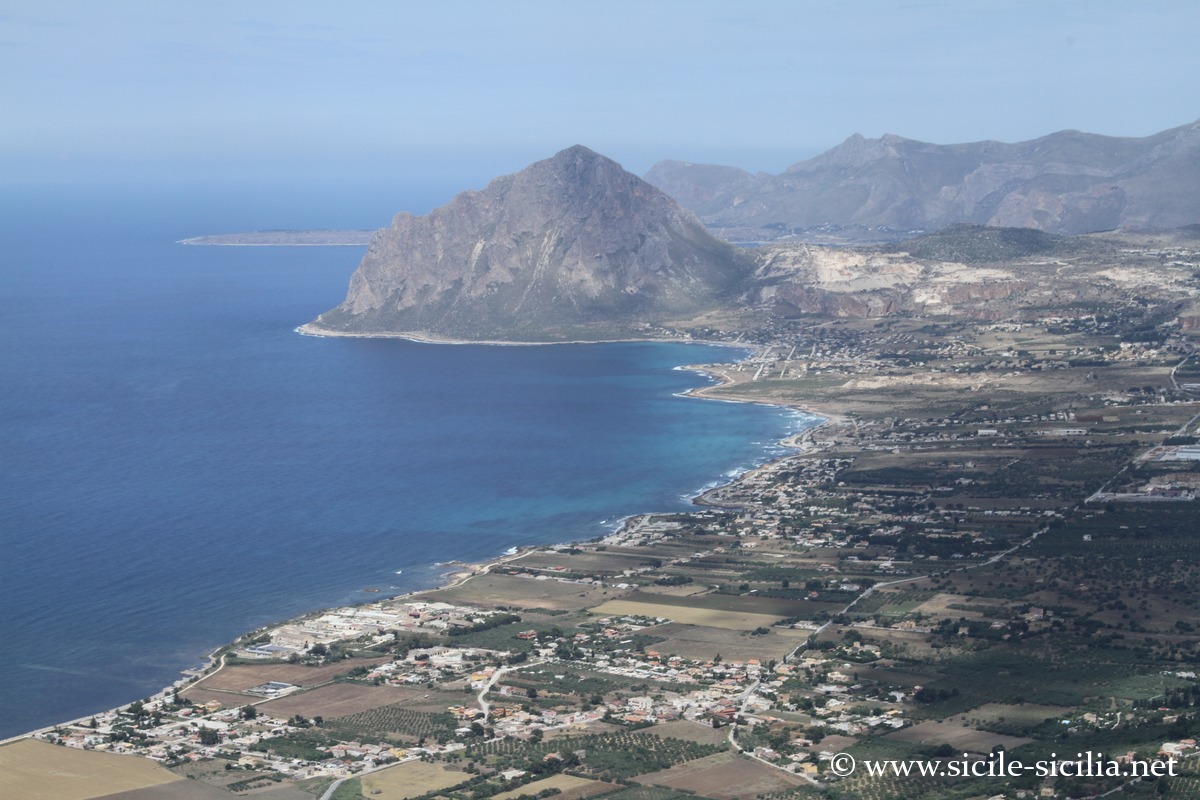
Panorama of Monte Cofano from Erice
To the west, above the bay of Cornino, a charming little village is home to an artisan community, working on basket weaving, pottery, bread and olives.
To the south of the reserve lies the village of Custonaci with its magnificent sanctuary dedicated to the Madonna.
Visiting Monte Cofano and itineraries
One can enter the Cofano Reserve at several points with parking, including on the coast to the east and west, or from the south coming from Custonaci. A coastal trail skirts the massif and forms a loop passing over the mountain, which can be covered in 2 or 3 hours on foot, or by mountain bike.
An old mule track arrives from the south from Custonaci, called the Sentiero Religioso (Religious Path), which links several religious and natural sites around Custonaci.

Torre di Tonno
From the main entrance with parking located to the east, one can start by following the coast, reaching the hamlet of the Tonnara di Cofano at the foot of the massif, with the Torre di Tono. This tower has a star-shaped plan, remarkable with its concave walls, built in 1500 to defend the tuna fishery.
The coastal path then leads to the Saracen Point (Punta del Saraceno), a remarkable cape where the cliffs become steeper, with small coves, and close to an archaeological site slightly uphill.
Further on, a small chapel stands near the small cave of the Grotta del Crocefisso, accessible by a small staircase.
Then the Torre di San Giovanni is part of the vast system of coastal fortifications erected to defend the coast against pirate raids between the 15th and 18th centuries.

Monte Cofano Nature Reserve
After reaching the entrance on the western side, one can return inland, skirting the mountain to the south.
With a small detour one can discover the Mangiapane cave.
Halfway up one reaches a large cistern, the Gorgo Cofano, which fills with water in winter. From there, several paths branch off: one can close the loop towards the east entrance, either by heading towards the tonnara, or by a path further to the right which is more direct (the Scaletta trail) to reach the eastern entrance via a staircase carved into the rock. Some of these paths may be closed.
The leftmost path, difficult, climbs the mountain to the summit. It peaks at 659 metres, with extensive views over the gulfs of Makari and Cornino.

Agliareddi Beach 
Coastal trail 
Coastal trail 
Cofano Mountains 
Tono Tower of the Tonnara 


Mangiapane and Scurati Caves

Grotta Mangiapane
The Mangiapane Cave, one of the Scurati caves, about fifty metres deep and seventy metres high, is today the site of a living nativity scene each year and a small “living museum” organised by local volunteers, recreating scenes of traditional Sicilian rural life.
It served as a dwelling place since the Palaeolithic and more recently as a troglodyte village until the 20th century.
The Scurati caves, nine in number, have been occupied since prehistory and the Upper Palaeolithic, and by small houses in the 18th and 19th centuries.
Flint tools, pottery fragments and artefacts have been found there attesting to a human occupation dating back about 36,000 years, among the oldest in northwestern Sicily.
Nearby sites
Sanctuary of Maria Santissima di Custonaci
The Santuario di Maria Santissima di Custonaci sanctuary dates from the 16th century and houses a painting of the Virgin attributed to the school of Antonello da Messina of the 15th century. It is the object of an ancient cult and a very well-attended annual festival at the end of August, with a procession and local traditions.
The building was enlarged and embellished in the 18th and 19th centuries and has Baroque and Gothic architectural elements, as well as a museum of religious objects and ex-votos.
Cornino Bay
Cornino Bay, near the western entrance of the Monte Cofano reserve, is a popular spot for swimming and diving, characterised by clear waters and rocky formations typical of the Sicilian coast.

Cappella del Cavaliere, Valderice 
Buffa Caves 
Grotta Mangiapane 
Cornino Bay


Where Monte Cofano is located and map
If you see this after your page is loaded completely, leafletJS files are missing.

Map of the Monte Cofano Reserve
Information
External sites
- Unofficial site: riservamontecofano.com
- Trails: riservamontecofano.com/sentieri
- Tourism portals: castelluzzo.net
- Wikipedia page: it.wikipedia.org
- Caves: www.prolococustonaci.it
In the Trapani and Castellammare category
- Gulf of Castellammare
 The Gulf of Castellammare extends along the northwestern coast of Sicily, between ...
- Segesta
 Segesta was an ancient Greek city, whose site is renowned notably for ...
- Zingaro Nature Reserve
 The Zingaro Reserve is one of the most beautiful nature reserves in ...
- Carini and surroundings
 The village of Carini stands at the foot of Monte Saraceno, northwest ...
- The coast from Capo Rama to Terrasini
 The Sicilian coast between Capo Rama and Terrasini extends just east of ...
- Montelepre
 Montelepre is a village in the Palermo hinterland, situated on the first ...