
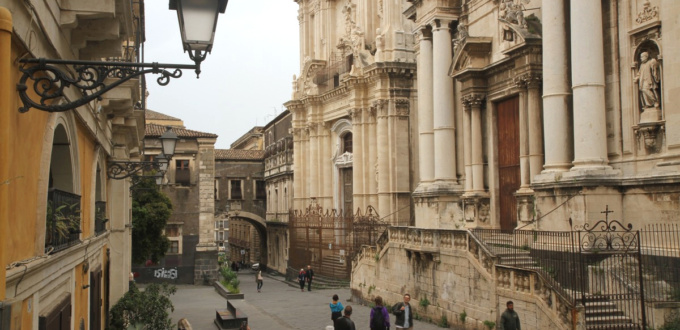
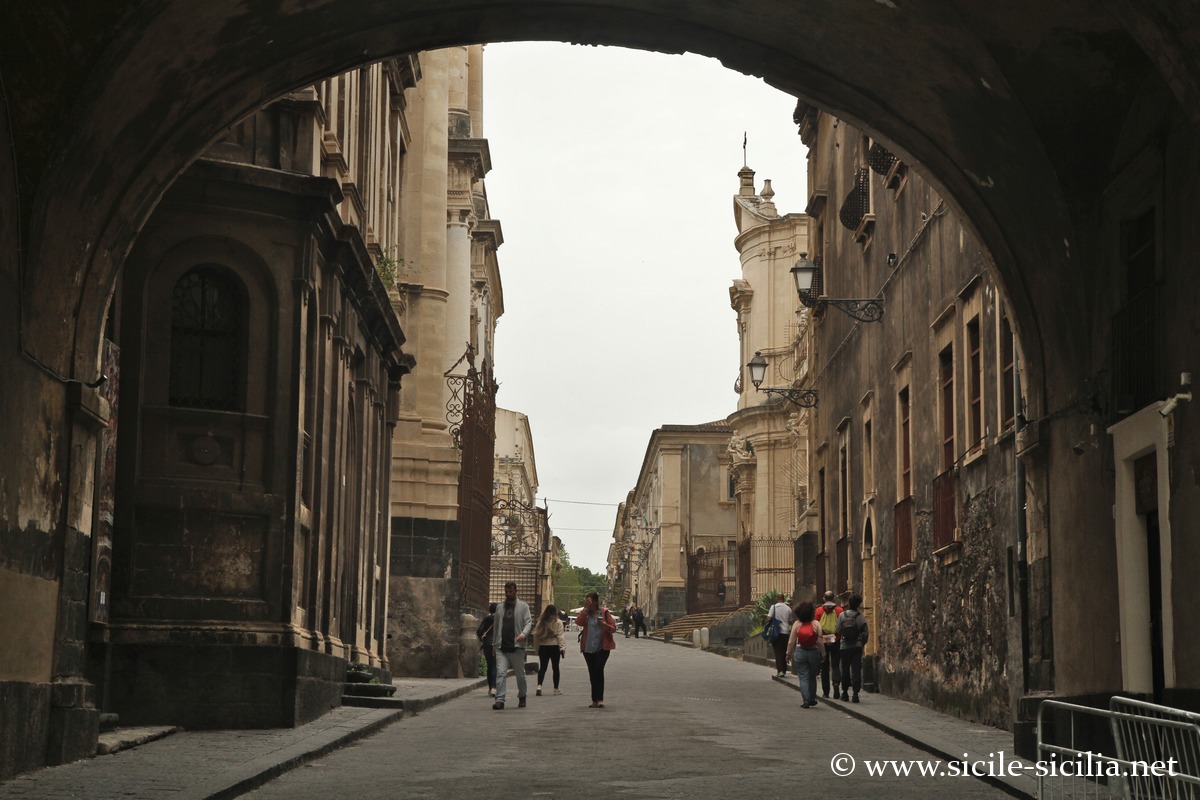
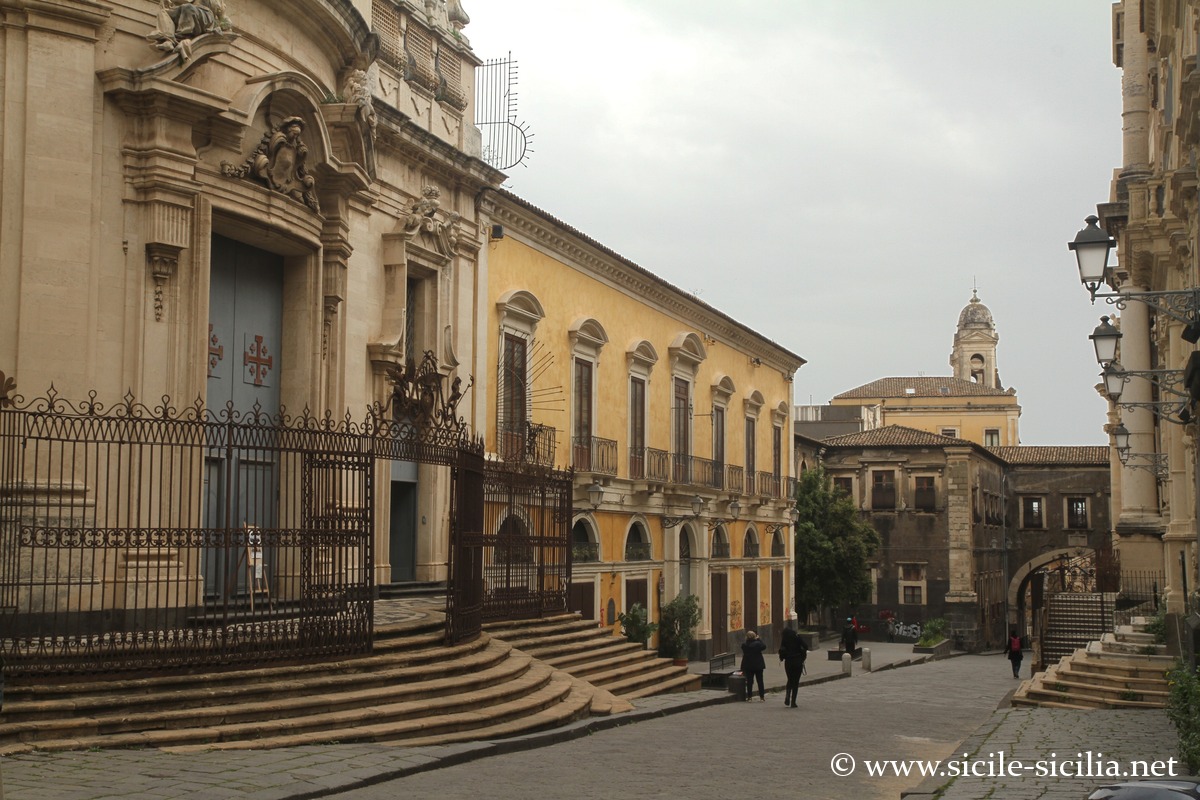
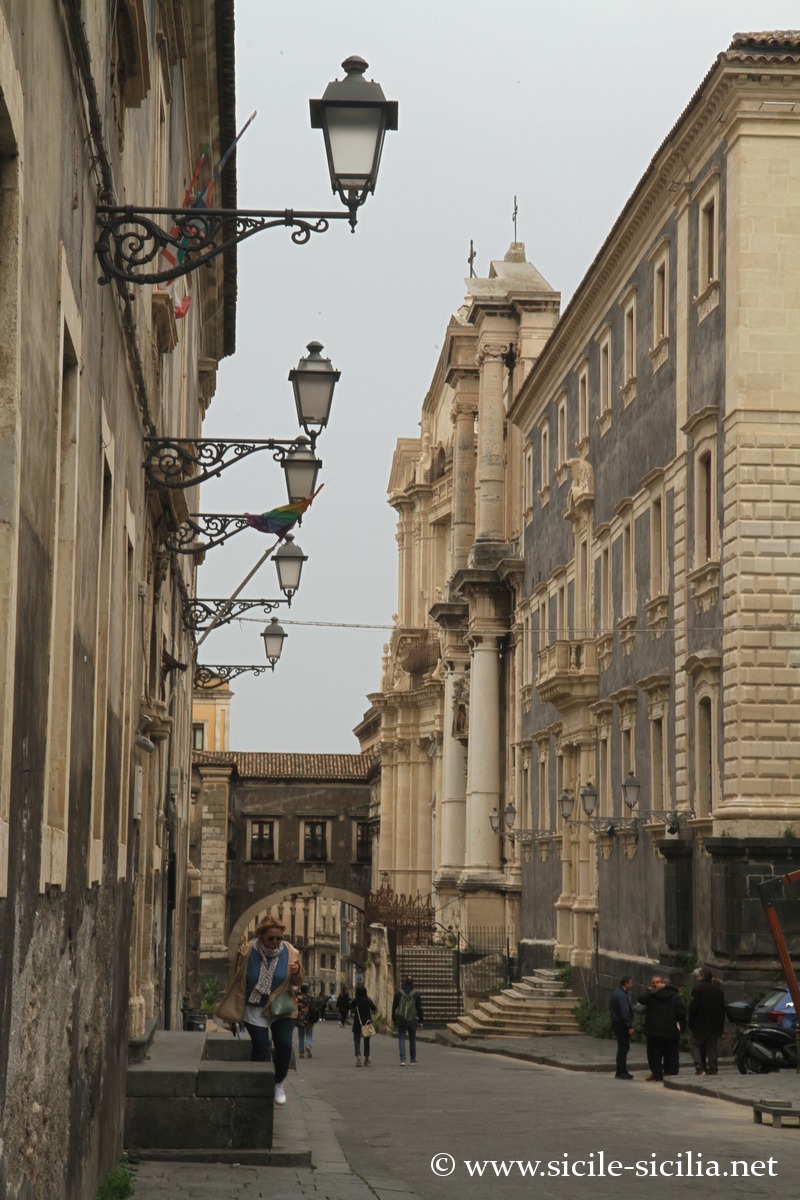
The Via Crociferi is called the “street of churches”, a monumental and emblematic street of Catania, very dense with Baroque architecture, not to be missed during a visit to the city.
In fact, over less than 200 metres, four churches follow one another along with three monasteries, Baroque monuments built after the 1693 earthquake, including civil buildings such as the Villa Cerami at the northern end of the street.
This street was one of the main axes of the post-seismic reconstruction and today constitutes one of the most homogeneous examples of 18th-century Catania Baroque.
It also stands out for its rectilinear plan, which favours the visual perspective of the Baroque façades, and for the integration of private palaces and cloisters into the urban alignment.
To the south, it starts from Piazza San Francesco d’Assisi, where the church of the same name stands.
Church of San Francesco d’Assisi in Catania and Palazzo Gravina
The history of the Church of Saint Francis of Assisi at the Immaculate is linked to the figure of Queen Eleanor of Anjou, wife of Frederick II of Aragon and sister of Saint Louis. There is a plaque recalling that the remains of the queen, who died in 1343, are kept in the church. Furthermore, on an 18th-century canvas, the queen is depicted together with Saint Clare, the founder of the Order of the Poor Clares.
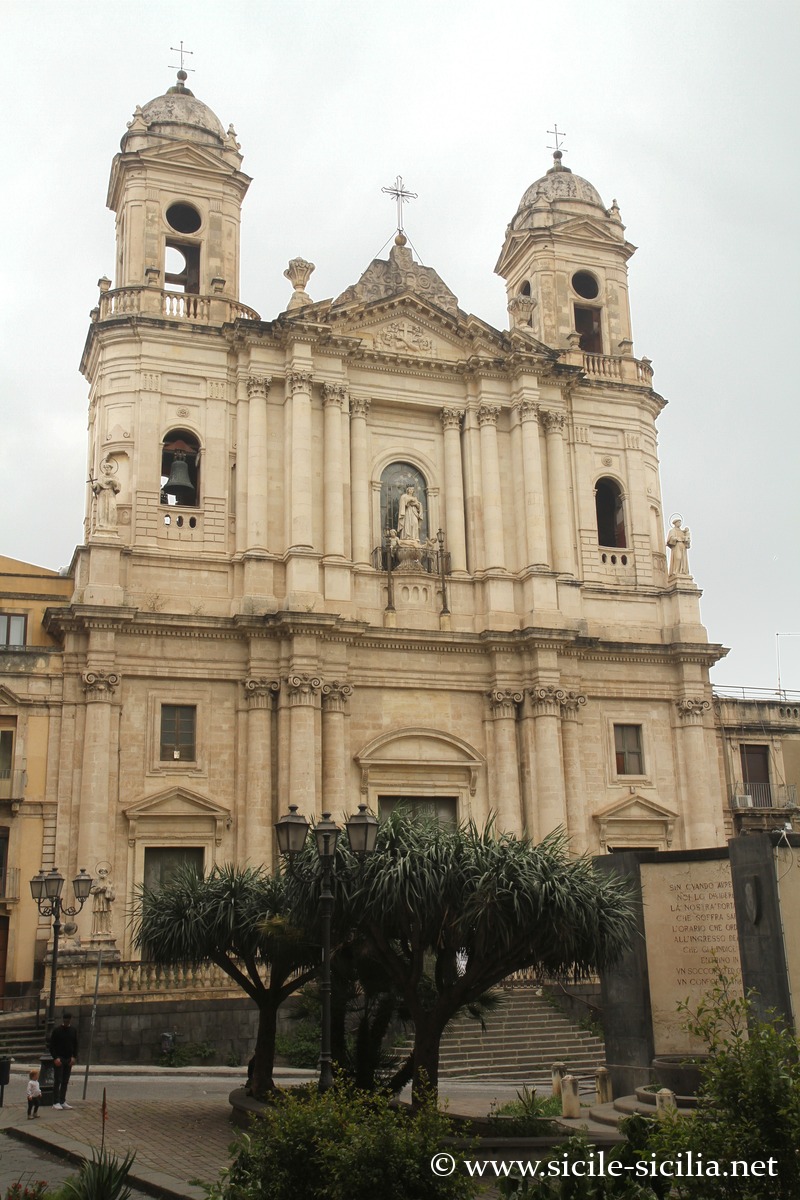
Its elegant Baroque façade was only completed in 1854, blending elements of late Sicilian Baroque with a Neoclassical portico.
In the vast interior space, the crossing is covered by a painting of a false dome. A beautiful 16th-century altar is preserved there, behind which a large fresco by Battaglia depicts the indulgence of the Porziuncola (the pardon of Assisi).
The organ to the right of the altar was used by Vincenzo Bellini during his childhood; he was born in Palazzo Gravina Cruyllas, located just opposite. It was in fact the residence of the composer’s family, today the seat of the museum dedicated to Bellini.
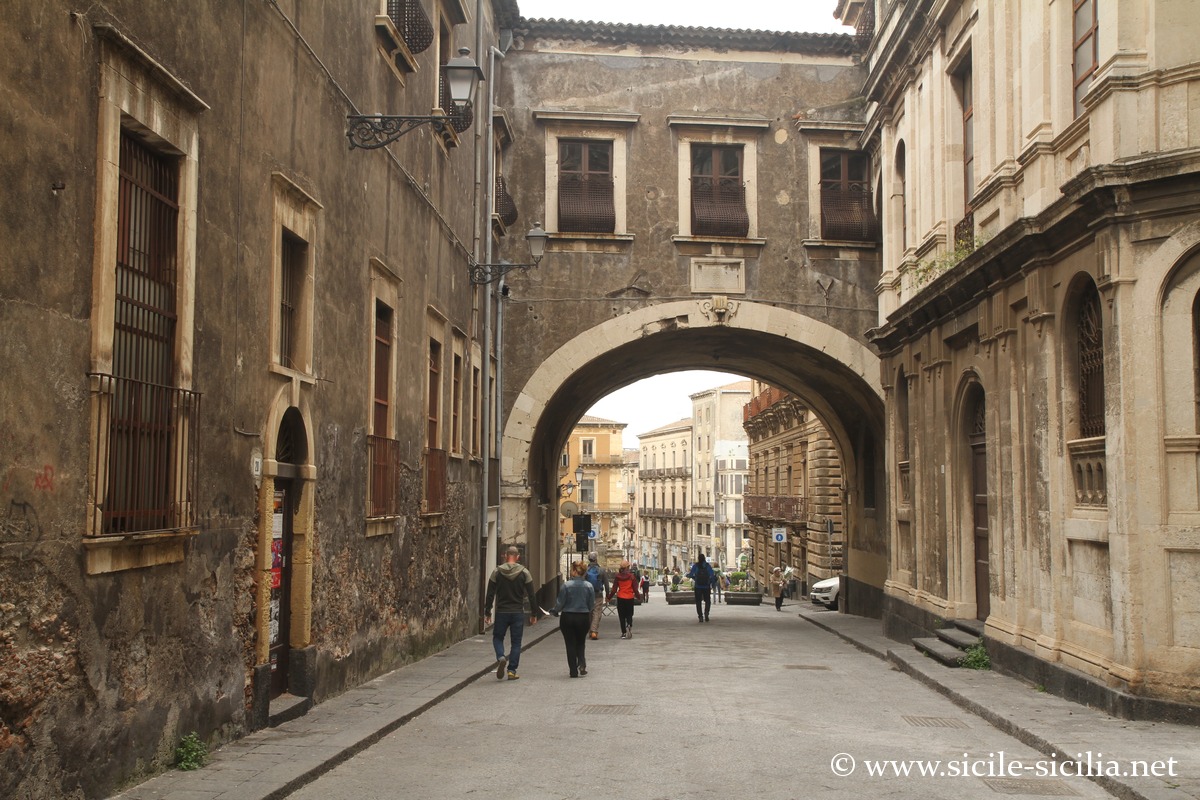
As you go along the street, you pass under the arch of the Monastery of Saint Benedict, connecting the great abbey to the small abbey.
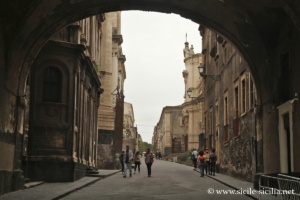
Arch of Saint Benedict, Via Crociferi 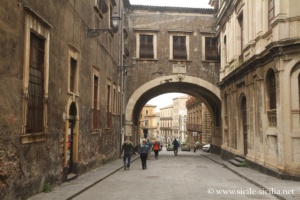
Arch of Saint Benedict, Via Crociferi 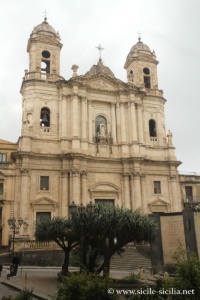
Church of Saint Francis of Assisi
Monastery and Church of Saint Benedict in Catania
Originally built in the mid-14th century, the nuns’ monastery was rebuilt in the early 18th century after the 1693 earthquake.
The suspended arch that crosses the Via Crociferi connects the great abbey, with its church of Saint Benedict (San Benedetto), to the small abbey. Also called “Arco delle Monache” (Arch of the Nuns), it was built to allow the cloistered nuns to move between the two buildings without leaving the monastery.
The façade of San Benedetto, rhythmically articulated with Corinthian columns and statue niches, is a typical example of 18th-century Sicilian Baroque. The niches contain statues of Benedictine saints and allegories of faith and charity.
The guided tour allows visitors to discover the site while respecting the nuns’ seclusion, such as the remains of a Roman domus in the basement, several rooms of the monastery, the Church of Saint Benedict (built between 1704 and 1713) and its imposing staircase, called the Scalinata degli Angeli, as well as the Museum of Contemporary Art of Sicily (MACS) in the small abbey.
Inside the church, one can discover Tuccari’s frescoes on the vault and the apse, illustrating the stories of Saint Benedict or his triumph framed by allegories. They are among the most representative of late Sicilian Baroque, incorporating illusionistic motifs and a dramatic use of light.
One can also admire the paintings by Desiderato and Rapisardi and the splendid altar decorated with polychrome marbles, jasper and silver leaf.
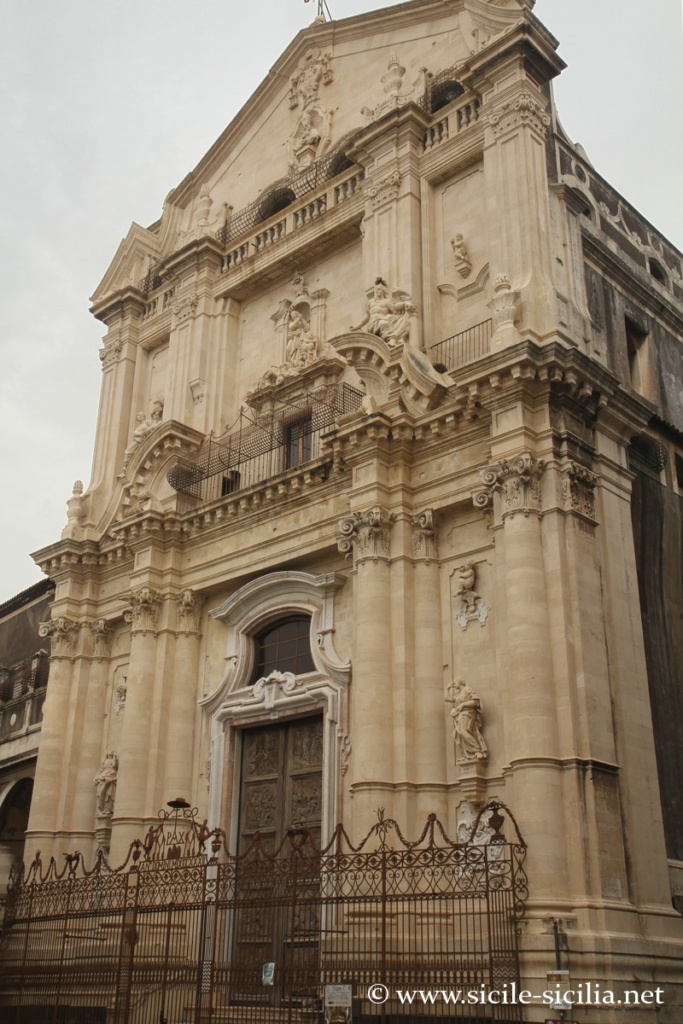
Church of Saint Benedict, Via Crociferi 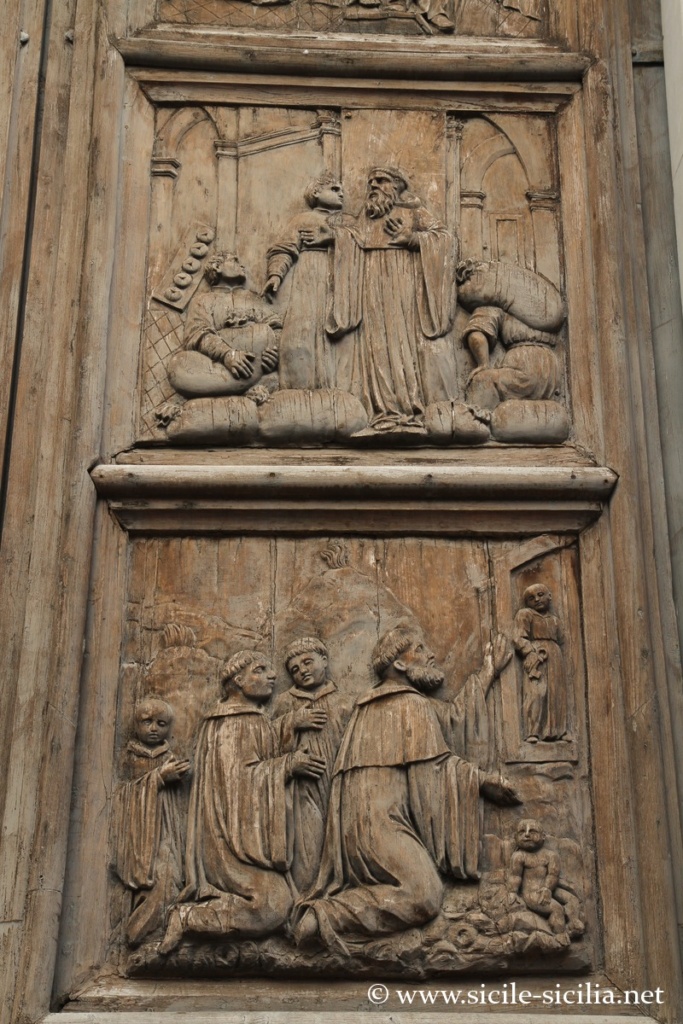

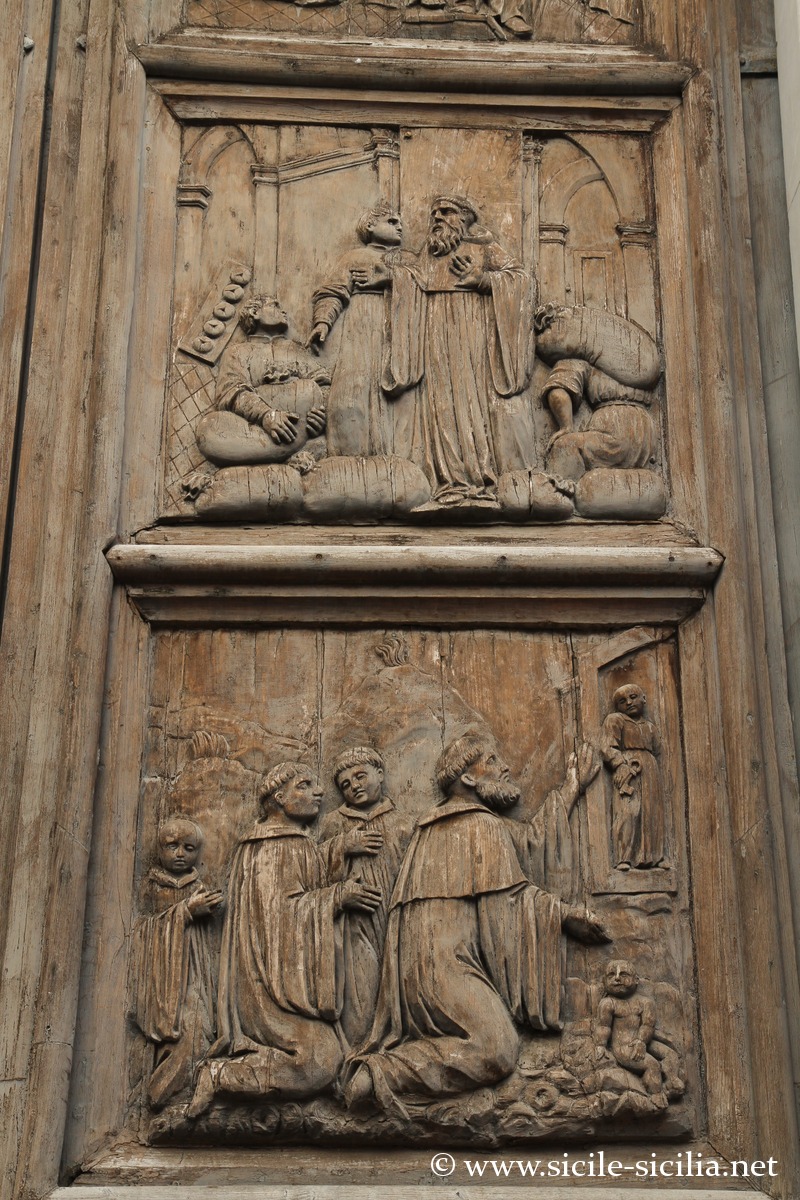
Wooden portal of the Church of Saint Benedict 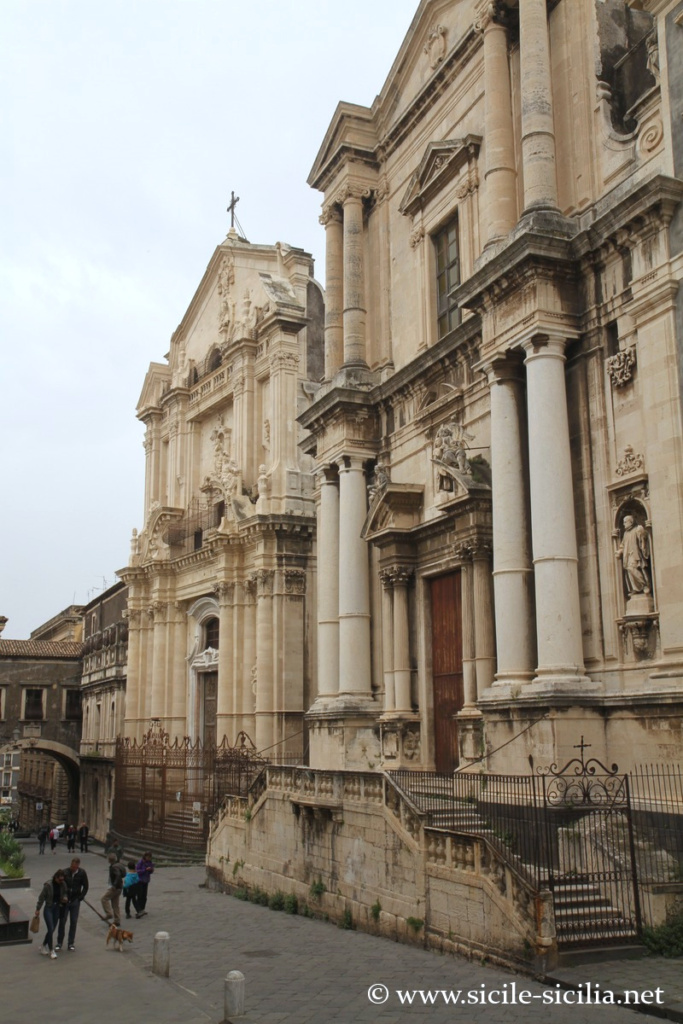
Churches Via Crociferi 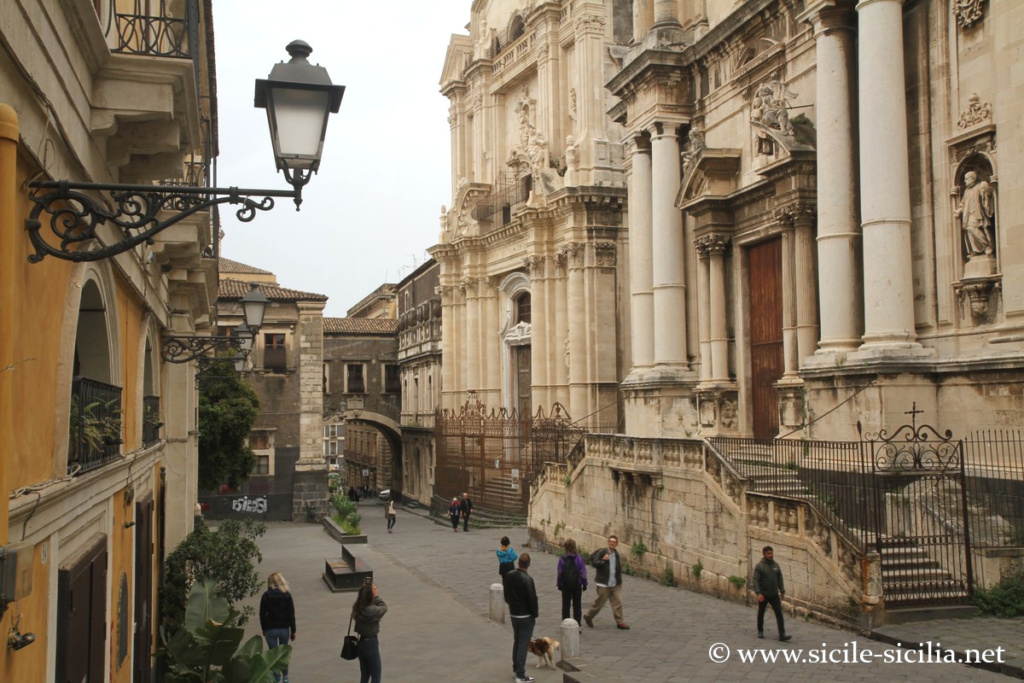

Churches Via Crociferi
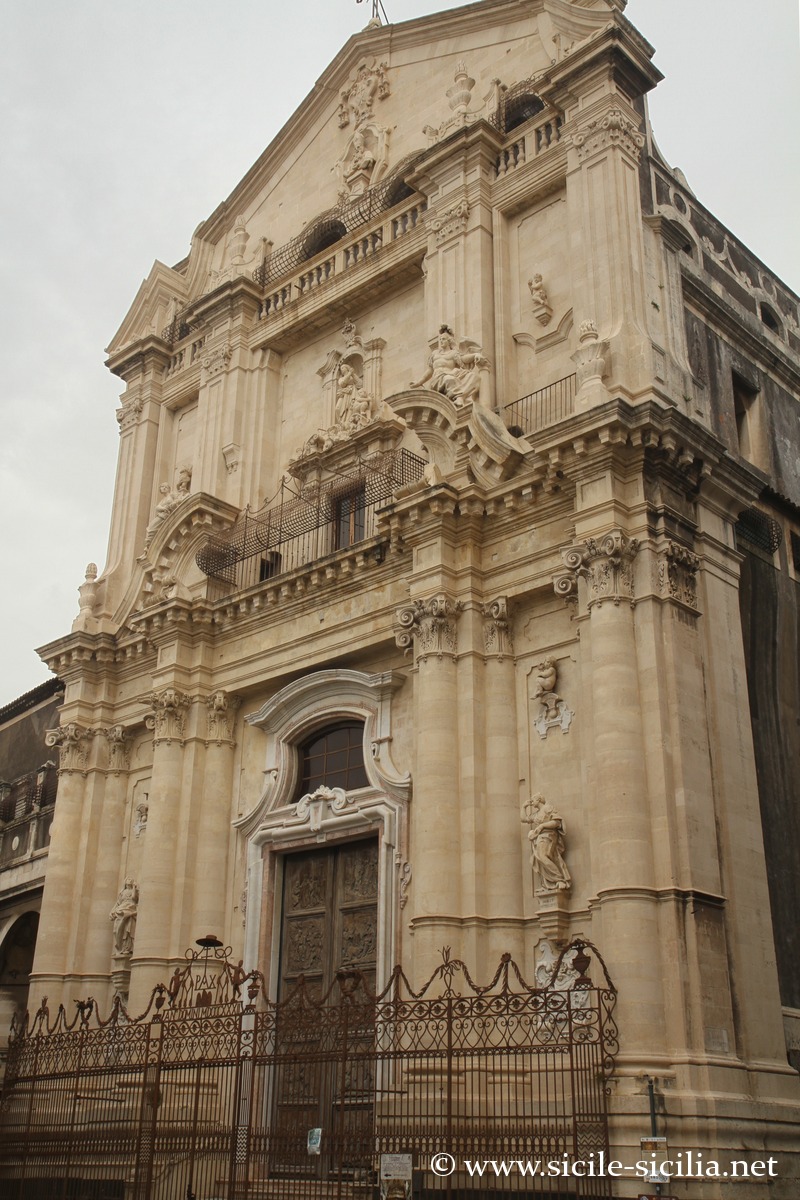
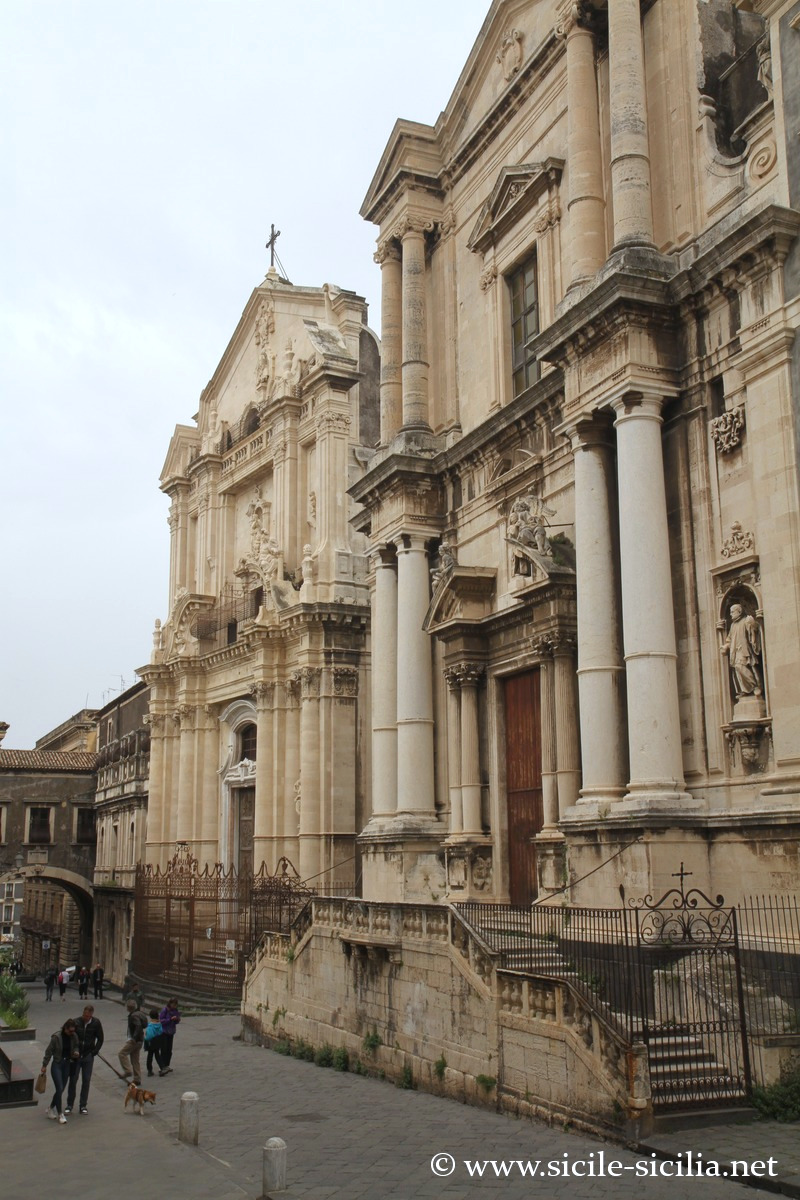
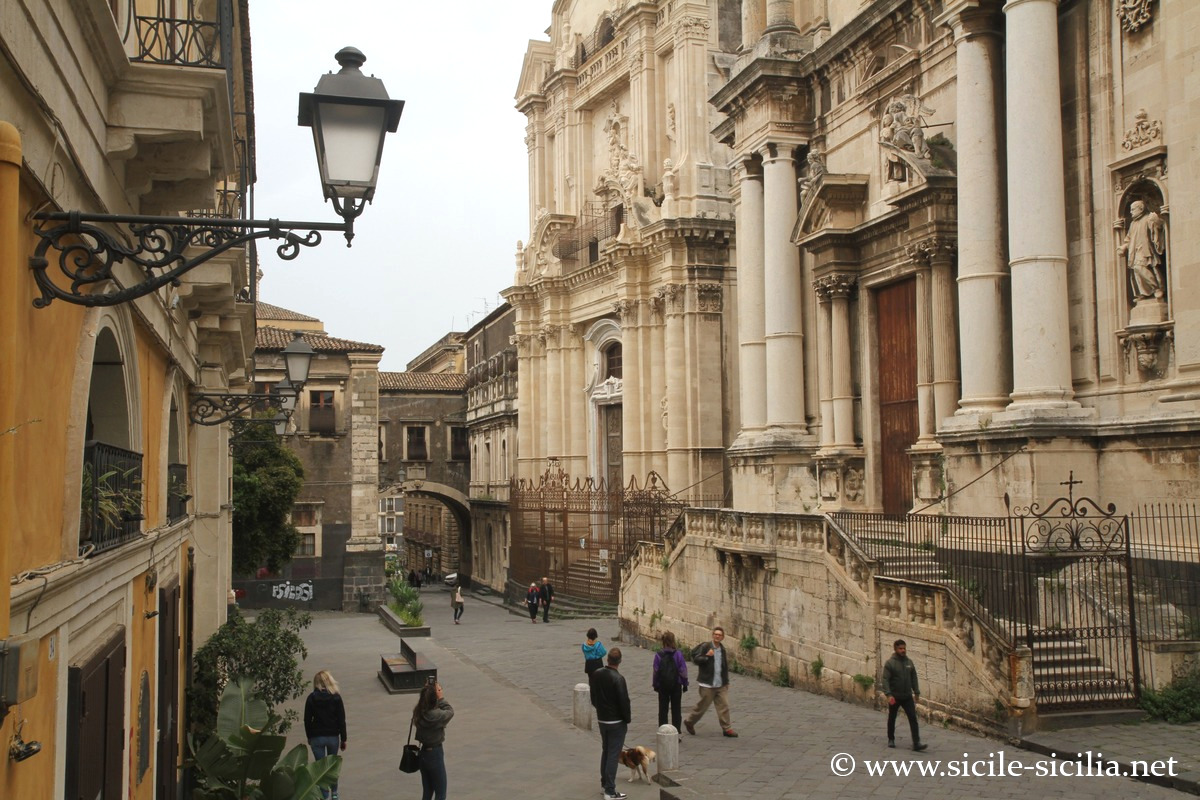
Church of San Francesco Borgia in Catania
The Church of San Francesco Borgia (dedicated to Saint Francis Borgia, Jesuit and relative of Charles V) is annexed to the Jesuit college that was used for religious and artistic education. It has a beautiful white stone façade and preserves remarkable works of art such as the pulpit with its sculpted drapery, the Chapel of San Ignazio and the Chapel of San Francesco Saverio covered with precious marbles. The entire Jesuit complex now houses the seat of the Academy of Fine Arts and temporary exhibitions.
The adjoining Jesuit cloister preserves frescoes and decorations typical of Sicilian Baroque.
Church of Saint Julian in Catania
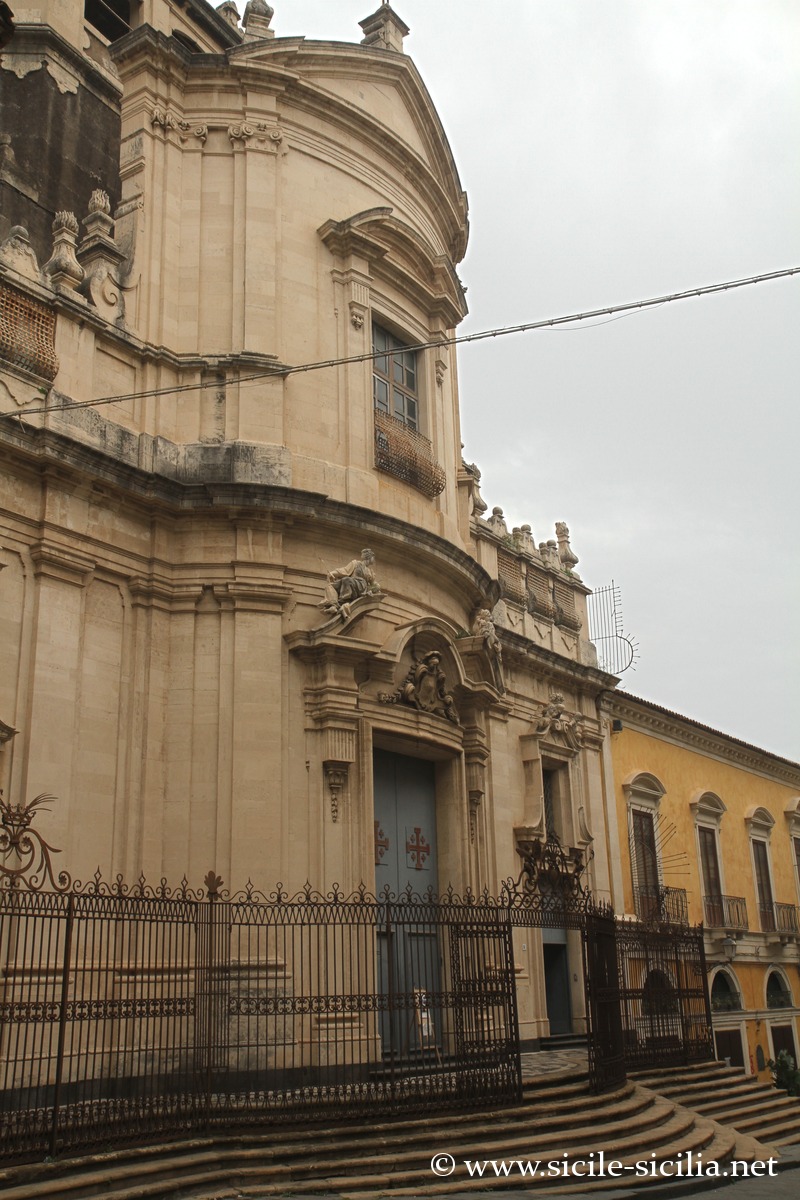
Opposite the previous church, the Church of Saint Julian (San Giuliano) is considered a masterpiece of religious Baroque architecture, attributed to Vaccarini and completed in the mid-18th century.
Its harmonious façade stands out for its concave central section, preceded by an iron railing. The dome is surrounded by a polygonal loggia.
The interior, bathed in a beautiful golden light, has an octagonal plan with two arms forming a Greek cross. This church belonged to a monastery of Benedictine nuns; the upper loggia was used to attend Mass without direct contact with the outside. The interior also preserves stuccoes and frescoes attributed to Giuseppe Rapisardi from the 19th century.

Church of Saint Francis Borgia, Via Crociferi, Catania 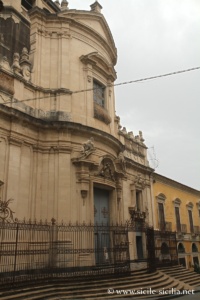
Church of Saint Julian, Via Crociferi 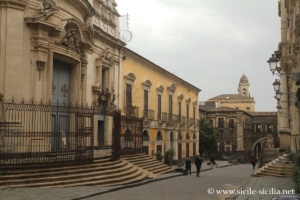

Via Crociferi
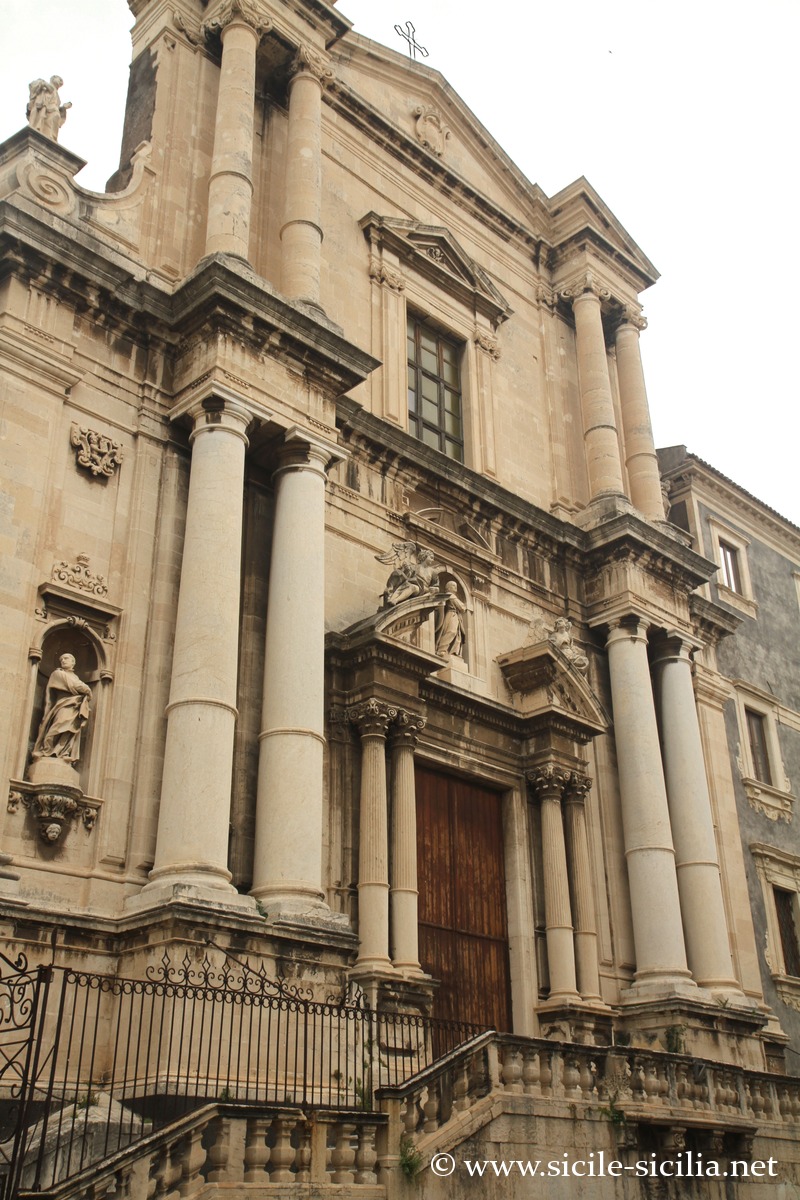
Church of San Camillo de’ Lellis
Continuing slightly further up the street, you come to the Church of San Camillo de’ Lellis, dedicated to the founder of the Camillians, built in the first half of the 18th century. It preserves a main altar adorned with polychrome marbles, a decorated coffered ceiling, carved details in the late Rococo style, and preserves frescoes illustrating the life of Saint Camillo and . Although more modest than the previous ones, it completes the Baroque ensemble of Via Crociferi.
Monastery of the Crociferi Fathers and Villa Cerami
Further on, you reach the Monastery of the Crociferi Fathers, built between 1771 and 1780 to a design by Francesco Battaglia. And at the end of the street is the entrance to the Villa Cerami.
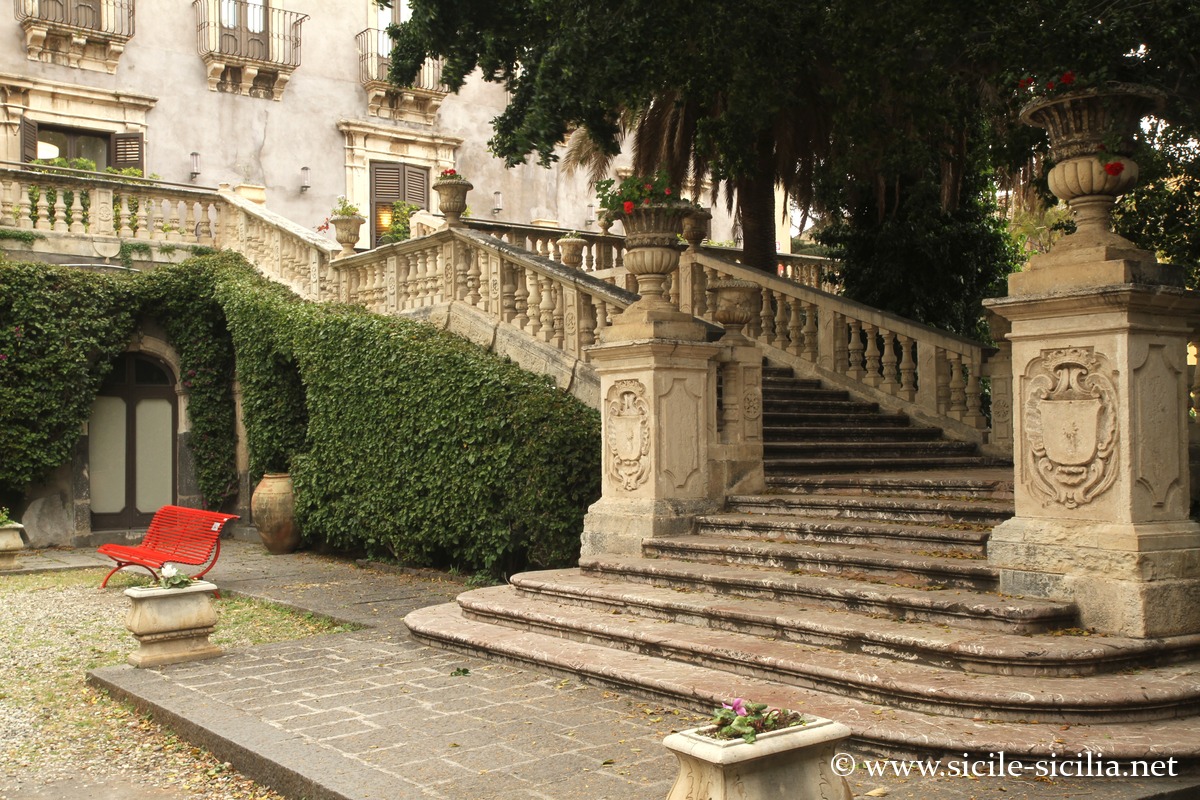
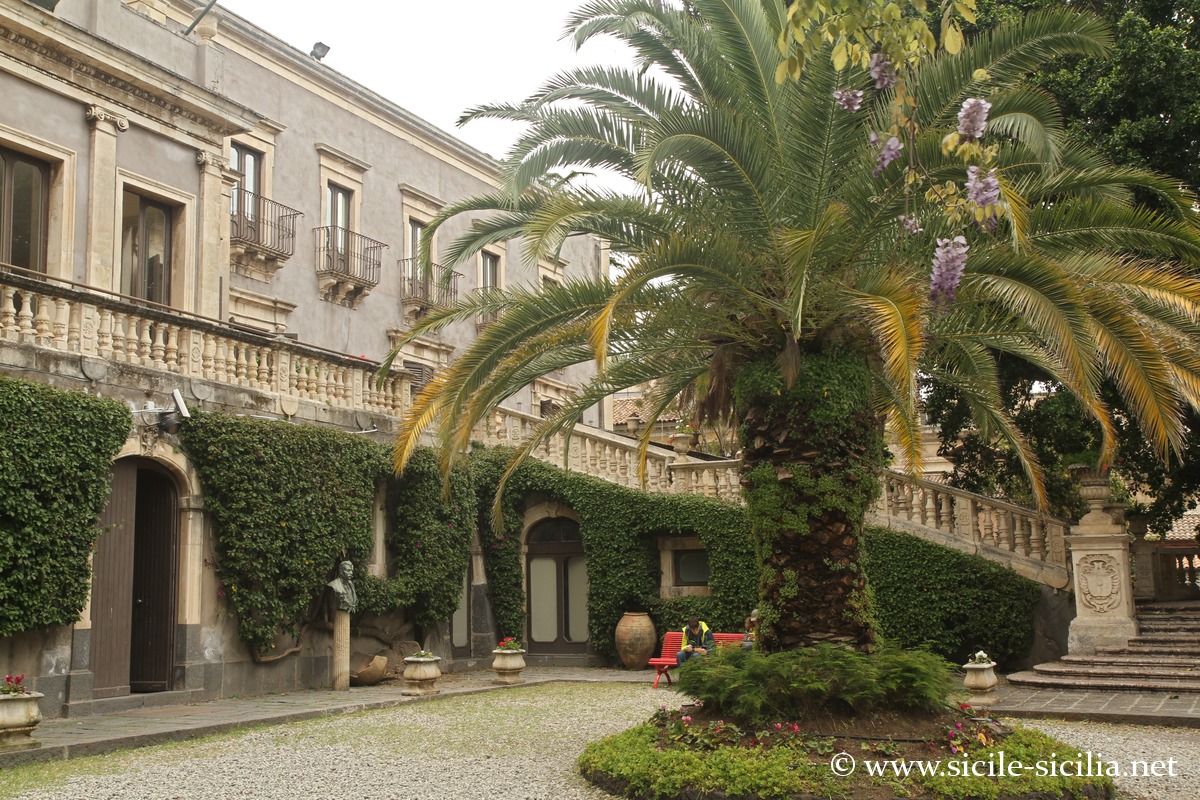
Villa Cerami, residence of the Rosso di Cerami family, was built after 1693 in a late Baroque style and remodelled in the 19th century. Its portal bears the family coat of arms, the courtyard contains a decorative fountain and a sculpture by Emilio Greco, La Grande Bagnante. It now houses the Faculty of Law of the University of Catania.
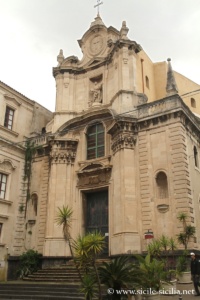
Church of San Camillo de Lellis, Via Crociferi 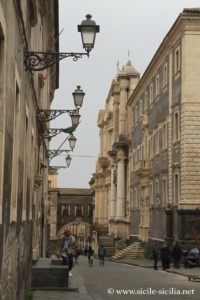
Via Crociferi 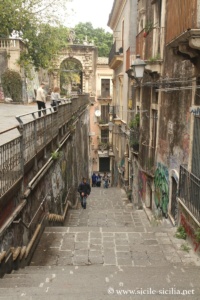
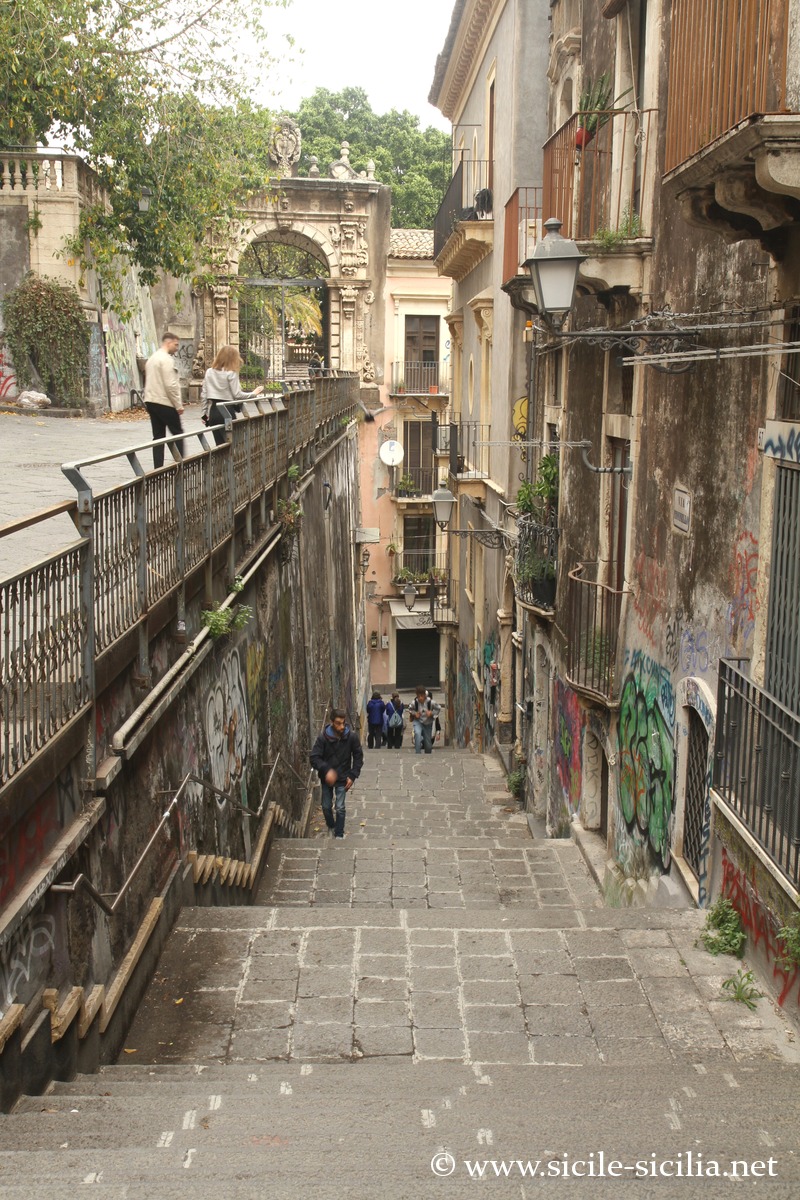
Stairs leading to Via Crociferi 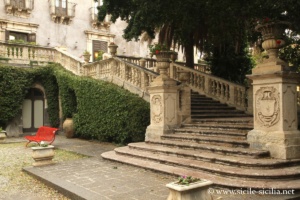
Villa Cerami, Via Crociferi 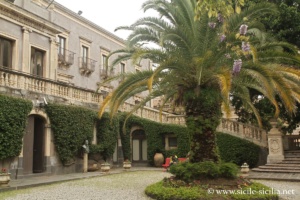
Villa Cerami, Via Crociferi 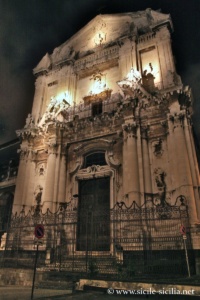
Church of Saint Benedict
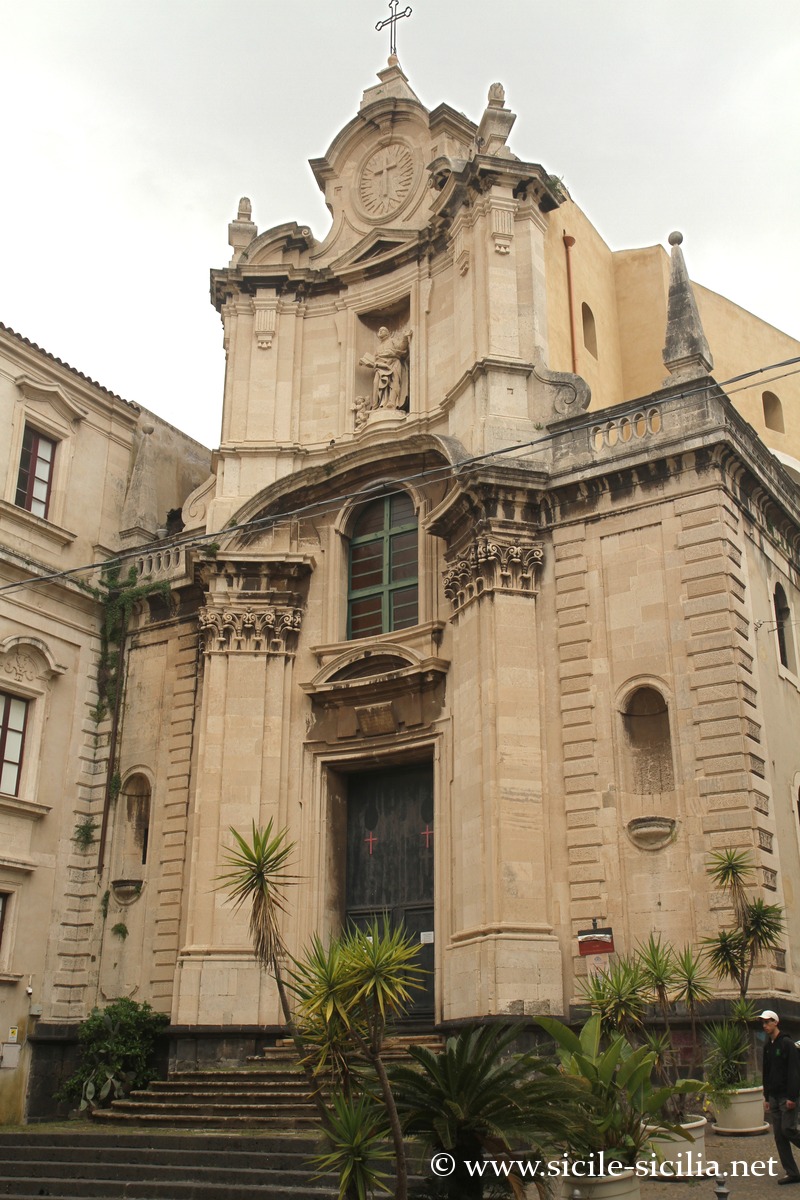
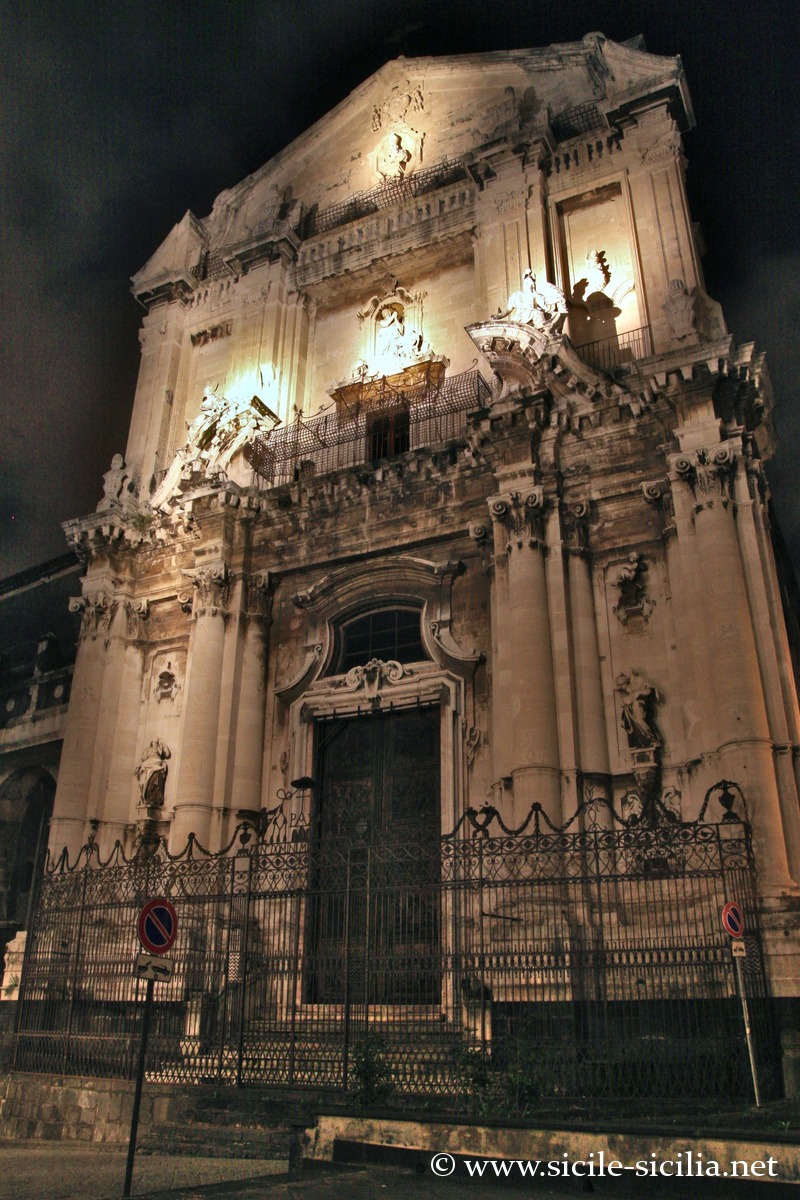
Map of the Via dei Crociferi
 Show interactive map
 Information
Suggested itineraries and guided tours
External sites
- Blogs and tourist websites: heritage-sicily.com
- Saint Francis of Assisi at the Immaculate: Wikipedia page
- Basilica of Saint Benedict in Catania: Wikipedia page
- Church of San Francesco Borgia: Wikipedia page
- Church of Saint Julian: Wikipedia page
- Via Crociferi – cultural presentation: aroundcatania.it
- Villa Cerami – university heritage: officineculturali.net
- Church of San Camillo de’ Lellis: Wikipedia page
Articles about Catania
- Catania
 The second most populous city in Sicily after Palermo, Catania has ...
 - Hotels in Catania
 Hotels in Catania in Sicily, at the foot of Mount Etna. ...
 - Riviera of the Cyclops
 Along the coast north of Catania, the “Riviera dei Ciclopi” (Riviera ...
 - Catania Walking Tour Itinerary
 The interesting historic centre of Catania is marked by Baroque architecture, ...
 - Piazza del Duomo and Catania Cathedral
 In the heart of Catania, the Piazza Duomo is the starting ...
 - Churches of Catania
 Beyond this article dedicated to the churches of the city, also ...
 - Ancient sites of Catania
 The ancient remains of Catania bear witness to the importance of ...
 - Along the Via Etnea in Catania
 The Via Etnea is the main shopping street in the centre ...
 - Palaces of Catania to discover
 Beyond this page dedicated to the most remarkable palaces in Catania, ...
 - Bellini Square and Theatre in Catania
 Bellini Theatre Located towards the north-east of Piazza Duomo, on the square ...
 - Ursino Castle of Catania
 The Ursino Castle of Catania was built between 1239 and 1250 ...
 - Benedictine Monastery and San Nicolò of Catania
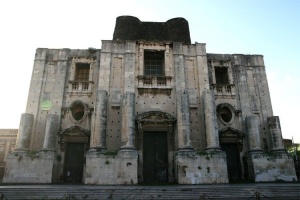 About 850 metres west of Piazza Duomo, Piazza Dante sits in ...
 - Museums of Catania
 List of the main museums of Catania, including palaces, religious and ...
 - Other sites and places in Catania
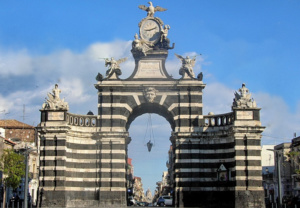 Porta Garibaldi in Catania In the south-west of Catania’s centre, more than ...
 - Discovering underground Catania
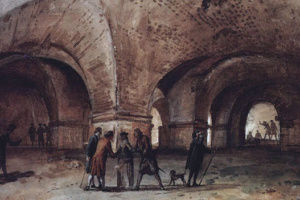 Lava flows have periodically covered entire districts of Catania, burying much ...
 - Catania Environs: Riviera and Countryside
 Mount Etna (overview) In the environs of Catania, the Etna park offers ...
 - Traditions and gastronomy in Catania
 Feast of Saint Agatha in Catania The main festival of Catania is ...
 - Activities in Catania, guided tours and excursions
 Booking activities in Catania and its surroundings, guided tours, tastings, outings ...
 - Around Catania
 Sicilian destinations near Catania, including Mount Etna rising to the northwest, ...