
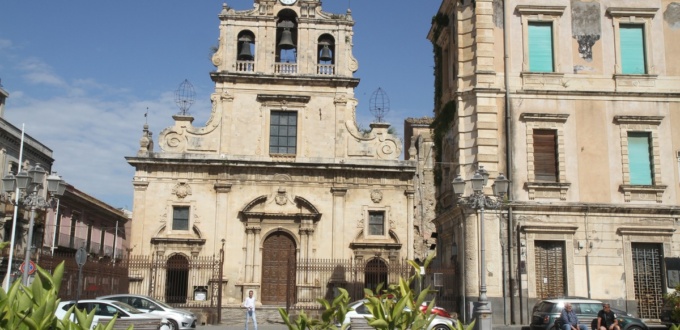
Lentini is a Sicilian town located in the province of Syracuse, in south-eastern Sicily, on the first slopes of the Hyblaean Mountains. It owes its fame to its history, founded in the 8th century BC by Greeks from Chalcis who called it Leontinoi.
Besides the religious buildings of the historic centre, resulting from the Baroque reconstruction after the 1693 earthquake, one
can discover the archaeological area of the Castellaccio, with the remains of the medieval fortress and the Grotto of the Crucifix, as well as the archaeological site of the ancient city.
Visiting Lentini and its heritage
Historic centre
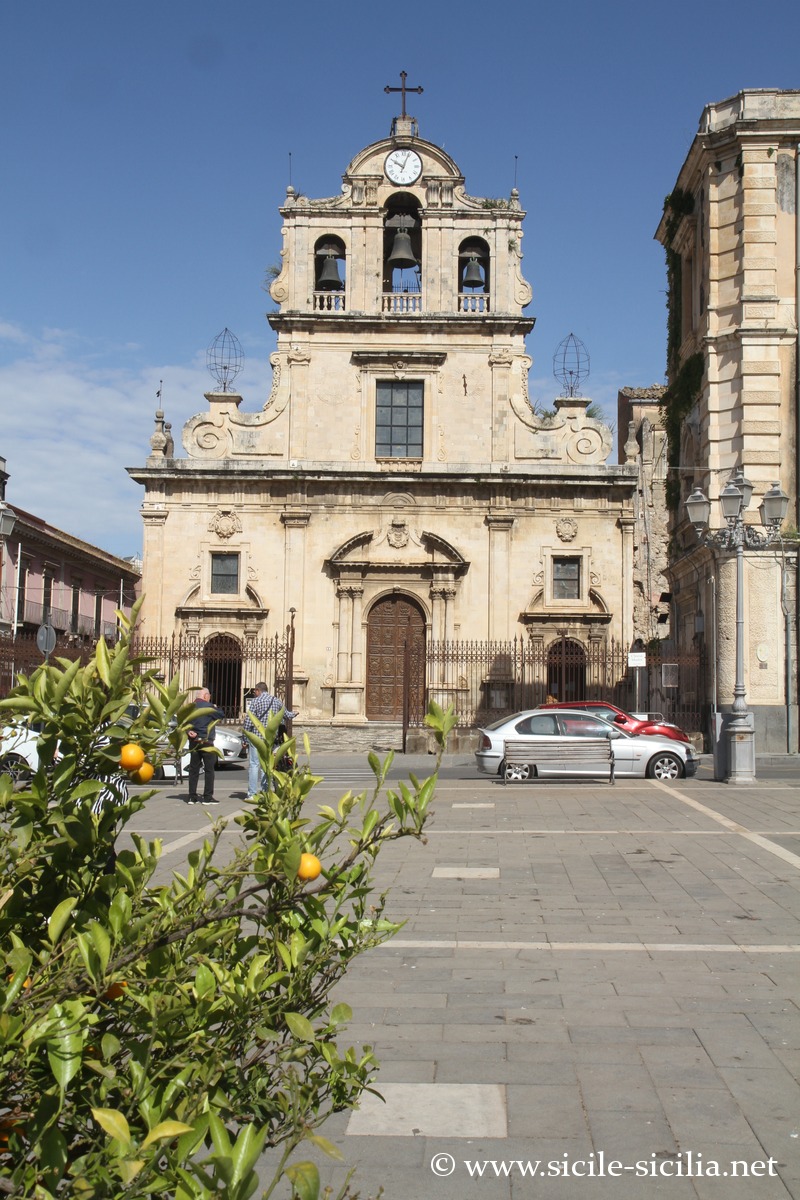
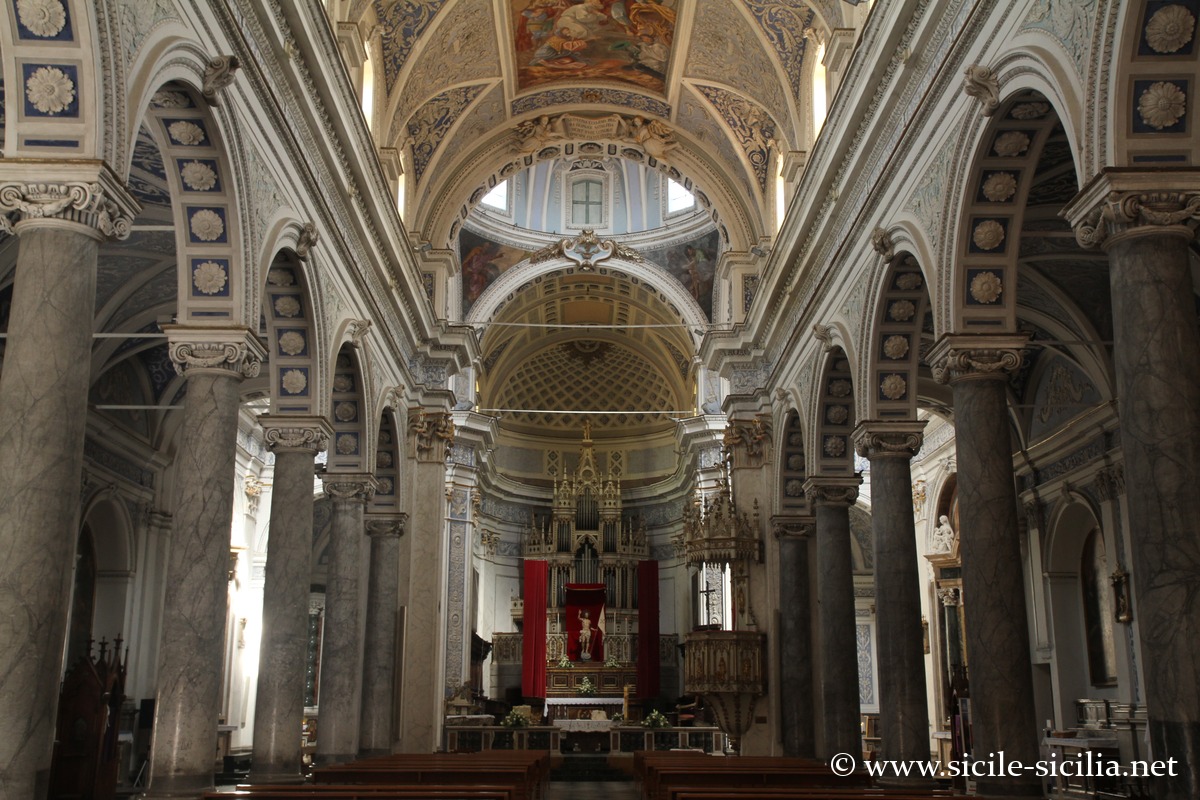
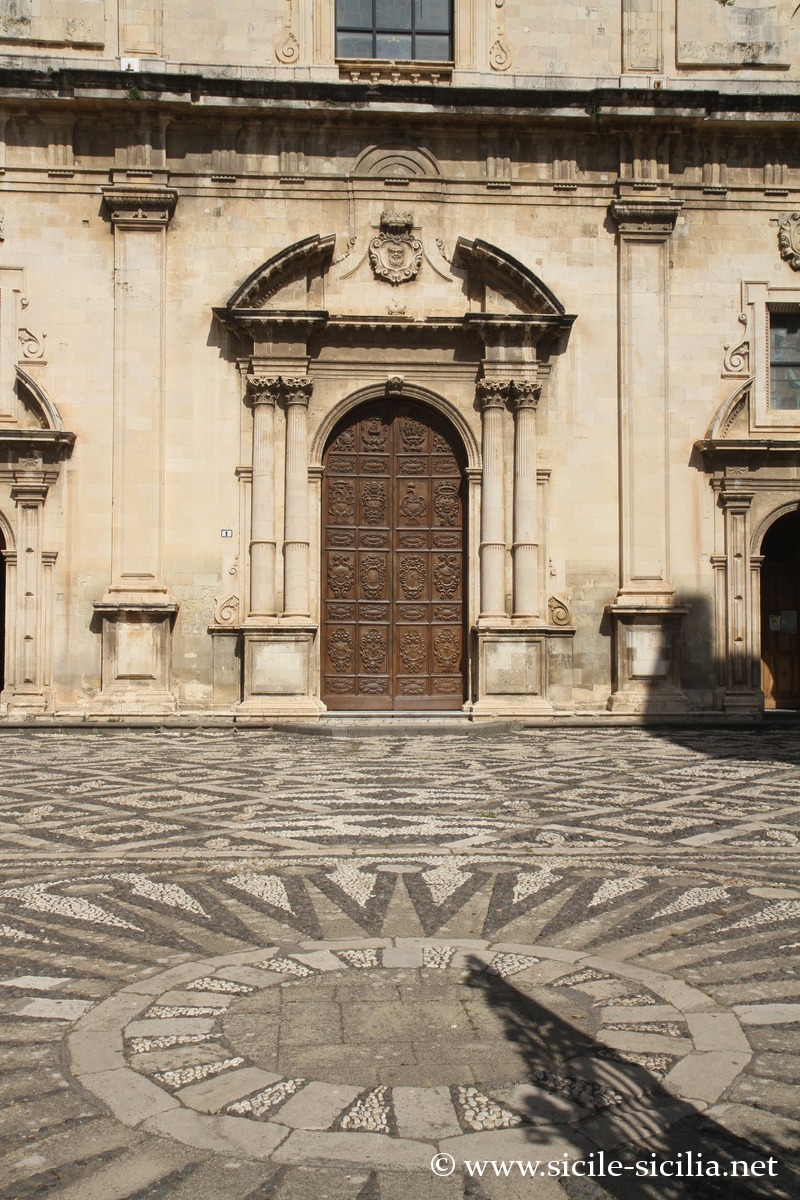
The eventful history of Lentini has bequeathed it several remarkable buildings, first of all the Chiesa Madre de Santa Maria la Cava et Sant’Alfio. It is an 18th-century Baroque church, whose history dates back to Byzantine times, with a rather sober facade and an elegant interior, preserving a Byzantine icon of the Madonna Odigitria from the 12th century, funeral altars, an interesting effigy of the brothers and saints Alfio, Filadelfo and Cirino, martyred in 253 in Lentini.
Several churches are of interest, such as the church of the Holy Trinity and San Marziano built on the ruins of an ancient monastery and of the 16th-century La Palumba palace; the church of the fountain (or of the three saints) which was rebuilt in 1805 on the site of the martyrdom of the three holy brothers; the Capuchin convent, the 18th-century church of the Immaculate Conception; San Francesco di Paola, etc
The regional archaeological museum of Lentini houses an important collection, illustrating the history of the town and its territory from prehistory to the Middle Ages, passing through the Greeks and Romans.
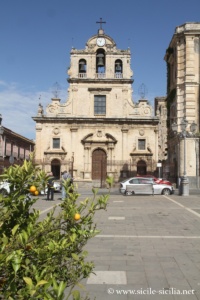
Chiesa Madre Sant’Alfio 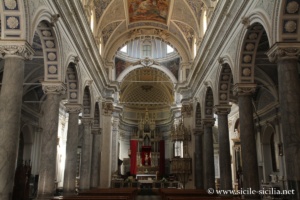
Chiesa Madre Sant’Alfio 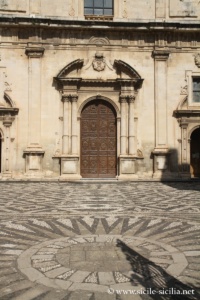
Chiesa Madre Sant’Alfio
Castellaccio
The area of the Castellaccio corresponds to the remains of the medieval fortress dating back to the Normans and to Frederick II. This stronghold remained important for a long time, struck by an earthquake in 1542, and by that of 1693 which largely destroyed it, until it was abandoned in our era.
Around the fortress remain the natural and man-made defensive systems, including moats separating it from the other hills, walls to the north and south, remains of walls visible to the south and north-east, remains of towers, a cliff to the west and walls.
Towards the centre of the site, a staircase leads to an “underground hall”.
In the archaeological park is the Oratory of Saint Lucy, a cave used as a place of worship between the 12th and 14th centuries, with a tomb dug into the ground and precious frescoes from around the 14th century, including those of Saint Lucy, accompanied by a Christ Pantocrator and a bearded saint (perhaps Saint Nicholas), a Madonna, etc
Grotto of the Crucifix
Near the Castellaccio, the Grotto of the Crucifix is another important place of worship, for its frescoes, an example of the coexistence of Greek and Latin cults, in rooms dating back to the
7th century BC
. The current entrance dates from the 18th century. Near it is a vaulted niche with an altar, two ossuaries (around the 15th century), and an underground crypt.
The nave was entirely covered with cycles of frescoes, from the 12th to the 17th century. On the altar on the east side, dedicated to the Eastern cult, is a splendid fresco of Christ Pantocrator dating from around the 13th century. To the north, the wall of the “Mater Domini” mixes various styles. One can observe the representations of numerous saints, a scene of the Crucifixion, etc.
A Deposition of Christ has been moved to the archaeological museum of Lentini.
Archaeological site of Lentinoi
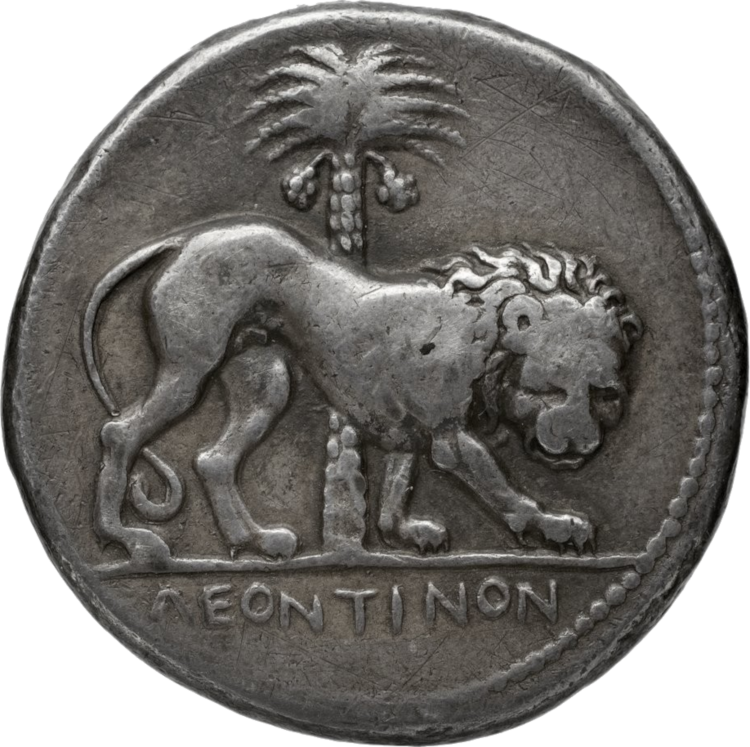
Tetradrachm of Leontinoi
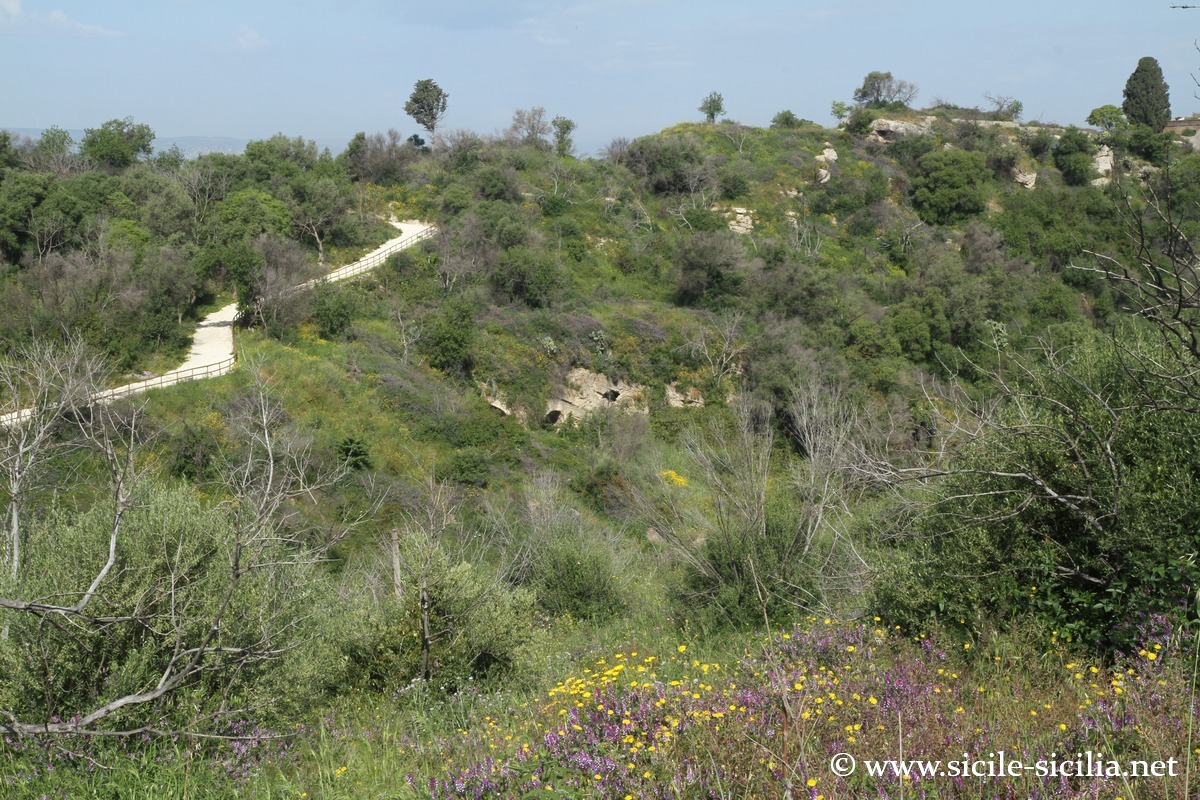
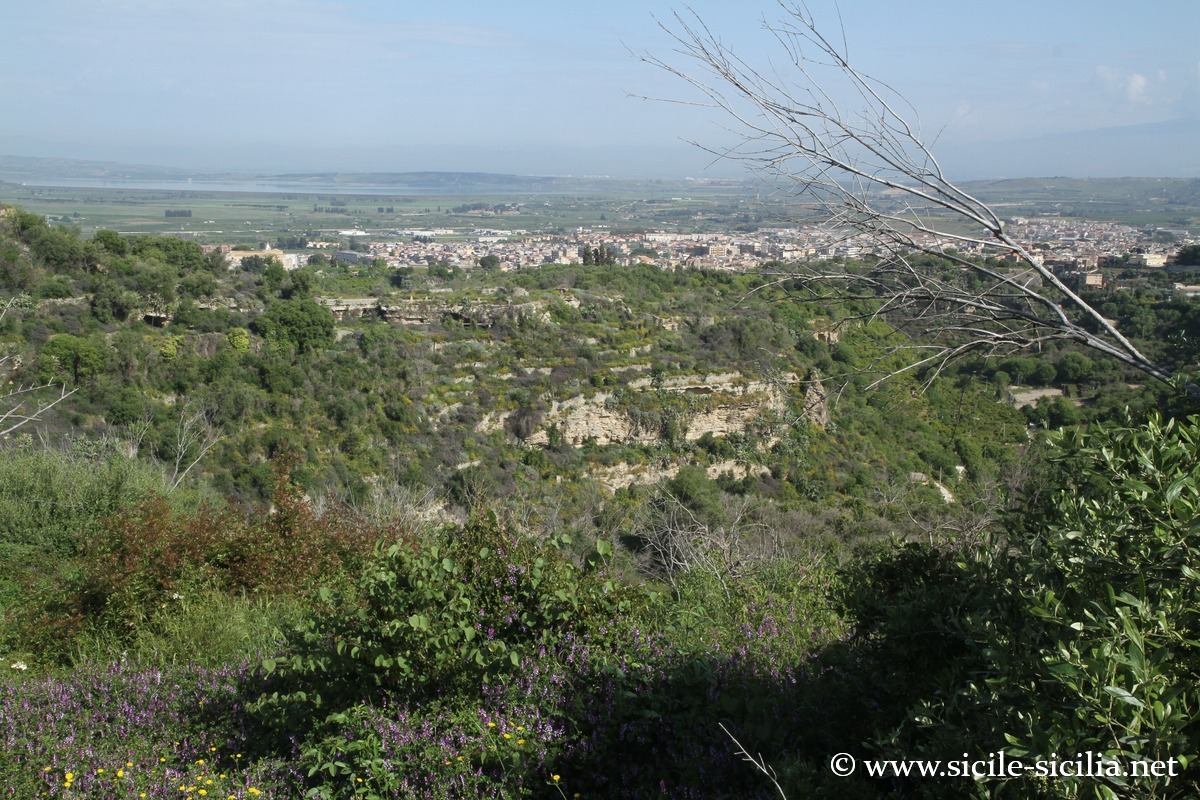
The archaeological site of the ancient city of Lentinoi is located south of the present-day town of Lentini, with the acropolis on the San Mauro hill, the agora in the valley between this last hill to the south-west and that of Metapiccola to the south-east. The Castellaccio area is further north, where the medieval fortress was later erected.
On the hill of Metapiccola, a prehistoric Iron Age village was brought to light, identified with the mythical Sicel settlement of Xouthia, with traces of rectangular huts that were made of wood. A necropolis of the period is found along the Cava Ruccia.
To the north-west of this hill, the agora is located in the valley.
On the San Mauro hill are the remains of the acropolis of the city founded by the Greeks around 730, extending over the slopes.
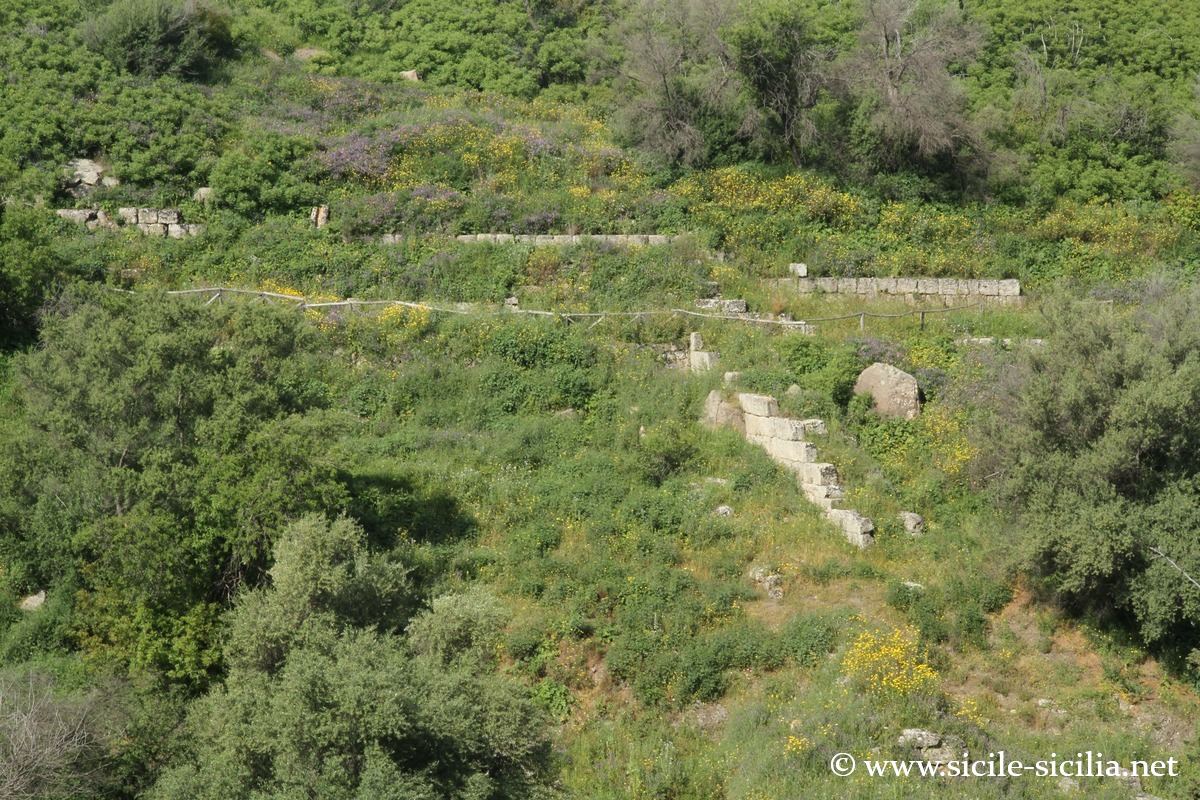
The walls show successive interventions, from the 7th century BCE for the oldest ones that protected only the acropolis.
In the 6th century a circuit wall was built to protect the two hills and the center of the valley, blocking the northern entrance with the Syracuse gate, beyond which extends the Hellenistic necropolis, with more than 600 tombs including small funerary monuments (dating from the 4th and 3rd centuries BCE).
Sections of these walls are visible on the eastern side of the San Mauro hill, and remains of a tower toward the other hill.
The oldest funerary monuments, which are close to the entrance, date back to the 6th century BCE.


Archaeological site of Lentinoi 
Archaeological site of Lentinoi 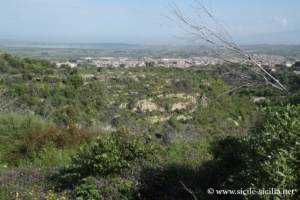
Archaeological site of Lentinoi
History of Lentini
A legend tells that the region was occupied by the Laestrygonians, man-eating giants resembling the Cyclopes and living on Etna. According to Homer, this people would have evolved as herders and farmers, becoming the Sicans.
Be that as it may, the Sicels coming from the Italian peninsula came into conflict with the Sicans to push the latter back and finally occupy eastern Sicily, including the region of Lentini.
In the 8th century BCE, Greeks founded colonies in Sicily, coexisting with the indigenous populations before driving them into the hinterland. According to Thucydides, it was Greeks from Chalcis who settled here on the San Mauro hill around 730 BCE, coexisting temporarily with the Sicels. They would have driven the latter out with the help of Greeks from Megara (and future founders of Megara Hyblaea).
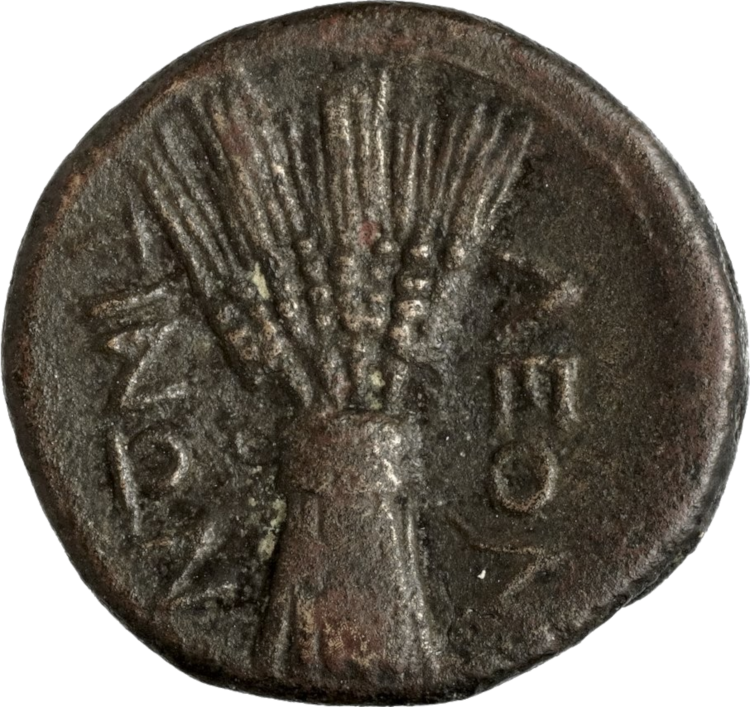
Bronze trias
Agriculture was the main economic activity of the city, in particular the cultivation of barley (which can be seen on coins), as well as horse breeding.
According to Aristotle, at the end of the 7th century, during a conflict with the neighboring Megara Hyblae, the first Sicilian tyrant emerged, named Panezio.
An oligarchic government led the city, which became prosperous economically and demographically. It lost its independence in 494 BCE, occupied by Hippocrates of Gela, then in 476, when Gelon of Syracuse deported inhabitants of Naxos and Catania there.
Lentini later regained its freedom, but under various threats (including the adventure of the Sicel king Ducetius) it asked Athens for help against Syracuse. In 424 BCE an agreement was reached with the withdrawal of the Athenians from Sicily, in exchange for the assurance of the autonomy of the Greek cities. But the conflict continued internally in Lentinoi, the pro-Syracuse aristocrats expelled the pro-Athens democrats. The city was included in the chôra (territory) of Syracuse. However, these aristocrats found themselves dissatisfied, allied with the democrats supported once again by Athens, and marched against Syracuse. The expedition ended in the definitive defeat of the Athenians, and Syracuse imposed itself on Lentini.
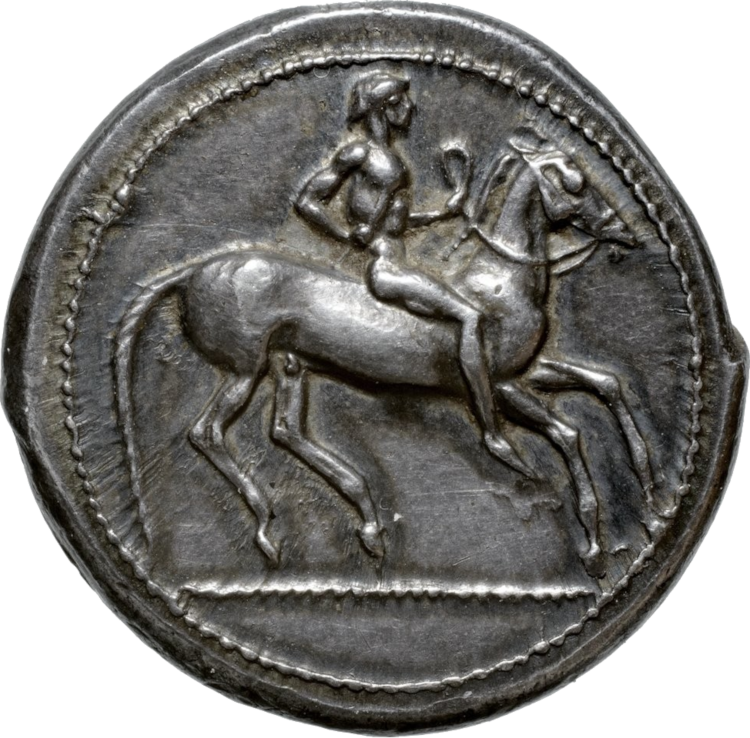
Didrachm (obverse)
In 406, following the defeat of Syracuse against the Carthaginians, the city briefly regained its autonomy, but Dionysius the tyrant of Syracuse seized it and transformed it into a military stronghold.
Unable to pay the mercenaries, Dionysius gave them the city. After several events, Lentini remained under Syracusan domination and in 214 BCE, the Romans settled there.
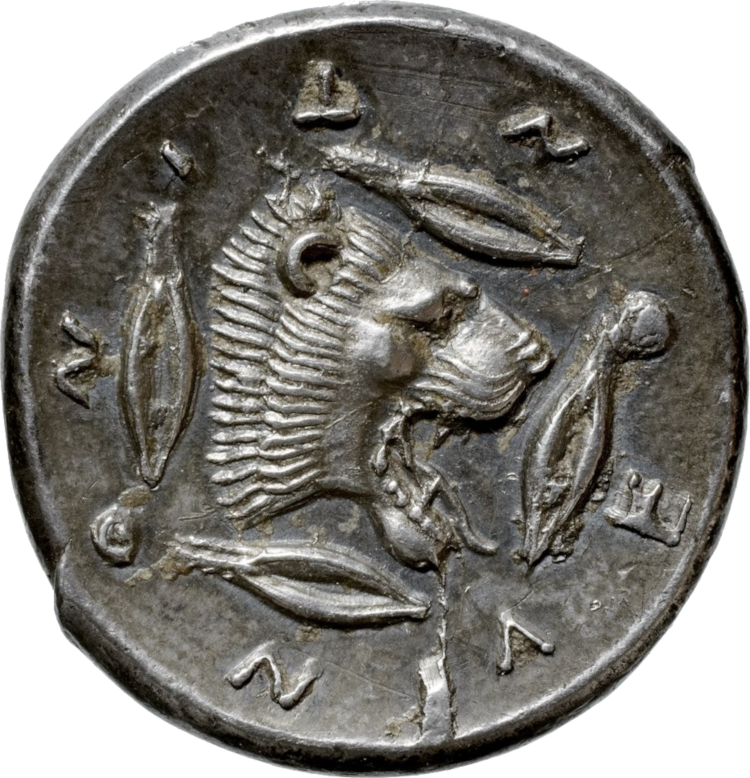
Didrachm (reverse)
From the Roman period, little information has come down to us, and the city declined from the 1st century BCE.
After the barbarian conquest, Lentini was occupied by the Byzantines. It is known that a bishopric was installed there. The Saracens settled in 847 and the city seems to have experienced a relatively prosperous period, until the arrival of the Normans when it would have declined again, struck in particular by the two earthquakes of 1140 and 1169.
With Frederick II of Swabia, Lentini regained vigor, but revolted in 1250, was repressed, independent like other cities of Sicily thanks to the Pope in 1254, but only briefly, then the Angevins oppressed Sicily, until they were expelled in 1282 before the arrival of the Aragonese.
The history of the city remained chaotic, until the earthquake of 1693 which completely destroyed it. It was subsequently rebuilt, laboriously.
Where Lentini is located: map
If you see this after your page is loaded completely, leafletJS files are missing.
Information
External sites
- Lentini: fr.wikipedia.org/wiki/Lentini
- Church of the Crucifix: it.wikipedia.org
- Archaeological Museum of Lentini: it.wikipedia.org
- Ancient city of Leontinoi: it.wikipedia.org/wiki/Leontinoi