

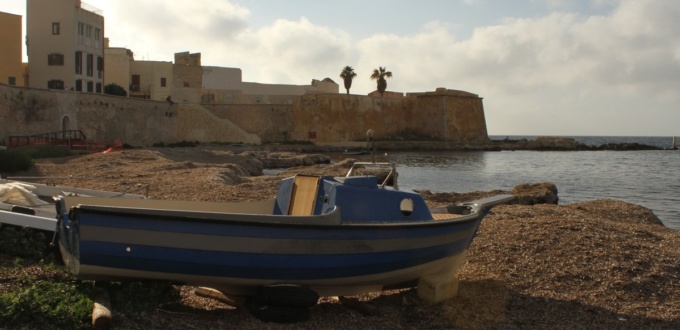
Trapani is a provincial capital of Sicily, at the far west of the island, where nearly 54,000 inhabitants live (in 2025). It is not among the most touristy cities on the island, but its historic centre, without major spectacular monuments, offers a pleasant atmosphere, punctuated by baroque facades and ancient churches (see the article Visiting Trapani).
In the immediate vicinity of the city stretch the vast salt pans of Trapani and Paceco, integrated into a protected nature reserve. A few kilometres to the east, the medieval town of Erice dominates the plain from its high promontory, while offshore unfolds the archipelago of the Egadi Islands, one of the most evocative island groups on the Sicilian coast.
A maritime city turned towards the Maghreb
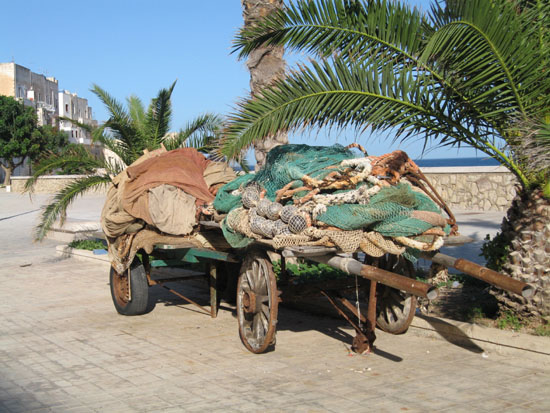 A port city, the history and culture of Trapani bear a strong Mediterranean imprint, notably of Arab-Muslim influence, perceptible even in the local gastronomy, where couscous occupies an emblematic place.
Fishing remains one of the city’s essential activities. Every morning, the fish market brings the port to life, bearing witness to the close link between Trapani and the sea. The city is also a strategic starting point for reaching the Egadi Islands, located a few kilometres offshore, as well as the more distant island of Pantelleria.
→ See the page dedicated to the heritage and sites of Trapani to discover
What to see or do first in Trapani
- Torre di Ligny and its maritime museum
This defensive tower from the 17th century, located at the western end of the city, offers panoramic views of the sea and the Egadi archipelago. It also houses a small museum presenting artefacts related to the maritime history of Trapani. - Waterfront, port and fish market
The port of Trapani is a central place of local life: between fishing boats, seaside cafes and Mediterranean atmosphere. Today, the Trapani fish market is located along the port area, around Via Cristoforo Colombo, where local fishermen and vendors offer their fresh products in the morning. - Historic centre and its monuments
Cathedral, baroque Palazzo Senatorio, and other historic buildings scattered throughout the original medieval heart. - Boat trip to the Egadi Islands
Trapani is the main starting point for ferries and excursions to Favignana, Levanzo and Marettimo, three islands with crystal-clear waters and spectacular seascapes.
→ See the page dedicated to the heritage and sites of Trapani to discover
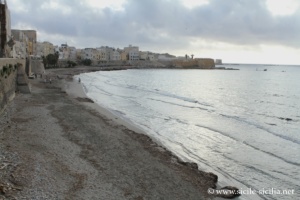
Mura di Tramonto 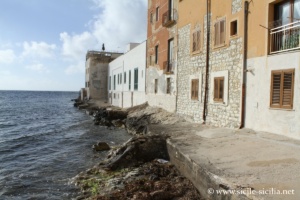
Piazzetta del Tramonto
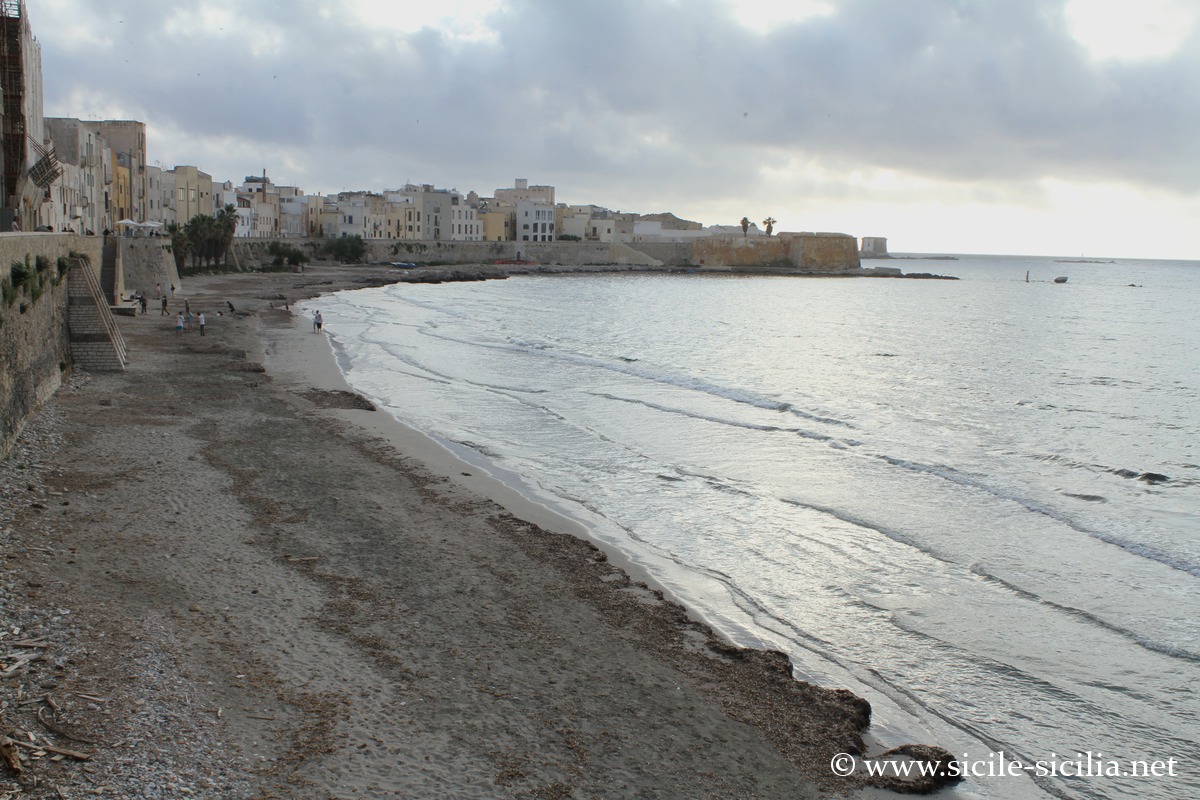
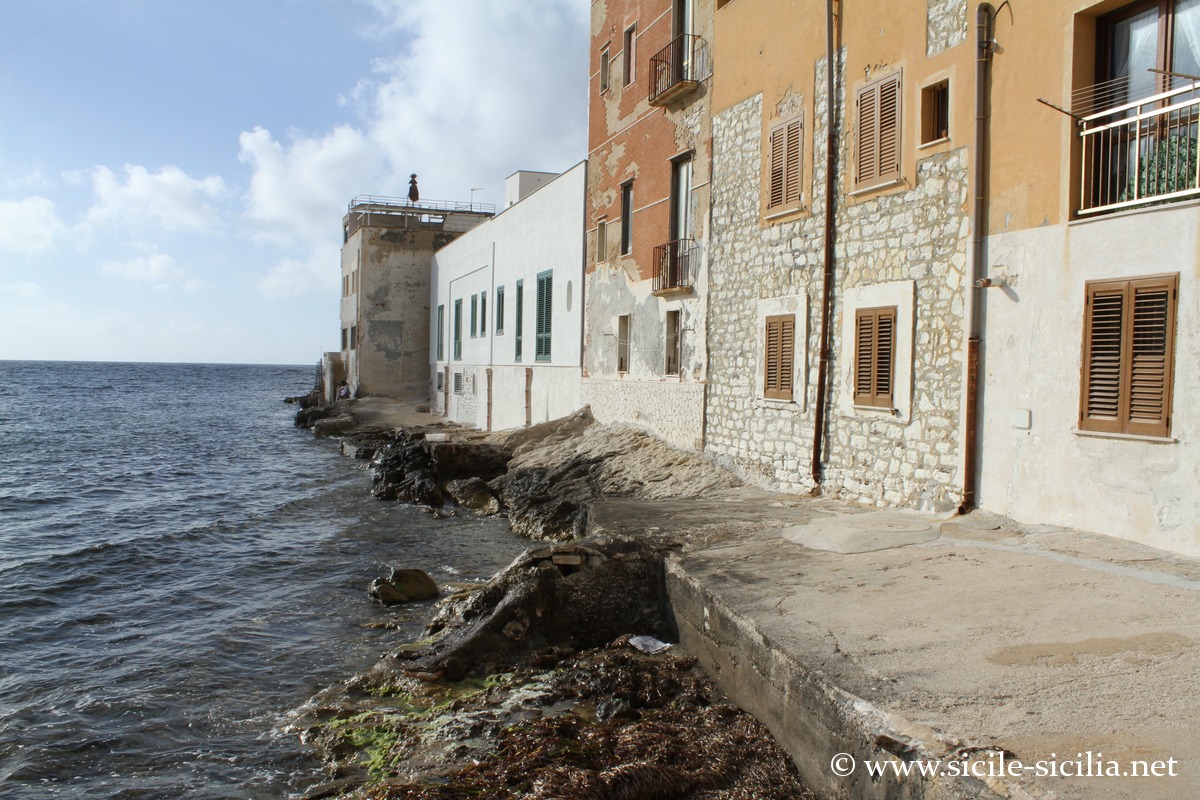
Historical overview of Trapani
Trapani is said to have been founded in the 13th century BC by the Elymians, before becoming an important port in Phoenician times. From the 8th century BC, the city came under Punic influence and remained allied to Carthage for a long time. In Antiquity, it was known as Drepanum (“sickle” in Greek), probably in reference to the curved shape of its coastline, which separates two stretches of sea. It then served as the port for the city of Erice, located on the mountain overlooking the city.
After the Roman conquest, Trapani experienced a period of decline, before passing successively under Vandal, Byzantine and then Muslim domination from the 9th century. Under Islamic administration, the city regained significant economic and maritime momentum, of which certain culinary traditions, such as couscous, preserve the memory.
The Normans settled there in the 11th century. Subsequently, under the Aragonese, Trapani developed thanks to the trade in salt, coral and preserved tuna, while also constituting a stop on the routes taken by the Crusaders.
Gastronomy, festivals and traditions in Trapani
Traditions
The traditional culture of Trapani is closely linked to the sea, fishing and port activities, which have shaped the social and economic practices of the city since Antiquity. One of the most striking traditions is that linked to tuna fishing and the ancient tuna traps, in particular those of Favignana offshore and on the coast.
The culture of salt constitutes another pillar of identity. The salt pans of Trapani and Paceco, exploited since Phoenician and Roman times, have generated know-how passed down from generation to generation.
The decorative and craft arts, notably the Trapanese coralline (coral work), reached their peak between the 16th and 18th centuries, and Trapani was one of the major centres for the production of sculptures, crucifixes and liturgical objects in coral, intended for Sicilian churches and Mediterranean export.
Festivals in Trapani
The Procession of the Mysteries (Processione dei Misteri), attested since the beginning of the 17th century (1612), constitutes one of the longest and most complex Easter processions in Europe. It takes place from Good Friday until Saturday afternoon and stages twenty sculpted groups representing the Passion of Christ, carried through the city by the historic craft confraternities. The procession combines religious devotion, funeral music, codified choreography and strong popular participation.
The Feast of San Lorenzo, patron saint of Trapani, celebrated in August, combines liturgical ceremonies, maritime processions and civic events. The maritime dimension is central, with blessings at sea and the participation of fishermen.
In July, Trapani hosts the Stragusto, International Street Food Festival, dedicated to Mediterranean and international street food. The event highlights popular culinary traditions, in particular those of western Sicily.
Other festivals punctuate the year, such as the Marian celebrations, the Madonna di Trapani, and events linked to the agricultural and maritime cycle, often accompanied by traditional music and community practices.
Gastronomy: productions and cuisine
The gastronomy of Trapani reflects the city’s geographical position, at the crossroads of Mediterranean, Arab, Spanish and Sicilian influences.
The emblematic dish remains fish couscous (cùscusu), a direct legacy of the Arab-Berber presence in western Sicily. The semolina is worked by hand and steamed, then served with a concentrated broth of fish and shellfish. This dish constitutes a strong marker of identity, celebrated each year at the Cous Cous Fest in San Vito Lo Capo, to which Trapani is historically linked.
Seafood occupies a central place. Rock fish, bluefin tuna, swordfish, sardines and shellfish are prepared according to simple techniques intended to preserve the quality of the product: grilling, frying, oven cooking or in broth. Fish soups and dishes based on mixed fish bear witness to a fishermen’s cuisine, adapted to the day’s catch.
Tuna is consumed fresh, dried or preserved in oil, and bottarga (dried tuna or mullet roe) is also part of the traditional productions.
Among the pasta specialities is pasta con pesto alla trapanese, a preparation based on tomatoes, garlic, basil, almonds and olive oil.
The surrounding agricultural productions complete the local cuisine: olive oil, capers, almonds, citrus fruits and wines of the territory (Marsala, Alcamo, Erice DOC).
Where Trapani is located and map
If you see this after your page is loaded completely, leafletJS files are missing.
Information
Articles in the Trapani category
- Aegadian Islands
 The Aegadian Islands, known in antiquity by the Latin name Aegates, are an archipelago of three main islands (Favignana, Marettimo and Levanzo) and two smaller rocky islands (Formica and Maraone), ...
External sites
- Wikipedia page: fr.wikipedia.org/wiki/Trapani
- Blogs and tourist sites: www.turismotrapani.net, www.turismo.trapani.it
Comments in other languages
The fish market was what I liked most in Trapani; you can also taste some fresh fried seafood there. To eat good couscous, the small, discreet family-run trattorias are often more authentic than the well-known restaurants.
Useful to know if you’re passing through Trapani to reach the Egadi Islands (which is often the case): in summer, opt for the first hydrofoils in the morning to arrive before the groups and enjoy a calmer sea!
In any case, book your crossing to avoid unpleasant surprises on site, especially in peak season.
To Marettimo, connections are less frequent than to Favignana and are fully booked during the day.